Yang Li, Shen Ke'Feng, Zhang Mei'Lan, Zhang Wei, Cai Hao'Dong, Lin Li'Man, Long Xiao'Lu, Xing Shu'Gang, Tang Yang, Xiong Jie, Wang Jia'Chen, Li Deng'Ju, Zhou Jian'Feng, Xiao Min
Department of Hematology, Tongji Medical College, Tongji Hospital, Huazhong University of Science and Technology, Wuhan, China.
Department of Oncology, Tongji Medical College, Tongji Hospital, Huazhong University of Science and Technology, Wuhan, China.
Front Oncol. 2019 Oct 24;9:1133. doi: 10.3389/fonc.2019.01133. eCollection 2019.
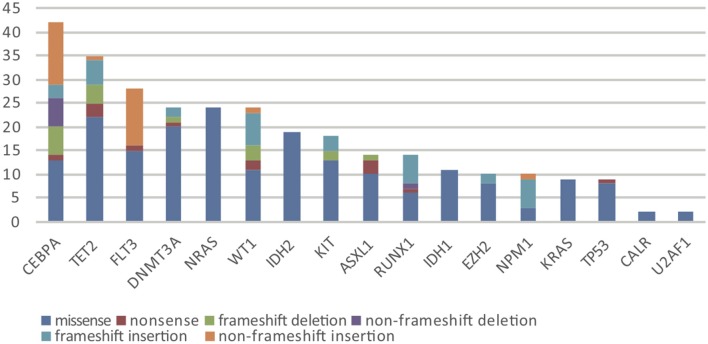
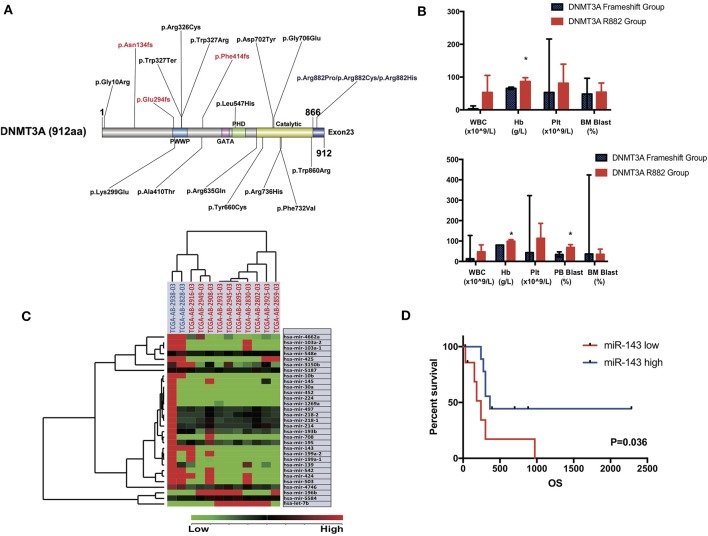
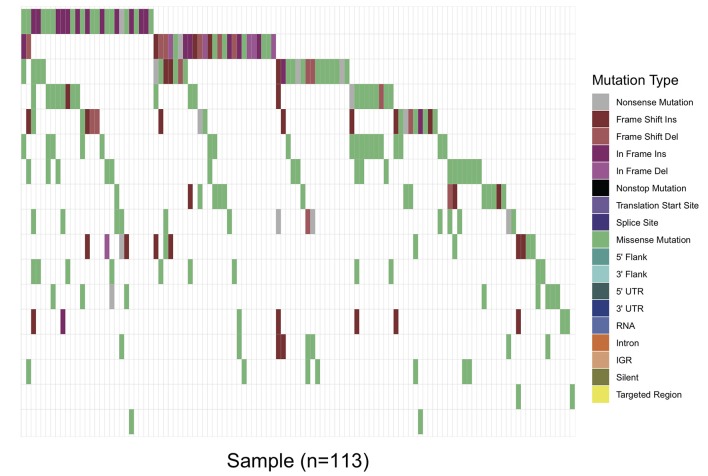
DNA methyltransferase 3A (DNMT3A) plays a unique role in hematopoiesis and acute myeloid leukemia (AML) pathogenesis. While the influences of DNMT3A mutation subtypes are still under debate. Exploration of the clinical and molecular differences between AML patients carrying DNMT3A R882 mutations and DNMT3A frameshift mutations. Next generation of sequencing (NGS) and clinical data of 118 AML patients in our center were analyzed and compared. NGS, mRNA and miRNA profiling and clinical data from 12 patients in TCGA database were integrative analyzed. Among all patients enrolled, 113 patients were positive for the variants of interest. Overall, a total of 295 variants were discovered, among which 24 DNMT3A mutations were detected, including 1 non-sense, 20 missense, 3 frameshift mutations. And 7 DNMT3A R882 mutations (3 R882H, 2 R882C, and 2 R882P) were found. Clinical analysis from our cohort and TCGA database indicated that patients carrying DNMT3A R882 mutation exhibited significantly higher levels of peripheral blood hemoglobin and non-significantly inferior prognosis compared with patients with DNMT3A frameshift mutations. Integrative analysis indicated that miR-10b, miR-143, and miR-30a were significantly decreased in the DNMT3A R882 group. High miR-143 expression is significantly associated with better prognosis in AML patients with DNMT3A mutations. Different molecular and clinical characteristics existed between patients with DNMT3A variant subtypes. The distinct microRNA expression pattern for DNMT3A R882 AML patients might not only act as markers to predict disease prognosis, but also could be further investigated to develop novel therapeutic targets for patients with DNMT3A mutations.
DNA甲基转移酶3A(DNMT3A)在造血作用和急性髓系白血病(AML)发病机制中发挥着独特作用。虽然DNMT3A突变亚型的影响仍存在争议。本研究旨在探索携带DNMT3A R882突变的AML患者与携带DNMT3A移码突变的AML患者之间的临床和分子差异。分析并比较了本中心118例AML患者的二代测序(NGS)结果和临床数据。对TCGA数据库中12例患者的NGS、mRNA和miRNA谱以及临床数据进行了综合分析。在所有纳入的患者中,113例患者的感兴趣变异为阳性。总体而言,共发现295个变异,其中检测到24个DNMT3A突变,包括1个无义突变、20个错义突变、3个移码突变。并且发现了7个DNMT3A R882突变(3个R882H、2个R882C和2个R882P)。来自本队列和TCGA数据库的临床分析表明,与携带DNMT3A移码突变的患者相比,携带DNMT3A R882突变的患者外周血血红蛋白水平显著更高,预后虽无显著差异但稍差。综合分析表明,miR-10b、miR-143和miR-30a在DNMT3A R882组中显著降低。高miR-143表达与DNMT3A突变的AML患者更好的预后显著相关。DNMT3A变异亚型患者之间存在不同的分子和临床特征。DNMT3A R882 AML患者独特的微小RNA表达模式不仅可能作为预测疾病预后的标志物,还可以进一步研究以开发针对DNMT3A突变患者的新型治疗靶点。