Department of Psychiatry and Behavioral Sciences, University of Washington, Seattle, Washington.
Department of Psychology, North Carolina State University, Raleigh, North Carolina.
Alcohol Clin Exp Res. 2020 Jan;44(1):233-243. doi: 10.1111/acer.14237. Epub 2019 Dec 4.
Explicit (self-report) and implicit (indirect) measures of identification with drinking alcohol-drinking identity-are associated with drinking outcomes cross-sectionally and longitudinally. A key next step is to identify moderators. The current study evaluated a promising moderator: mindsets of alcoholism. Believing people can change (growth mindset) is associated with adaptive outcomes in domains such as mental health, but research is scant regarding mindsets related to problematic drinking. We evaluated whether individuals' alcoholism mindsets moderated the drinking identity to drinking relation as part of a larger, longitudinal web-based study of heavy drinkers.
A total of 422 US college graduates (59% women) who were heavy drinkers completed measures assessing drinking identity, mindsets, and drinking outcomes (consumption, problems, and risk of alcohol use disorder). Drinking outcomes were assessed at 2 subsequent assessments occurring 4 and 8 months after the initial assessment.
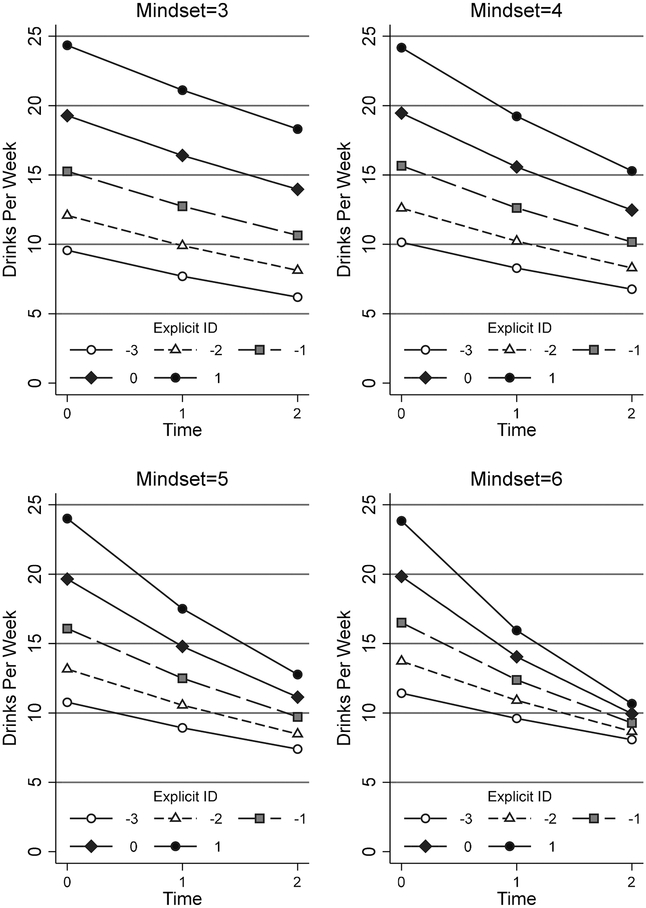
Drinking identity was positively associated with drinking outcomes, and drinking outcomes reduced following college graduation. Alcoholism mindsets were significantly and negatively correlated with all drinking outcomes. Mindsets were only conditionally associated with drinking behaviors over time in models that evaluated mindsets, drinking identity measures, and their interaction. Mindsets moderated the relationship between drinking identity and changes in drinking behaviors, but the relation was specific to explicit drinking identity and consumption. Among participants with stronger drinking identity, those who had stronger (vs. weaker) growth mindsets reported reduction in consumption over time.
Growth mindsets of alcoholism appear adaptive for college graduate heavy drinkers with a stronger drinking identity. Mindsets are amenable to interventions; targeting them may be useful in heavy-drinking college graduates.
明确的(自我报告)和隐含的(间接)对饮酒的认同度衡量指标——饮酒身份认同——与饮酒的横向和纵向结果相关。下一步的关键是确定调节因素。本研究评估了一个有前途的调节因素:酗酒的思维模式。相信人们可以改变(成长型思维)与心理健康等领域的适应性结果有关,但关于与酗酒问题相关的思维模式的研究很少。我们评估了个体的酗酒思维模式是否调节了饮酒身份与饮酒关系,这是一项针对重度饮酒者的更大规模、纵向网络研究的一部分。
共有 422 名美国大学毕业生(59%为女性)完成了衡量饮酒身份、思维模式和饮酒结果(消费、问题和酒精使用障碍风险)的措施。饮酒结果在初始评估后的 4 个月和 8 个月后进行了两次后续评估。
饮酒身份与饮酒结果呈正相关,且在大学毕业后饮酒结果减少。酗酒思维模式与所有饮酒结果显著负相关。在评估思维模式、饮酒身份衡量标准及其相互作用的模型中,思维模式仅在时间上与饮酒行为相关,具有条件性。思维模式调节了饮酒身份与饮酒行为变化之间的关系,但这种关系仅针对明确的饮酒身份和消费。在具有更强饮酒身份的参与者中,那些具有更强(而非较弱)成长型思维模式的人报告随着时间的推移消费减少。
对于具有强烈饮酒身份的大学毕业生重度饮酒者来说,酗酒的成长型思维模式似乎是适应性的。思维模式可以接受干预;针对这些因素可能对重度饮酒的大学毕业生有用。