Nuffield Department of Primary Care Health Sciences, University of Oxford, Oxford, UK.
NIHR Biomedical Research Centre, Oxford, UK.
Diabetes Obes Metab. 2020 Apr;22(4):512-520. doi: 10.1111/dom.13915. Epub 2019 Nov 25.
To examine the feasibility of a food-based, low-energy, low-carbohydrate diet with behavioural support delivered by practice nurses for patients with type 2 diabetes.
People with type 2 diabetes and a body mass index (BMI) of ≥30 kg/m were randomized 2:1 to intervention or control (usual care) and assessed at 12 weeks. The intervention comprised an 800-1000 kcal/day, food-based, low-carbohydrate (<26% energy) diet for 8 weeks, followed by a 4-week weight maintenance period and four 15-20-minute appointments with a nurse. Primary outcomes were feasibility of recruitment, fidelity of intervention delivery and retention of participants at 12 weeks. Secondary outcomes included change in weight and HbA1c. Focus groups explored the intervention experience.
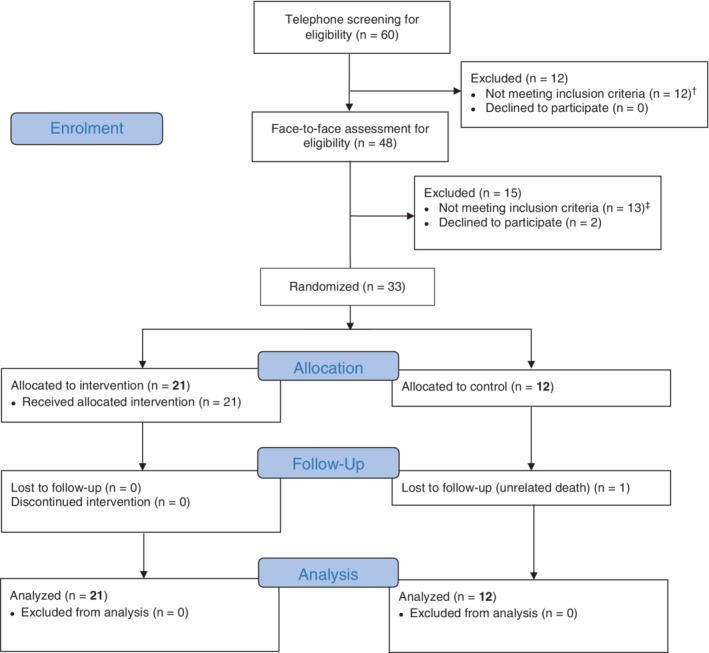
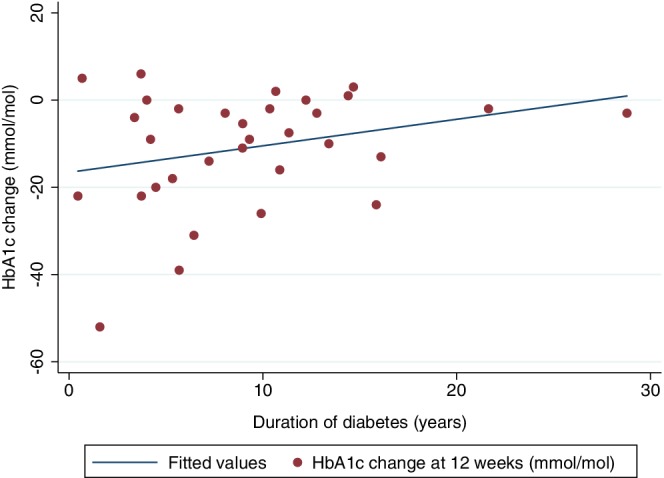
Forty-eight people were screened, 33 enrolled and 32 followed-up. Mean (±SD) weight loss in the intervention group was 9.5 kg (± 5.4 kg) compared with 2 kg (± 2.5 kg) in the control group (adjusted difference - 7.5 kg [-11.0 to -4.0, P < 0.001]). Mean reduction in HbA1c in the intervention group was 16.3 mmol/mol (± 13.3 mmol/mol) compared with 0.7 mmol/mol (±4.5 mmol/mol) in the control group (difference - 15.7 mmol/mol [-24.1 to -7.3, P < 0.001]).
It is feasible to recruit participants to a food-based, low-energy, low-carbohydrate intervention, for practice nurses to deliver the programme in primary care, and to retain participants in both groups. There is evidence of clinically significant short-term improvements in weight and glycaemic control.
检验由执业护士提供行为支持的基于食物的低碳水化合物低能量饮食对 2 型糖尿病患者的可行性。
将体质指数(BMI)≥30kg/m²的 2 型糖尿病患者随机分为干预组(2:1)和对照组(常规护理),并在 12 周时进行评估。干预组包括 800-1000kcal/天、基于食物的低碳水化合物(<26%能量)饮食 8 周,然后进行 4 周的体重维持期和 4 次与护士的 15-20 分钟预约。主要结局是招募的可行性、干预实施的一致性和 12 周时的参与者保留率。次要结局包括体重和 HbA1c 的变化。焦点小组探讨了干预经验。
对 48 名患者进行了筛查,33 名患者入组,32 名患者完成了随访。干预组的平均(±SD)体重减轻 9.5kg(±5.4kg),而对照组为 2kg(±2.5kg)(调整差异-7.5kg[-11.0 至-4.0,P<0.001])。干预组的平均 HbA1c 降低 16.3mmol/mol(±13.3mmol/mol),而对照组为 0.7mmol/mol(±4.5mmol/mol)(差值-15.7mmol/mol[-24.1 至-7.3,P<0.001])。
由执业护士在初级保健中提供方案,招募参与者参加基于食物的低碳水化合物低能量干预,保留两组参与者是可行的。有证据表明,体重和血糖控制在短期内有明显改善。