Ogunwale Abayomi N, Colon-Emeric Cathleen S, Sloane Richard, Adler Robert A, Lyles Kenneth W, Lee Richard H
Department of Medicine, Duke University, Durham, NC, USA.
Durham Veterans Affairs Medical Center, Durham, NC, USA.
J Bone Miner Res. 2020 Mar;35(3):440-445. doi: 10.1002/jbmr.3916. Epub 2019 Dec 12.
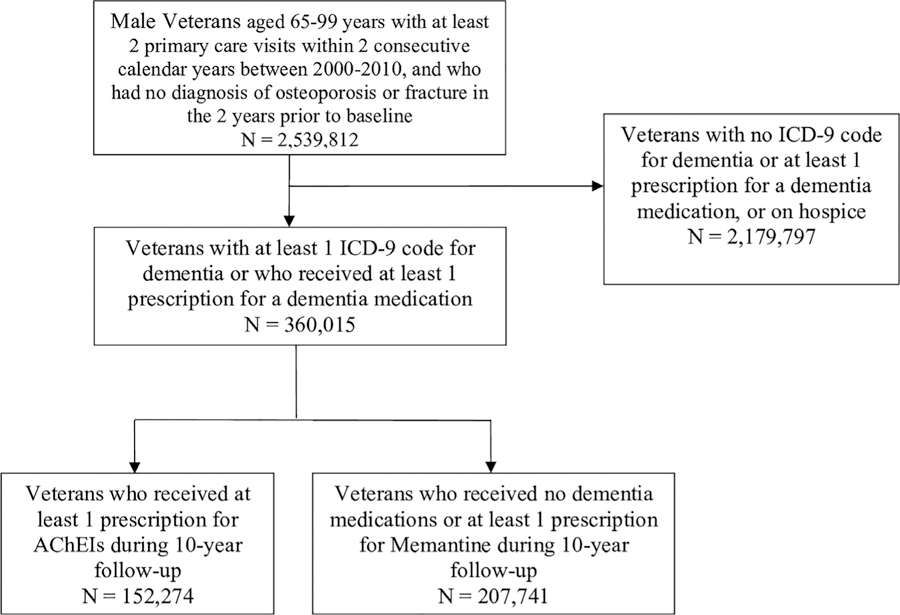
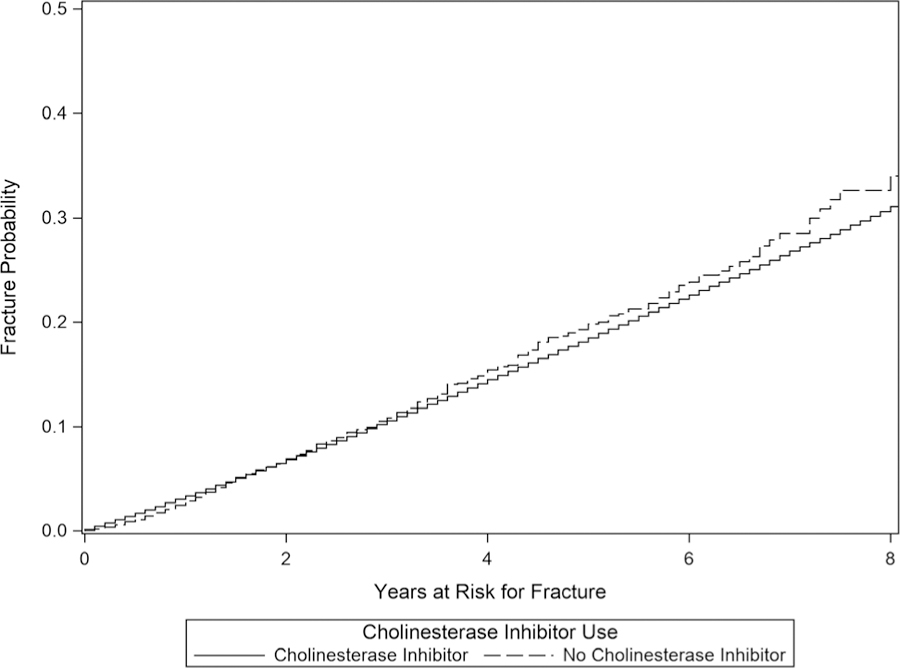
Acetylcholinesterase inhibitors (AChEIs) have been noted to increase bone density and quality in mice. Human studies are limited but suggest an association with improved bone healing after hip fracture. We examined the relationship between AChEI use and fracture risk in a national cohort of 360,015 male veterans aged 65 to 99 years with dementia but without prior fracture using Veterans Affairs (VA) hospital, Medicare, and pharmacy records from 2000 to 2010. Diagnosis of dementia, any clinical fracture (excluding facial and digital), comorbidities, and medications were identified using ICD-9 and drug class codes. Cox proportional hazard models considering AChEI use as a time-varying covariate and adjusting for fall and fracture risk factors compared the time-to-fracture in AChEI users versus non-AChEI users. Potential confounders included demographics (age, race, body mass index), comorbidities associated with fracture or falls (diabetes, lung disease, stroke, Parkinson's, seizures, etc.) and medications associated with fracture or falls (bisphosphonates, glucocorticoids, androgen deprivation therapy [ADT], proton pump inhibitors [PPIs], selective serotonin receptor inhibitors [SSRIs], etc.). Competing mortality risk was considered using the methods of Fine and Gray. To account for persistent effects on bone density or quality that might confer protection after stopping the medication, we completed a secondary analysis using the medication possession ratio (MPR) as a continuous variable in logistic regression models and also compared MPR increments of 10% to minimal/no use (MPR 0 to <0.10). Among older veterans with diagnosis of dementia, 20.1% suffered a fracture over an average of 4.6 years of follow-up. Overall, 42.3% of the cohort were prescribed AChEIs during the study period. The hazard of any fracture among AChEI users compared with those on other/no dementia medications was significantly lower in fully adjusted models (hazard ratio [HR] = 0.81; 95% confidence interval [CI] 0.75-0.88). After considering competing mortality risk, fracture risk remained 18% lower in veterans using AChEIs (HR = 0.82; 95% CI 0.76-0.89). © 2019 American Society for Bone and Mineral Research. Published 2019. This article is a U.S. Government work and is in the public domain in the USA.
乙酰胆碱酯酶抑制剂(AChEIs)已被证实可增加小鼠的骨密度和改善骨质。人体研究有限,但提示其与髋部骨折后骨愈合改善有关。我们利用退伍军人事务部(VA)医院、医疗保险和药房2000年至2010年的记录,在一个由360,015名年龄在65至99岁、患有痴呆症但无既往骨折史的男性退伍军人组成的全国队列中,研究了AChEI使用与骨折风险之间的关系。痴呆症诊断、任何临床骨折(不包括面部和手指骨折)、合并症及用药情况均根据ICD - 9和药物分类代码确定。Cox比例风险模型将AChEI使用作为一个随时间变化的协变量,并对跌倒和骨折风险因素进行调整,比较了AChEI使用者与非AChEI使用者发生骨折的时间。潜在混杂因素包括人口统计学特征(年龄、种族、体重指数)、与骨折或跌倒相关的合并症(糖尿病、肺部疾病、中风、帕金森病、癫痫等)以及与骨折或跌倒相关的药物(双膦酸盐、糖皮质激素、雄激素剥夺治疗[ADT]、质子泵抑制剂[PPIs]、选择性5 - 羟色胺再摄取抑制剂[SSRIs]等)。采用Fine和Gray方法考虑竞争死亡风险。为了说明停药后可能对骨密度或骨质产生的持续保护作用,我们在逻辑回归模型中使用药物持有率(MPR)作为连续变量进行了二次分析,并比较了MPR增加10%与极少/未使用(MPR 0至<0.10)的情况。在诊断为痴呆症的老年退伍军人中,平均4.6年的随访期内有20.1%发生了骨折。总体而言,队列中有42.3%的人在研究期间被处方使用AChEIs。在完全调整模型中,与使用其他/未使用痴呆症药物的人相比,AChEI使用者发生任何骨折的风险显著降低(风险比[HR]=0.81;95%置信区间[CI] 0.75 - 0.88)。在考虑竞争死亡风险后,使用AChEIs的退伍军人骨折风险仍低18%(HR = 0.82;95% CI 0.76 - 0.89)。©2019美国骨与矿物质研究学会。2019年发表。本文是美国政府作品,在美国属于公共领域。