Department of Brain and Cognitive Sciences, Daegu Gyeongbuk Institute of Science & Technology (DGIST), Daegu 42988, Korea.
Mol Cells. 2019 Nov 30;42(11):739-746. doi: 10.14348/molcells.2019.0200.
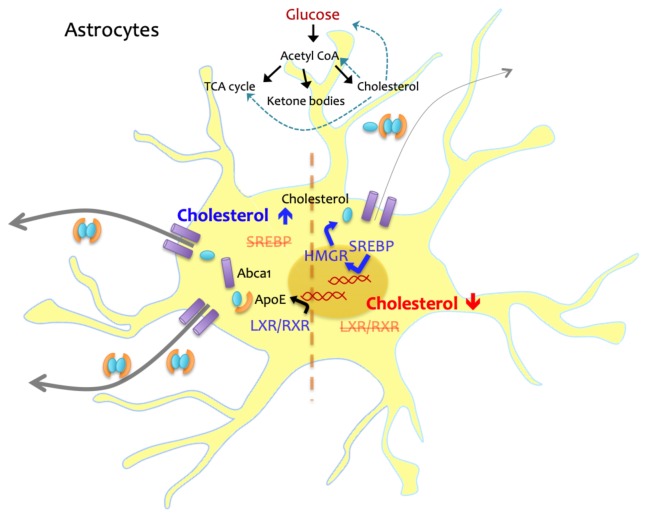
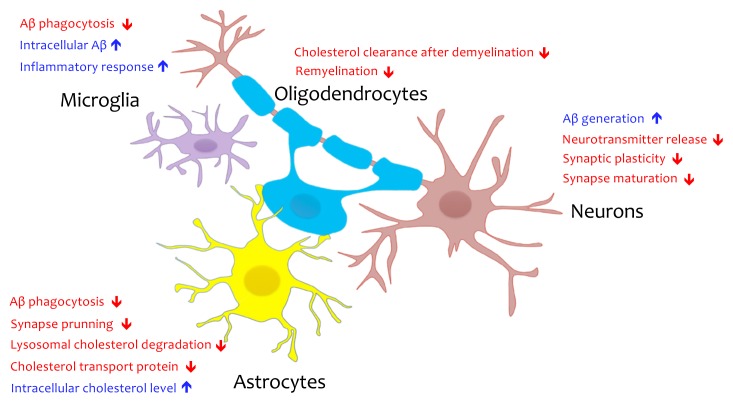
Significant knowledge about the pathophysiology of Alzheimer's disease (AD) has been gained in the last century; however, the understanding of its causes of onset remains limited. Late-onset AD is observed in about 95% of patients, and -encoding apolipoprotein E4 (ApoE4) is strongly associated with these cases. As an apolipoprotein, the function of ApoE in brain cholesterol transport has been extensively studied and widely appreciated. Development of new technologies such as human-induced pluripotent stem cells (hiPSCs) and CRISPR-Cas9 genome editing tools have enabled us to develop human brain model systems and readily manipulate genomic information. In the context of these advances, recent studies provide strong evidence that abnormal cholesterol metabolism by ApoE4 could be linked to AD-associated pathology. In this review, we discuss novel discoveries in brain cholesterol dysregulation by ApoE4. We further elaborate cell type-specific roles in cholesterol regulation of four major brain cell types, neurons, astrocytes, microglia, and oligodendrocytes, and how its dysregulation can be linked to AD pathology.
在上个世纪,人们对阿尔茨海默病(AD)的病理生理学有了重要的认识;然而,其发病原因仍知之甚少。约 95%的患者为迟发性 AD,载脂蛋白 E4(ApoE4)的编码与这些病例密切相关。作为一种载脂蛋白,ApoE 在大脑胆固醇转运中的功能已被广泛研究和充分认识。人类诱导多能干细胞(hiPSCs)和 CRISPR-Cas9 基因组编辑工具等新技术的发展使我们能够开发人类大脑模型系统,并轻松操纵基因组信息。在这些进展的背景下,最近的研究提供了强有力的证据,表明 ApoE4 异常的胆固醇代谢可能与 AD 相关的病理学有关。在这篇综述中,我们讨论了 ApoE4 导致大脑胆固醇失调的新发现。我们进一步阐述了四大主要脑细胞类型(神经元、星形胶质细胞、小胶质细胞和少突胶质细胞)中胆固醇调节的细胞类型特异性作用,以及其失调如何与 AD 病理学相关。