Department of Anesthesiology, Affiliated Tumor Hospital of Guangxi Medical University, Nanning, Guangxi, China.
The Laboratory of Perioperative Medicine Research Center, Affiliated Tumor Hospital of Guangxi Medical University, Nanning, Guangxi, China.
PLoS One. 2019 Nov 12;14(11):e0224737. doi: 10.1371/journal.pone.0224737. eCollection 2019.
Non-intubated anesthesia (NIA) has been proposed for video-assisted thoracoscopic surgery (VATS), although how the benefit-to-risk of NIA compares to that of intubated general anesthesia (IGA) for certain types of patients remains unclear. Therefore, the aim of the present meta-analysis was to understand whether NIA or IGA may be more beneficial for patients undergoing VATS.
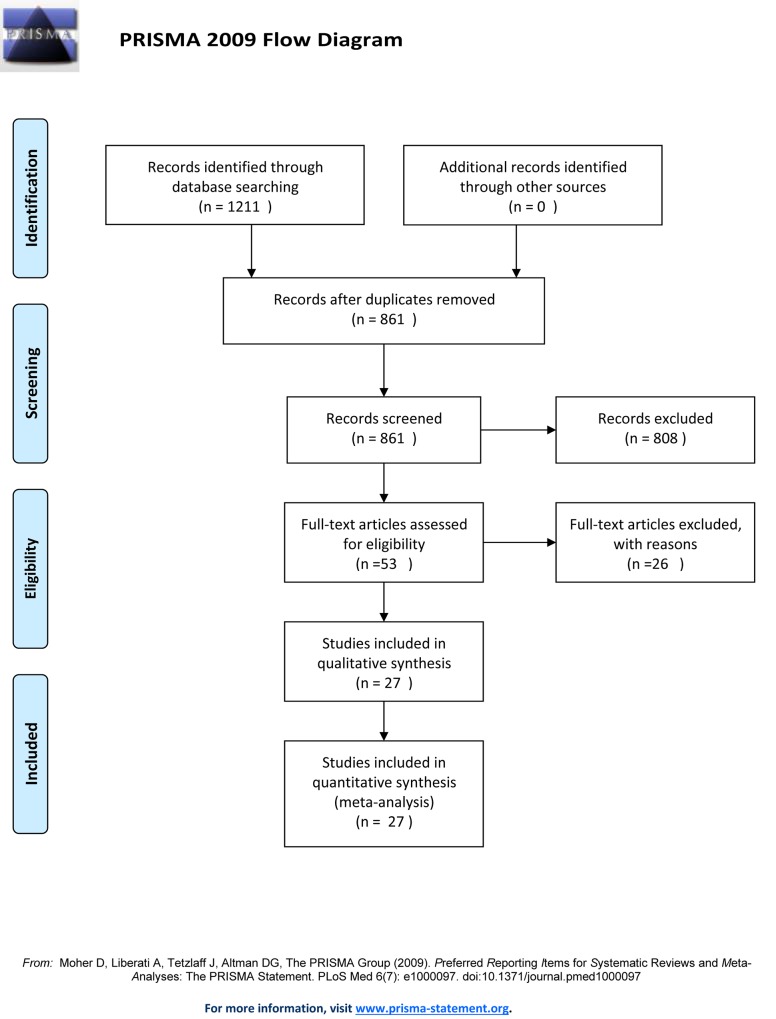
A systematic search of Cochrane Library, Pubmed and Embase databases from 1968 to April 2019 was performed using predefined criteria. Studies comparing the effects of NIA or IGA for adult VATS patients were considered. The primary outcome measure was hospital stay. Pooled data were meta-analyzed using a random-effects model to determine the standard mean difference (SMD) with 95% confidence intervals (CI).
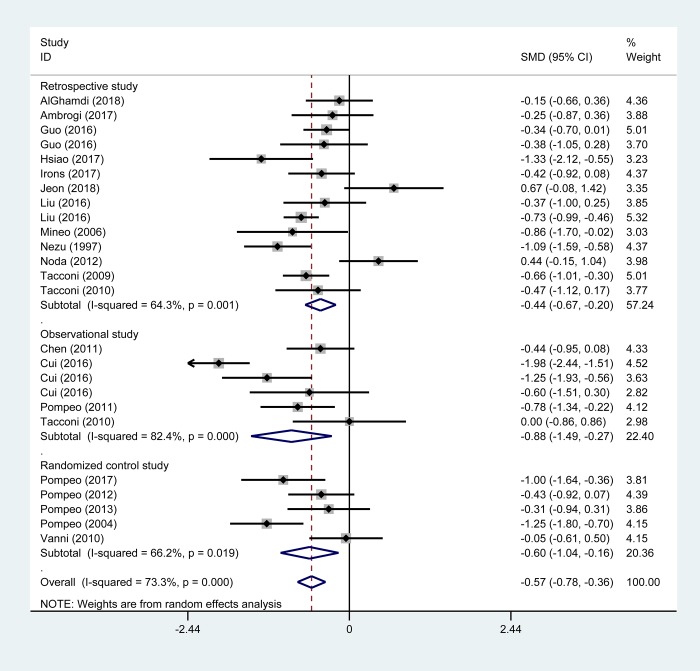
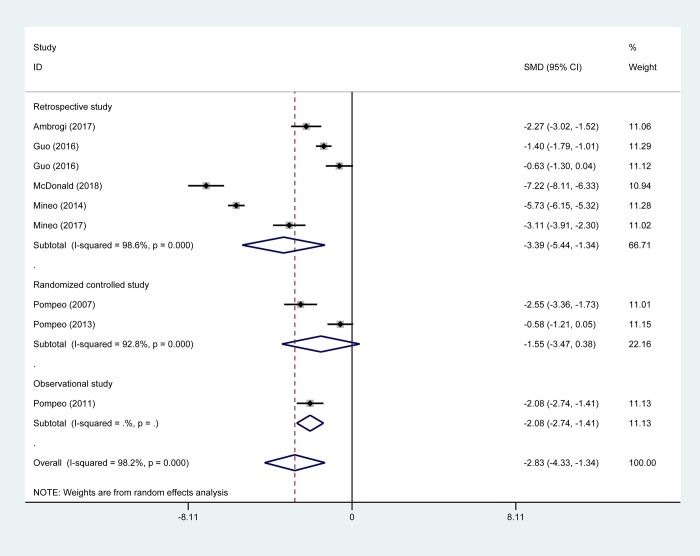
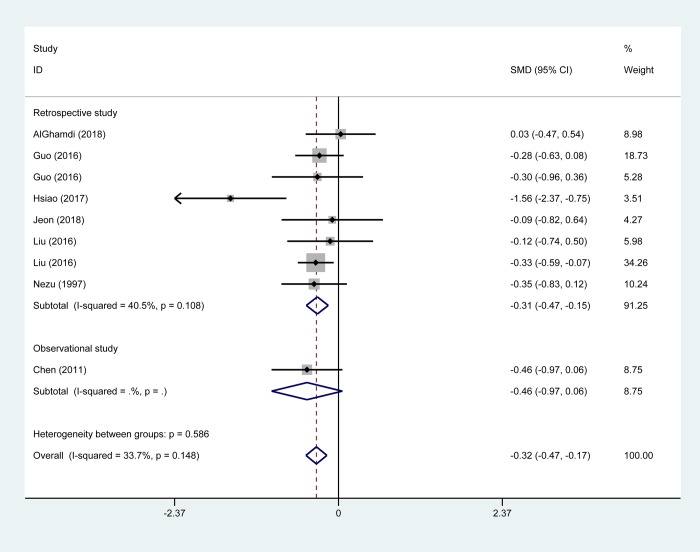
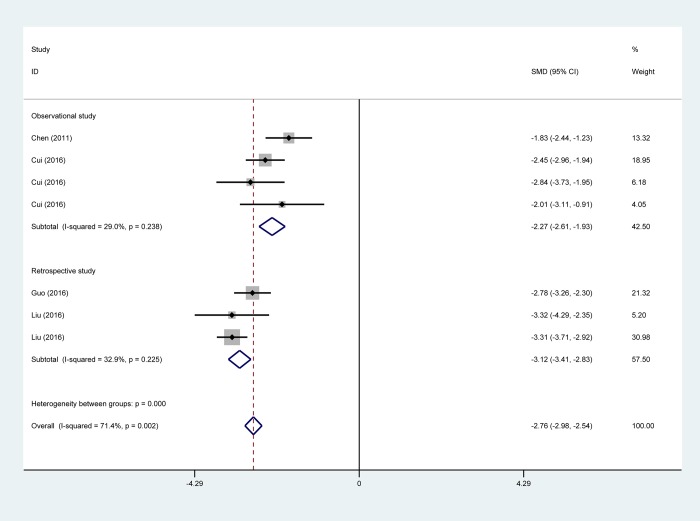
Twenty-eight studies with 2929 patients were included. The median age of participants was 56.8 years (range 21.9-76.4) and 1802 (61.5%) were male. Compared to IGA, NIA was associated with shorter hospital stay (SMD -0.57 days, 95%CI -0.78 to -0.36), lower estimated cost for hospitalization (SMD -2.83 US, 95% CI -4.33 to -1.34), shorter chest tube duration (SMD -0.32 days, 95% CI -0.47 to -0.17), and shorter postoperative fasting time (SMD, -2.76 days; 95% CI -2.98 to -2.54). NIA patients showed higher levels of total lymphocytes and natural killer cells and higher T helper/T suppressor cell ratio, but lower levels of interleukin (IL)-6, IL-8 and C-reactive protein (CRP). Moreover, NIA patients showed lower levels of fibrinogen, cortisol, procalcitonin and epinephrine.
NIA enhances the recovery from VATS through attenuation of stress and inflammatory responses and stimulation of cellular immune function.
非插管麻醉(NIA)已被提议用于电视辅助胸腔镜手术(VATS),尽管对于某些类型的患者,NIA 的获益与风险比与插管全身麻醉(IGA)相比如何尚不清楚。因此,本荟萃分析的目的是了解接受 VATS 的患者接受 NIA 或 IGA 是否更有益。
使用预设标准,对 Cochrane 图书馆、Pubmed 和 Embase 数据库进行了系统检索,检索时间从 1968 年到 2019 年 4 月。纳入比较 NIA 或 IGA 对成人 VATS 患者影响的研究。主要观察指标为住院时间。使用随机效应模型对汇总数据进行荟萃分析,以确定标准均数差(SMD)及其 95%置信区间(CI)。
共纳入 28 项研究,2929 例患者。参与者的中位年龄为 56.8 岁(范围 21.9-76.4),1802 例(61.5%)为男性。与 IGA 相比,NIA 与较短的住院时间(SMD-0.57 天,95%CI-0.78 至-0.36)、较低的住院费用估计值(SMD-2.83 美元,95%CI-4.33 至-1.34)、较短的胸腔引流管持续时间(SMD-0.32 天,95%CI-0.47 至-0.17)和较短的术后禁食时间(SMD-2.76 天;95%CI-2.98 至-2.54)相关。NIA 患者的总淋巴细胞和自然杀伤细胞水平较高,辅助性 T 细胞/抑制性 T 细胞比值较高,但白细胞介素(IL)-6、IL-8 和 C 反应蛋白(CRP)水平较低。此外,NIA 患者的纤维蛋白原、皮质醇、降钙素原和肾上腺素水平较低。
NIA 通过减轻应激和炎症反应以及刺激细胞免疫功能来促进 VATS 术后的恢复。