den Oudendammer Willemijn M, Noordhoek Jacquelien, Abma-Schouten Rebecca Y, van Houtum Lieke, Broerse Jacqueline E W, Dedding Christine W M
1Vrije Universiteit Amsterdam, de Boelelaan 1085, 1081 HV Amsterdam, The Netherlands.
2Nederlandse Cystic Fibrosis Stichting, Dr. A Schweitzerweg 3, 3744 MG Baarn, The Netherlands.
Res Involv Engagem. 2019 Nov 11;5:33. doi: 10.1186/s40900-019-0163-1. eCollection 2019.
Patient participation in decision-making on health-related research has gained ground. Nineteen Dutch health-related research-funding organisations (HFs) have taken up the challenge to include patients in their funding process. A 'Patient participation (PP) advisory team' was set-up, with HF-representatives and patient advocates, who together initiated this study. We provide an overview of , , and PP activities take place in HFs' funding processes, share main challenges and identify possible solutions.
A qualitative research design was used. Data was gathered by questionnaires ( = 14) and semi-structured interviews ( = 18) with HF employees responsible for patient participation, followed by a workshop ( = 27) with involved employees of HFs and key players in PP from national patient organisations and research organisations. A descriptive analysis was used for the questionnaire. A semi-directed content analysis was used for the interviews and the workshop.
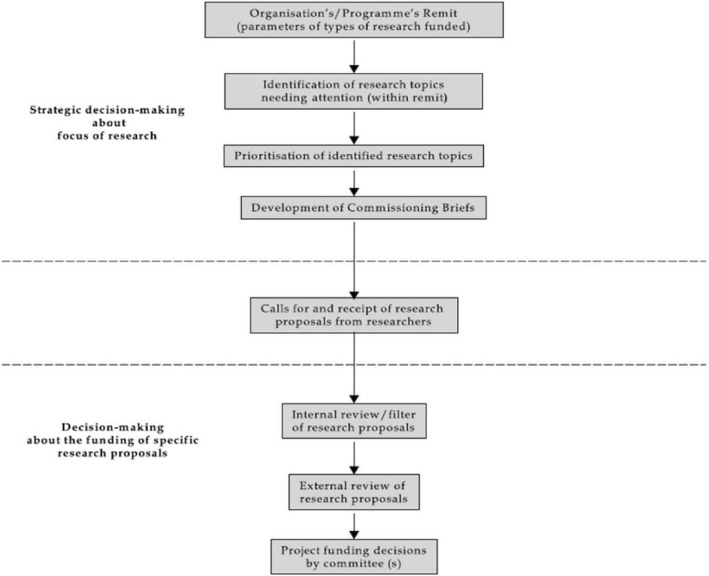
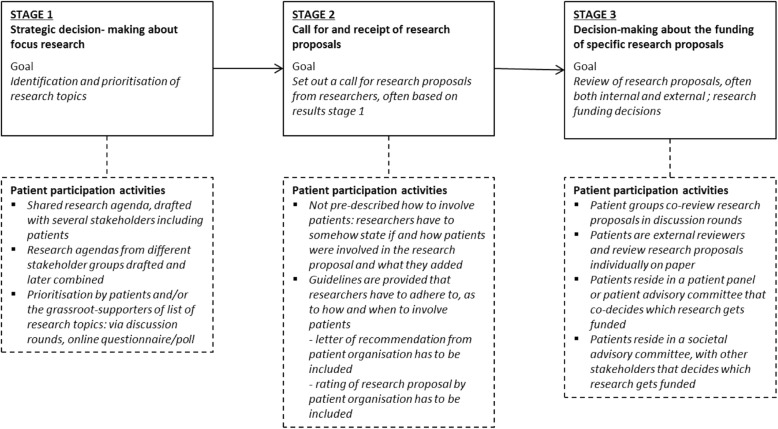
Three stages can be identified in the funding process in which HFs carry out PP activities: (1) strategic decision-making about focus of research (e.g. shared research agendas); (2) call for and receipt of research proposals (e.g. mandatory inclusion of letter of recommendation from patient organisation); (3) decision-making about the funding of research proposals (e.g. patients reside in a patient panel to co-review research proposals). Main challenges identified to carry out PP activities include: how to accommodate diversity of the patient body (mainly encountered in stage 1 and 3); to what extent should patients receive training to successfully participate (mainly encountered in stage 1 and 3); and who is responsible for patient-researcher dialogues (mainly encountered in stage 1 and 2). All nineteen HFs agree that patients should be included in at least one stage of the funding process for health-related research. CONCLUSION: Further broadening and optimising patient involvement is still needed. The proposed solutions to the identified challenges could serve as inspiration for national and international research funding foundations that aim to structurally include patients in their funding process.
患者参与健康相关研究的决策已逐渐兴起。19个荷兰健康相关研究资助组织(HFs)已接受挑战,将患者纳入其资助流程。为此成立了一个“患者参与(PP)咨询团队”,成员包括HFs代表和患者倡导者,他们共同发起了这项研究。我们概述了HFs资助流程中PP活动的开展情况、分享主要挑战并确定可能的解决方案。
采用定性研究设计。通过问卷调查(n = 14)和与负责患者参与的HFs员工进行半结构化访谈(n = 18)收集数据,随后与HFs相关员工以及国家患者组织和研究组织中PP的关键参与者举办了一次研讨会(n = 27)。对问卷进行描述性分析,对访谈和研讨会采用半定向内容分析。
在资助流程中可确定HFs开展PP活动的三个阶段:(1)关于研究重点的战略决策(如共享研究议程);(2)征集和接收研究提案(如强制要求包含患者组织的推荐信);(3)关于研究提案资助的决策(如患者参与评审小组共同评审研究提案)。开展PP活动所确定的主要挑战包括:如何适应患者群体的多样性(主要在第1阶段和第3阶段遇到);患者应接受何种程度的培训才能成功参与(主要在第1阶段和第3阶段遇到);以及谁负责患者与研究人员的对话(主要在第1阶段和第2阶段遇到)。所有19个HFs都同意患者应被纳入健康相关研究资助流程的至少一个阶段。结论:仍需进一步扩大和优化患者参与。针对所确定挑战提出的解决方案可为旨在将患者结构性纳入其资助流程的国家和国际研究资助基金会提供启发。