The University of Sydney Northern Clinical School, Women and Babies Research, St Leonards, New South Wales, Australia.
Northern Sydney Local Health District, Kolling Institute, New South Wales, Australia.
PLoS One. 2019 Nov 13;14(11):e0225123. doi: 10.1371/journal.pone.0225123. eCollection 2019.
Low haemoglobin has been linked to adverse pregnancy outcomes. Our study aimed to assess the association of haemoglobin (Hb) in the first 20 weeks of pregnancy, and restoration of low Hb levels, with pregnancy outcomes in Australia.
Clinical data for singleton pregnancies from two tertiary public hospitals in New South Wales were extracted for 2011-2015. The relationship between the lowest Hb result in the first 20 weeks of pregnancy and adverse outcomes was determined using adjusted Poisson regression. Those with Hb <110 g/L were classified into 'restored' and 'not restored' based on Hb results from 21 weeks onwards, and risk of adverse outcomes explored with adjusted Poisson regression.
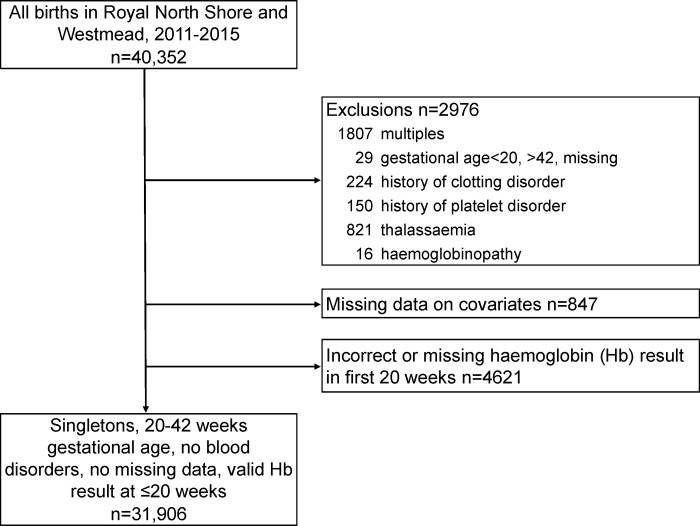
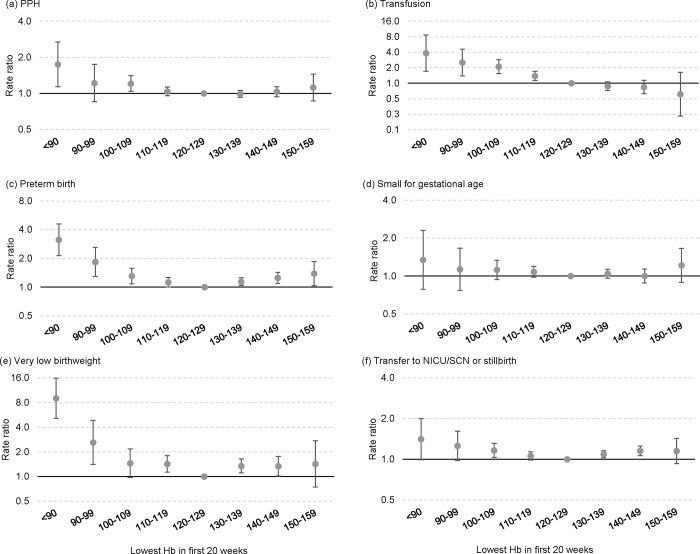
Of 31,906 singleton pregnancies, 4.0% had Hb <110 and 10.2% had ≥140 g/L at ≤20 weeks. Women with low Hb had significantly higher risks of postpartum haemorrhage, transfusion, preterm birth, very low birthweight, and having a baby transferred to higher care or stillbirth. High Hb was also associated with higher risks of preterm, very low birthweight, and transfer to higher care/stillbirth. Transfusion was the only outcome where risk decreased with increasing Hb. Risk of transfusion was significantly lower in the 'restored' group compared with the 'not restored' group (OR 0.39, 95% CI 0.22-0.70), but restoration of Hb did not significantly affect the other outcomes measured.
Women with both low and high Hb in the first 20 weeks of pregnancy had higher risks of adverse outcomes than those with normal Hb. Restoring Hb after 20 weeks did not improve most adverse outcome rates but did reduce risk of transfusion.
低血红蛋白与不良妊娠结局有关。我们的研究旨在评估澳大利亚妊娠前 20 周血红蛋白(Hb)水平及低 Hb 水平恢复情况与妊娠结局的关系。
从新南威尔士州两家三级公立医院提取了 2011 年至 2015 年单胎妊娠的临床数据。采用调整后的泊松回归确定妊娠前 20 周最低 Hb 值与不良结局之间的关系。根据 21 周以后的 Hb 值,将 Hb <110 g/L 的患者分为“恢复”和“未恢复”两组,采用调整后的泊松回归探讨不良结局的风险。
在 31906 例单胎妊娠中,4.0%的孕妇在妊娠≤20 周时 Hb <110 g/L,10.2%的孕妇 Hb ≥140 g/L。低 Hb 孕妇产后出血、输血、早产、极低出生体重和婴儿转至更高护理或死胎的风险显著增加。高 Hb 也与早产、极低出生体重和转至更高护理/死胎的风险增加有关。只有输血是 Hb 升高风险降低的唯一结局。与“未恢复”组相比,“恢复”组输血风险显著降低(OR 0.39,95%CI 0.22-0.70),但 Hb 的恢复并未显著影响其他测量结局。
妊娠前 20 周 Hb 水平低和高的孕妇不良结局风险均高于 Hb 水平正常的孕妇。20 周后 Hb 的恢复并不能显著改善大多数不良结局的发生率,但确实降低了输血的风险。