Bondaronek Paulina, Slee April, Hamilton Fiona L, Murray Elizabeth
eHealth Unit, Research Department of Primary Care and Population Health, University College London, London, UK
Research Department of Primary Care and Population Health, University College London, London, UK.
BMJ Open. 2019 Nov 14;9(11):e027536. doi: 10.1136/bmjopen-2018-027536.
To explore the relationship between popularity of mobile application (apps) for physical activity (PA) and their likely efficacy. The primary objective was to assess the association between app popularity (indicated by user ratings) and likely efficacy (indicated by the number of Behaviour Change Techniques (BCT) present). The secondary objective was to assess the relationship between user ratings and those BCTs that have been shown to be effective in increasing PA.
Observational study.
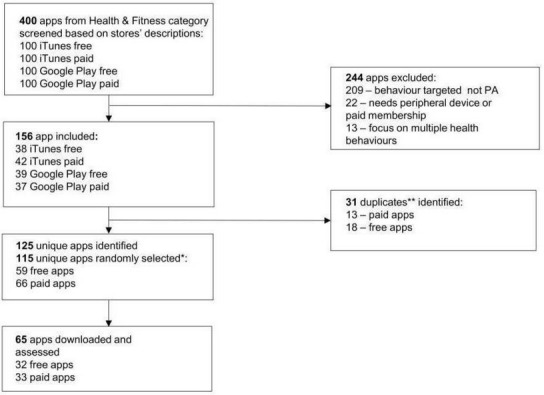
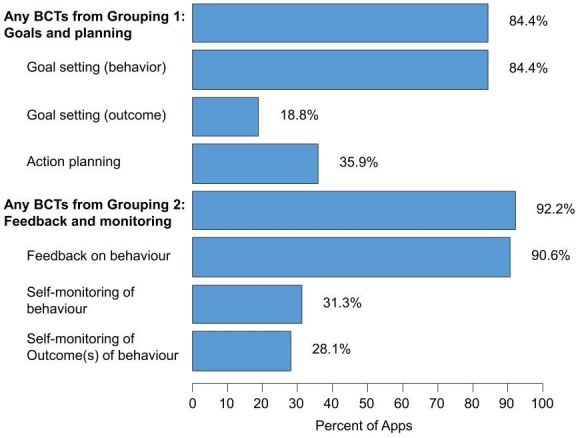
400 top-ranked free and paid apps from iTunes and Google Play stores were screened, and were included if the primary behaviour targeted was PA and they had stand-alone functionality. The outcome variable of user rating was dichotomised into high (4, 5 stars) or low (1, 2, 3 stars) rating.
iTunes and Google Play app stores.
No individual participants but the study used user-led rating system in the app store.
BCTs and user rating.
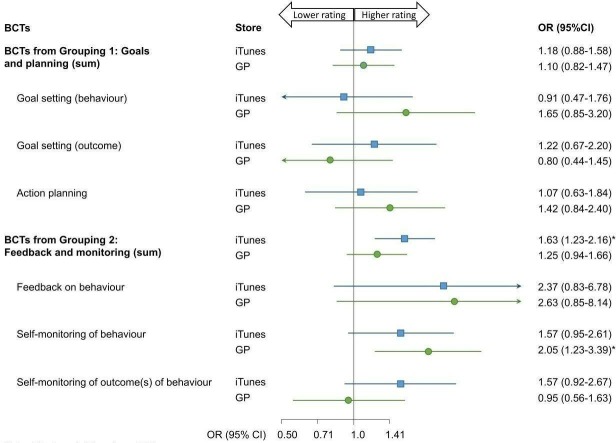
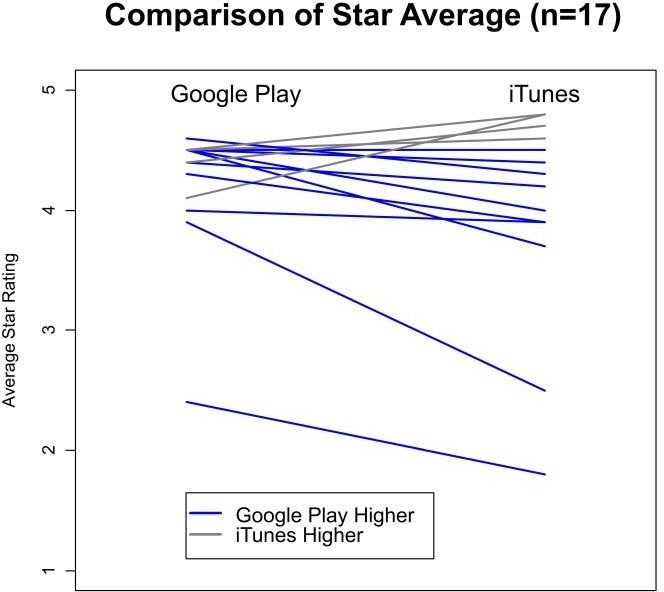
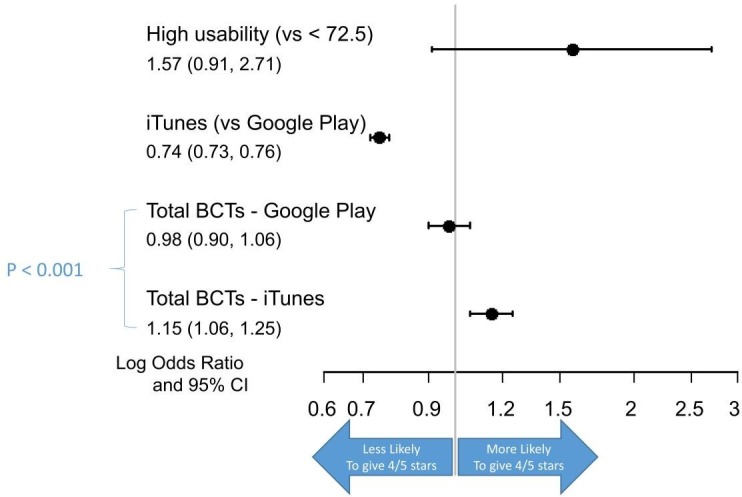
Of 400 apps, 156 were eligible and 65 were randomly selected, downloaded and assessed by two reviewers. There was no relationship overall between star ratings and the number of BCTs present, nor between star ratings and the presence of BCTs known to be effective in increasing PA. App store was strongly associated with star ratings, with lower likelihood of finding 4 or 5 stars in iTunes compared with Google Play (OR 0.74, 95% CI 0.73 to 0.76, p<0.001).
The findings of this study suggest that popularity does not necessarily imply the likelihood of effectiveness. Hence, public health impact is unlikely to be achieved by allowing market forces to 'prescribe' what is used by the public.
探讨体育活动(PA)移动应用程序(应用)的受欢迎程度与其可能的功效之间的关系。主要目的是评估应用受欢迎程度(以用户评分表示)与可能的功效(以存在的行为改变技术(BCT)数量表示)之间的关联。次要目的是评估用户评分与那些已被证明对增加PA有效的BCT之间的关系。
观察性研究。
从iTunes和谷歌应用商店筛选出400个排名靠前的免费和付费应用,如果其主要目标行为是PA且具有独立功能,则纳入研究。用户评分的结果变量被分为高(4星、5星)或低(1星、2星、3星)评分。
iTunes和谷歌应用商店。
没有个体参与者,但研究使用了应用商店中用户主导的评分系统。
BCT和用户评分。
在400个应用中,156个符合条件,随机选择65个下载并由两名评审员进行评估。总体而言,星级评分与存在的BCT数量之间没有关系,星级评分与已知对增加PA有效的BCT的存在之间也没有关系。应用商店与星级评分密切相关,与谷歌应用商店相比,在iTunes中找到4星或5星的可能性较低(OR 0.74,95%CI 0.73至0.76,p<0.001)。
本研究结果表明,受欢迎程度不一定意味着有效性。因此,让市场力量“规定”公众使用的东西不太可能实现公共卫生影响。