Nikolenko Vladimir N, Oganesyan Marine V, Vovkogon Angela D, Nikitina Arina T, Sozonova Ekaterina A, Kudryashova Valentina A, Rizaeva Negoria A, Cabezas Ricardo, Avila-Rodriguez Marco, Neganova Margarita E, Mikhaleva Liudmila M, Bachurin Sergey O, Somasundaram Siva G, Kirkland Cecil E, Tarasov Vadim V, Aliev Gjumrakch
Department of Human Anatomy, Federal State Autonomous Educational Institution of Higher Education I.M. Sechenov First Moscow State Medical University of the Ministry of Health of the Russian Federation (Sechenov University), St. Trubetskaya, 8, bld. 2, Moscow, 119991, Russia
Department of Normal and Topographic Anatomy, Federal State Budget Educational Institution of Higher Education M.V. Lomonosov Moscow State University, Leninskie Gory, 1, Moscow, 119991, Russia
Curr Neuropharmacol. 2020;18(11):1054-1063. doi: 10.2174/1570159X17666191113103850.
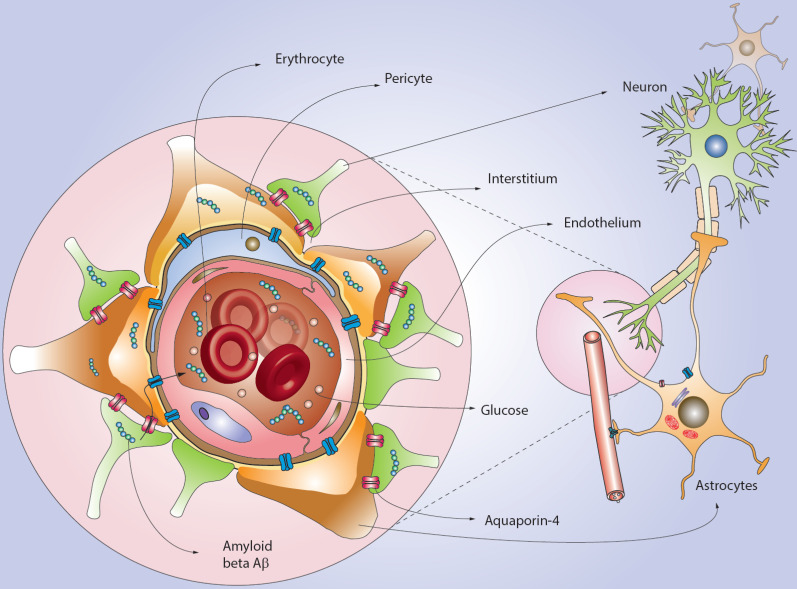
Until recently, it was thought that there were no lymphatic vessels in the central nervous system (CNS). Therefore, all metabolic processes were assumed to take place only in the circulation of the cerebrospinal fluid (CSF) and through the blood-brain barrier's (BBB), which regulate ion transport and ensure the functioning of the CNS. However, recent findings yield a new perspective: There is an exchange of CSF with interstitial fluid (ISF), which is drained to the paravenous space and reaches lymphatic nodes at the end. This circulation is known as the glymphatic system. The glymphatic system is an extensive network of meningeal lymphatic vessels (MLV) in the basal area of the skull that provides another path for waste products from CNS to reach the bloodstream. MLV develop postnatally, initially appearing around the foramina in the basal part of the skull and the spinal cord, thereafter sprouting along the skull's blood vessels and spinal nerves in various areas of the meninges. VEGF-C protein (vascular endothelial growth factor), expressed mainly by vascular smooth cells, plays an important role in the development of the MLV. The regenerative potential and plasticity of MLV and the novel discoveries related to CNS drainage offer potential for the treatment of neurodegenerative diseases such as dementia, hydrocephalus, stroke, multiple sclerosis, and Alzheimer disease (AD). Herein, we present an overview of the structure and function of the glymphatic system and MLV, and their potential involvement in the pathology and progression of neurodegenerative diseases.
直到最近,人们还认为中枢神经系统(CNS)中不存在淋巴管。因此,所有代谢过程都被认为仅在脑脊液(CSF)循环中以及通过调节离子运输并确保CNS功能的血脑屏障(BBB)进行。然而,最近的研究结果带来了新的观点:脑脊液与间质液(ISF)之间存在交换,间质液被引流到静脉旁间隙并最终到达淋巴结。这种循环被称为类淋巴系统。类淋巴系统是颅骨基部广泛的脑膜淋巴管(MLV)网络,为中枢神经系统的代谢废物进入血液循环提供了另一条途径。MLV在出生后发育,最初出现在颅骨基部和脊髓的孔周围,随后沿着颅骨血管和脑膜各区域的脊神经发芽。主要由血管平滑肌细胞表达的血管内皮生长因子C(VEGF-C)蛋白在MLV的发育中起重要作用。MLV的再生潜力和可塑性以及与中枢神经系统引流相关的新发现为治疗痴呆、脑积水、中风、多发性硬化症和阿尔茨海默病(AD)等神经退行性疾病提供了潜力。在此,我们概述了类淋巴系统和MLV的结构与功能,以及它们在神经退行性疾病的病理和进展中的潜在作用。