Palladino Antonio, Mavaro Isabella, Pizzoleo Carmela, De Felice Elena, Lucini Carla, de Girolamo Paolo, Netti Paolo A, Attanasio Chiara
CESMA-Centro Servizi Metrologici e Tecnologici Avanzati, University of Naples Federico II, 80146 Naples, Italy.
Department of Veterinary Medicine and Animal Productions, University of Naples Federico II, I-80137 Naples, Italy.
J Clin Med. 2019 Oct 25;8(11):1782. doi: 10.3390/jcm8111782.
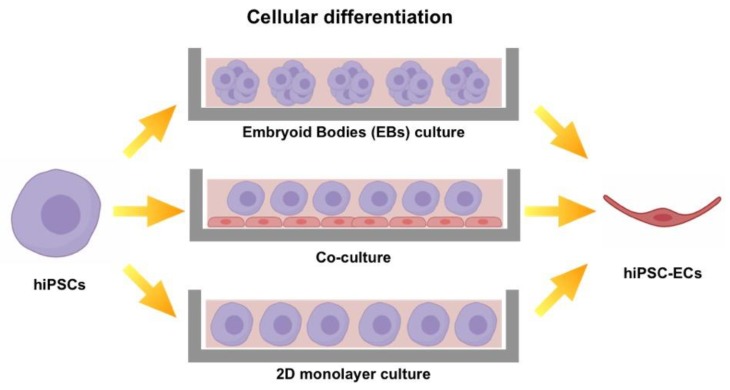
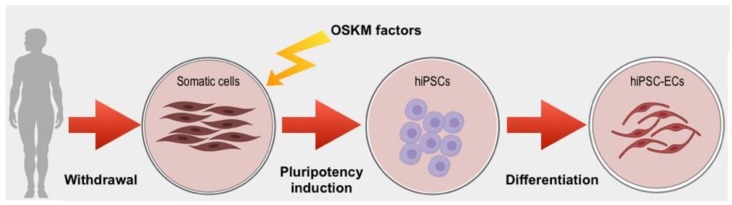
Tissue engineering (TE) pursues the ambitious goal to heal damaged tissues. One of the most successful TE approaches relies on the use of scaffolds specifically designed and fabricated to promote tissue growth. During regeneration the guidance of biological events may be essential to sustain vasculature neoformation inside the engineered scaffold. In this context, one of the most effective strategies includes the incorporation of vasculature forming cells, namely endothelial cells (EC), into engineered constructs. However, the most common EC sources currently available, intended as primary cells, are affected by several limitations that make them inappropriate to personalized medicine. Human induced Pluripotent Stem Cells (hiPSC), since the time of their discovery, represent an unprecedented opportunity for regenerative medicine applications. Unfortunately, human induced Pluripotent Stem Cells-Endothelial Cells (hiPSC-ECs) still display significant safety issues. In this work, we reviewed the most effective protocols to induce pluripotency, to generate cells displaying the endothelial phenotype and to perform an efficient and safe cell selection. We also provide noteworthy examples of both in vitro and in vivo applications of hiPSC-ECs in order to highlight their ability to form functional blood vessels. In conclusion, we propose hiPSC-ECs as the preferred source of endothelial cells currently available in the field of personalized regenerative medicine.
组织工程(TE)追求修复受损组织这一宏伟目标。最成功的组织工程方法之一依赖于使用专门设计和制造的支架来促进组织生长。在再生过程中,生物事件的引导对于维持工程支架内的血管新生可能至关重要。在这种情况下,最有效的策略之一包括将形成血管的细胞,即内皮细胞(EC),整合到工程构建体中。然而,目前可用的最常见的作为原代细胞的内皮细胞来源受到多种限制,使其不适用于个性化医疗。人类诱导多能干细胞(hiPSC)自发现以来,为再生医学应用带来了前所未有的机遇。不幸的是,人类诱导多能干细胞来源的内皮细胞(hiPSC-ECs)仍然存在重大安全问题。在这项工作中,我们回顾了诱导多能性、生成具有内皮表型的细胞以及进行高效安全的细胞筛选的最有效方案。我们还提供了hiPSC-ECs在体外和体内应用的显著例子,以突出它们形成功能性血管的能力。总之,我们提出hiPSC-ECs作为个性化再生医学领域目前可用的内皮细胞的首选来源。