Department of Neurobiology and Behavior, University of California Irvine, Irvine, California 92617, USA.
Department of Biology, Center for Molecular Investigation of Neurological Disorders, Pennsylvania State University, University Park, Pennsylvania 16802, USA.
Learn Mem. 2019 Nov 15;26(12):485-492. doi: 10.1101/lm.050278.119. Print 2019 Dec.
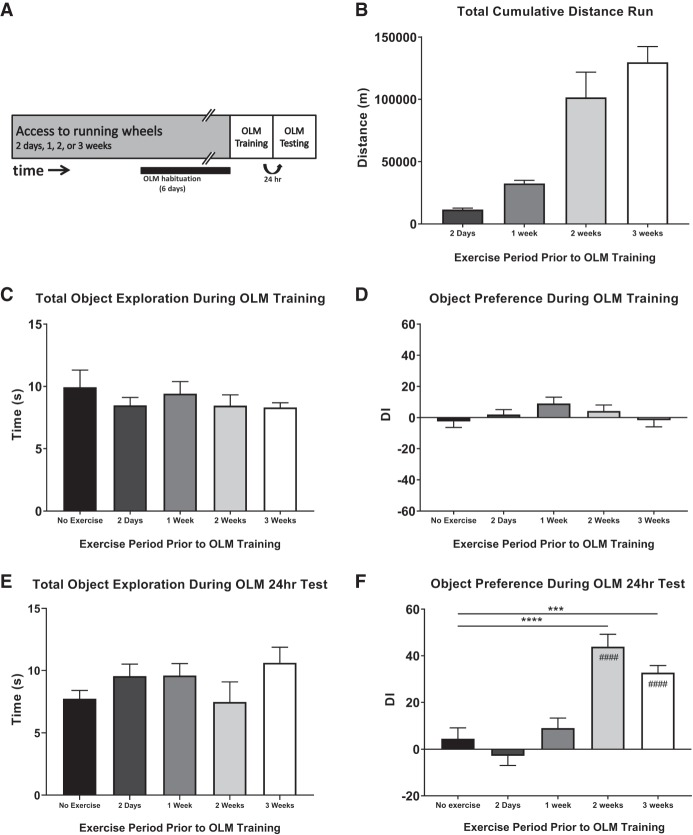
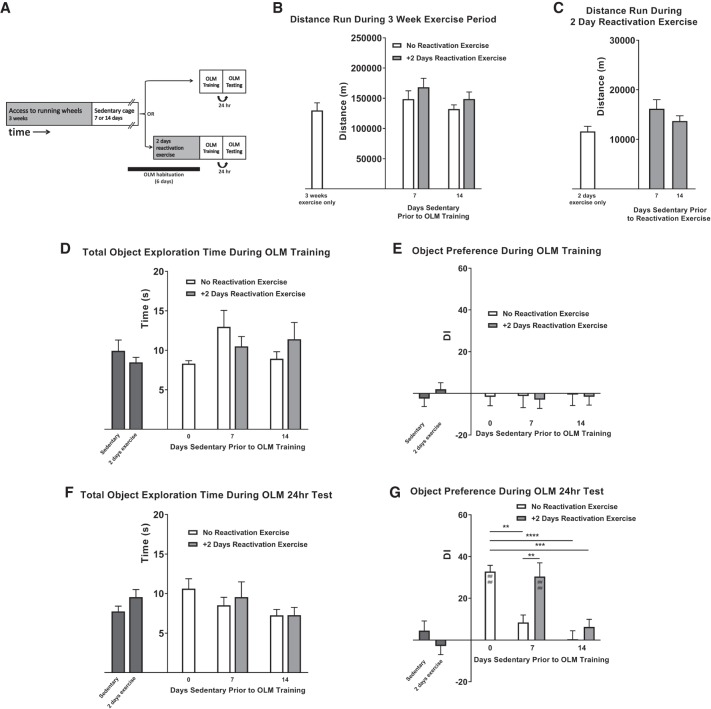
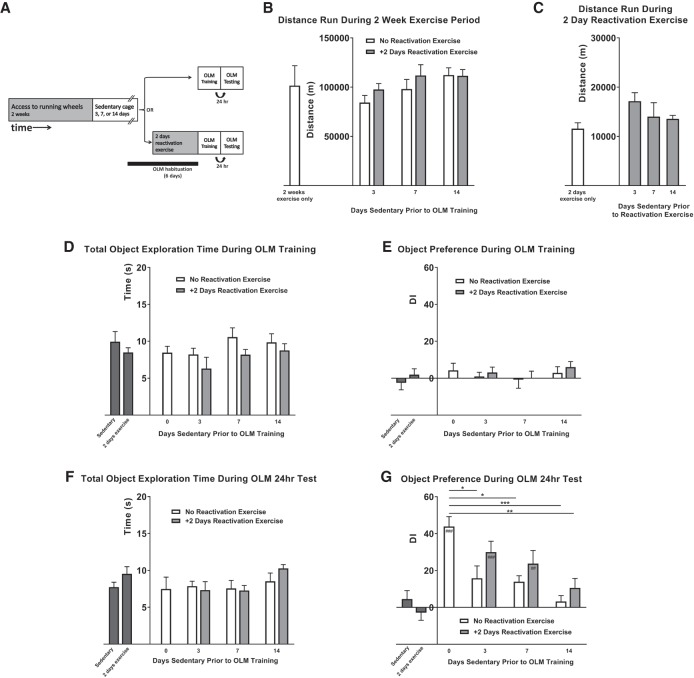
The beneficial effects of exercise on cognition are well established; however specific exercise parameters regarding the frequency and duration of physical activity that provide optimal cognitive health have not been well defined. Here, we explore the effects of the duration of exercise and sedentary periods on long-term object location memory (OLM) in mice. We use a weak object location training paradigm that is subthreshold for long-term memory formation in sedentary controls, and demonstrate that exercise enables long-term memories to form. We show that 14- and 21-d of running wheel access enables mice to discriminate between familiar and novel object locations after a 24 h delay, while 2- or 7-d running wheel access provides insufficient exercise for such memory enhancement using the subthreshold learning paradigm. After 14- and 21-d of wheel running, exercise-induced cognitive enhancement then decays back to baseline performance following 3-d of sedentary activity. However, exercise-induced cognitive enhancement can be reactivated by an additional period of just 2 d exercise, previously shown to be insufficient to induce cognitive enhancement on its own. The reactivating period of exercise is capable of enhancing memory after three- or seven-sedentary days, but not 14-d. These data suggest a type of "molecular memory" for the exercise stimulus, in that once exercise duration reaches a certain threshold, it establishes a temporal window during which subsequent low-level exercise can capitalize on the neurobiological adaptations induced by the initial period of exercise, enabling it to maintain the benefits on cognitive function. These findings provide new information that may help to guide future clinical studies in exercise.
运动对认知的有益影响已得到充分证实;然而,对于提供最佳认知健康的运动频率和持续时间的具体运动参数尚未得到很好的定义。在这里,我们探讨了运动和久坐时间的持续时间对小鼠长期物体位置记忆(OLM)的影响。我们使用了一种弱物体位置训练范式,该范式对于久坐对照组的长期记忆形成是亚阈值的,并且证明运动可以使长期记忆形成。我们表明,14 天和 21 天的跑步轮访问使小鼠能够在 24 小时延迟后区分熟悉和新颖的物体位置,而 2 天或 7 天的跑步轮访问提供的运动不足以通过亚阈值学习范式增强这种记忆。在 14 天和 21 天的轮式跑步后,在 3 天的久坐活动后,运动引起的认知增强会回落到基线表现。然而,运动引起的认知增强可以通过仅 2 天的额外运动重新激活,先前的研究表明,仅 2 天的运动不足以单独引起认知增强。重新激活运动的时期能够增强在三或七天久坐后,但不能增强在 14 天后的记忆。这些数据表明,运动刺激有一种“分子记忆”,即一旦运动持续时间达到一定阈值,它就会建立一个时间窗口,在此期间,随后的低水平运动可以利用初始运动期间诱导的神经生物学适应,从而保持对认知功能的益处。这些发现提供了新的信息,可能有助于指导未来的运动临床研究。