Key Laboratory of Crop Gene Resources and Germplasm Enhancement, Ministry of Agriculture, Institute of Crop Sciences, Chinese Academy of Agricultural Sciences, Beijing, China.
Center for Agricultural Resources Research, Institute of Genetics and Developmental Biology, Chinese Academy of Sciences, Shijiazhuang, Hebei, China.
Plant Biotechnol J. 2020 May;18(5):1330-1342. doi: 10.1111/pbi.13298. Epub 2019 Dec 4.
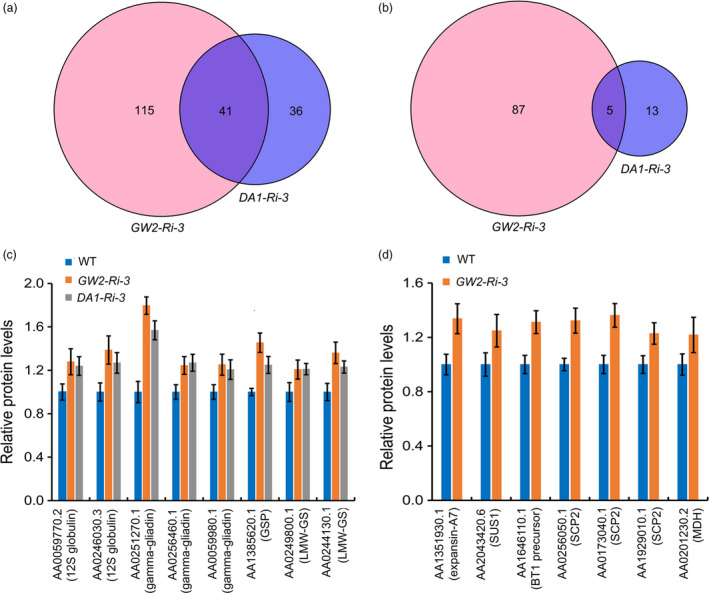
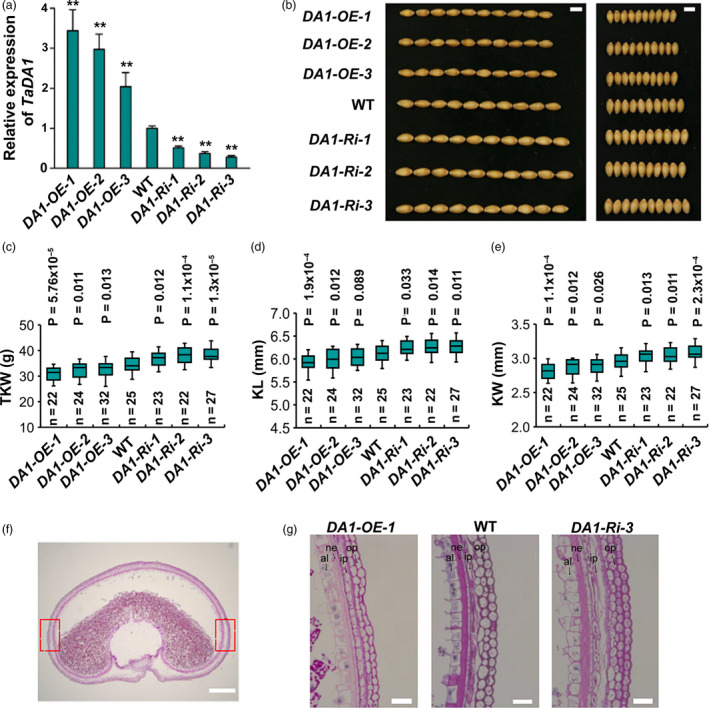
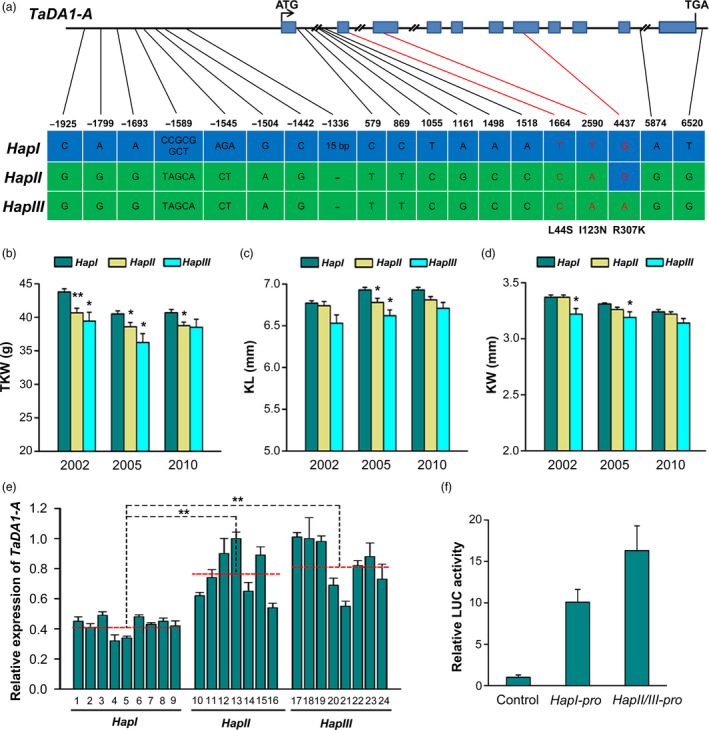
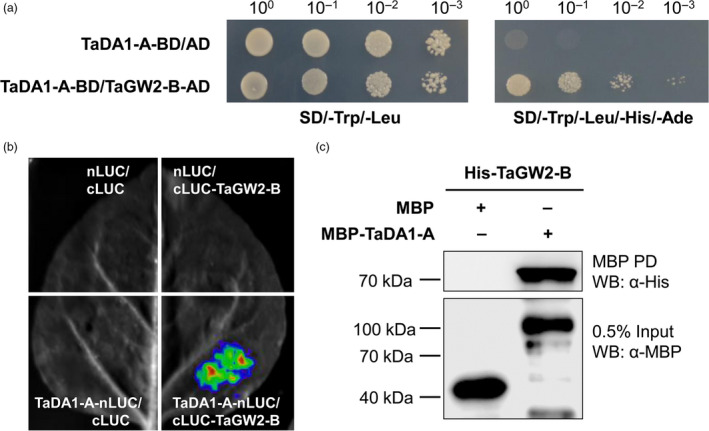
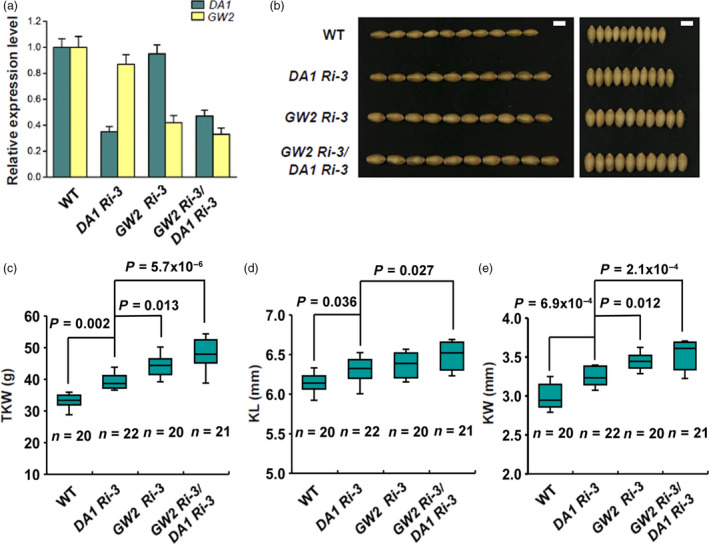
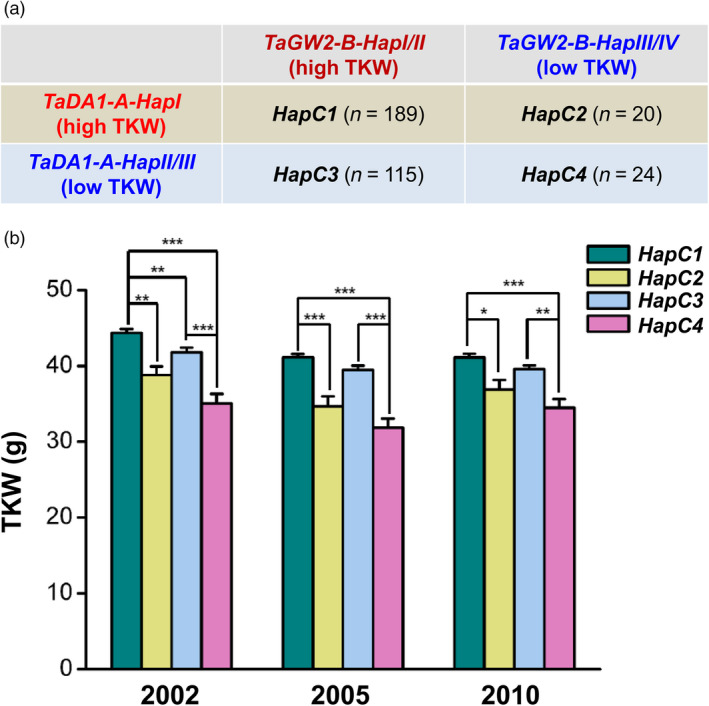
Kernel size is an important trait determining cereal yields. In this study, we cloned and characterized TaDA1, a conserved negative regulator of kernel size in wheat (Triticum aestivum). The overexpression of TaDA1 decreased the size and weight of wheat kernels, while its down-regulation using RNA interference (RNAi) had the opposite effect. Three TaDA1-A haplotypes were identified in Chinese wheat core collections, and a haplotype association analysis showed that TaDA1-A-HapI was significantly correlated with the production of larger kernels and higher kernel weights in modern Chinese cultivars. The haplotype effect resulted from a difference in TaDA1-A expression levels between genotypes, with TaDA1-A-HapI resulting in lower TaDA1-A expression levels. This favourable haplotype was found having been positively selected during wheat breeding over the last century. Furthermore, we demonstrated that TaDA1-A physically interacts with TaGW2-B. The additive effects of TaDA1-A and TaGW2-B on kernel weight were confirmed not only by the phenotypic enhancement arising from the simultaneous down-regulation of TaDA1 and TaGW2 expression, but also by the combinational haplotype effects estimated from multi-environment field data from 348 wheat cultivars. A comparative proteome analysis of developing transgenic and wild-type grains indicated that TaDA1 and TaGW2 are involved in partially overlapping but relatively independent protein regulatory networks. Thus, we have identified an important gene controlling kernel size in wheat and determined its interaction with other genes regulating kernel weight, which could have beneficial applications in wheat breeding.
粒宽是决定谷物产量的一个重要特征。本研究克隆并鉴定了 TaDA1,它是小麦中控制粒宽的保守负调控因子。TaDA1 的过表达会降低小麦粒的大小和重量,而其 RNA 干扰(RNAi)的下调则产生相反的效果。在我国小麦核心种质资源中鉴定到 3 个 TaDA1-A 单倍型,单倍型关联分析表明 TaDA1-A-HapI 与现代中国品种中较大粒和更高粒重的产生显著相关。这种单倍型效应源于不同基因型之间 TaDA1-A 表达水平的差异,TaDA1-A-HapI 导致 TaDA1-A 的表达水平降低。这种有利的单倍型在过去一个世纪的小麦育种中被证明是受到正向选择的。此外,我们还证明 TaDA1-A 与 TaGW2-B 发生物理互作。不仅通过同时下调 TaDA1 和 TaGW2 表达所产生的表型增强,而且通过来自 348 个小麦品种的多环境田间数据估算的组合单倍型效应,证实了 TaDA1-A 和 TaGW2-B 对粒重的累加效应。对发育中的转基因和野生型谷物的比较蛋白质组分析表明,TaDA1 和 TaGW2 参与了部分重叠但相对独立的蛋白质调控网络。因此,我们鉴定了一个控制小麦粒宽的重要基因,并确定了其与其他调控粒重的基因的相互作用,这可能对小麦育种具有有益的应用。