From Massachusetts General Hospital Neurological Clinical Research Institute and Harvard Medical School (J.D.B., M.E.C., K.N.), Boston; Mayo Clinic (A.J.W., N.P.S.), Rochester, MN; University of Massachusetts (M.O., D.M.-Y., R.H.B.), Worcester; Brainstorm Cell Therapeutics (Y.S.L., N.A., H.K., R.A., Y.G.), Petach Tikva, Israel; and Tigermed USA (M.M.), Somerset, NJ.
Neurology. 2019 Dec 10;93(24):e2294-e2305. doi: 10.1212/WNL.0000000000008620. Epub 2019 Nov 18.
To determine the safety and efficacy of mesenchymal stem cell (MSC)-neurotrophic factor (NTF) cells (NurOwn®, autologous bone marrow-derived MSCs, induced to secrete NTFs) delivered by combined intrathecal and intramuscular administration to participants with amyotrophic lateral sclerosis (ALS) in a phase 2 randomized controlled trial.
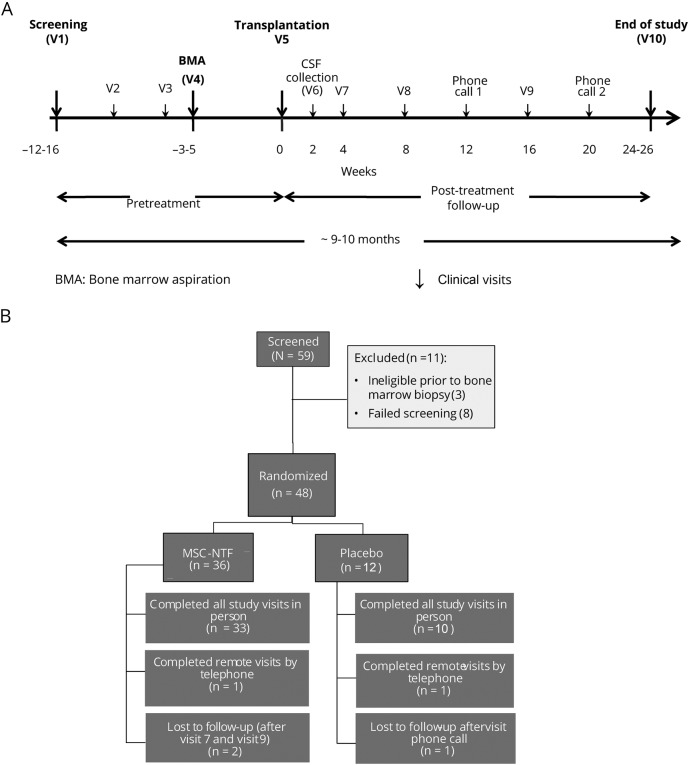
The study enrolled 48 participants randomized 3:1 (treatment: placebo). After a 3-month pretransplant period, participants received 1 dose of MSC-NTF cells (n = 36) or placebo (n = 12) and were followed for 6 months. CSF was collected before and 2 weeks after transplantation.
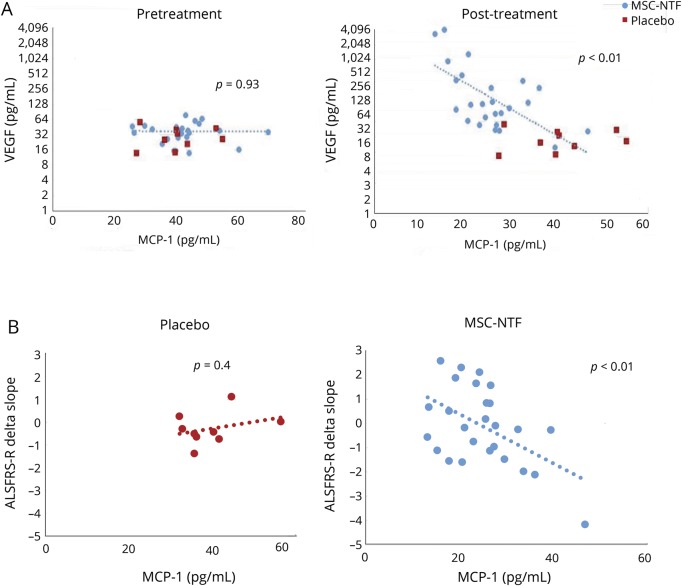
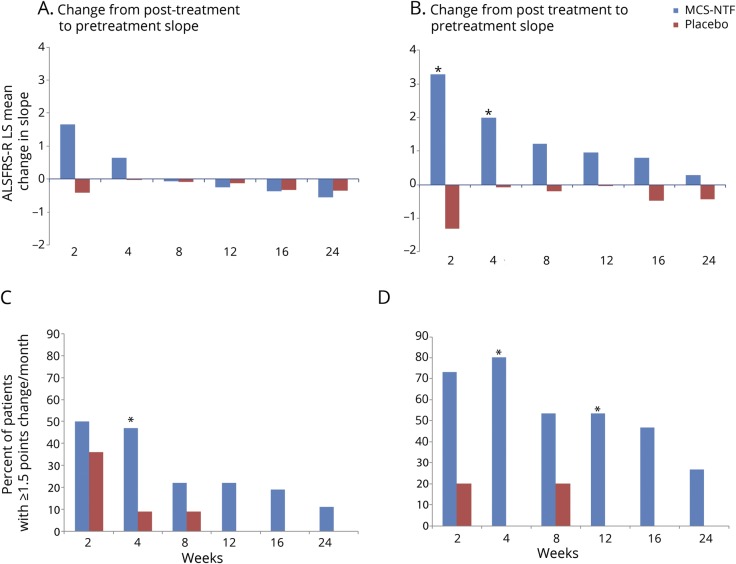
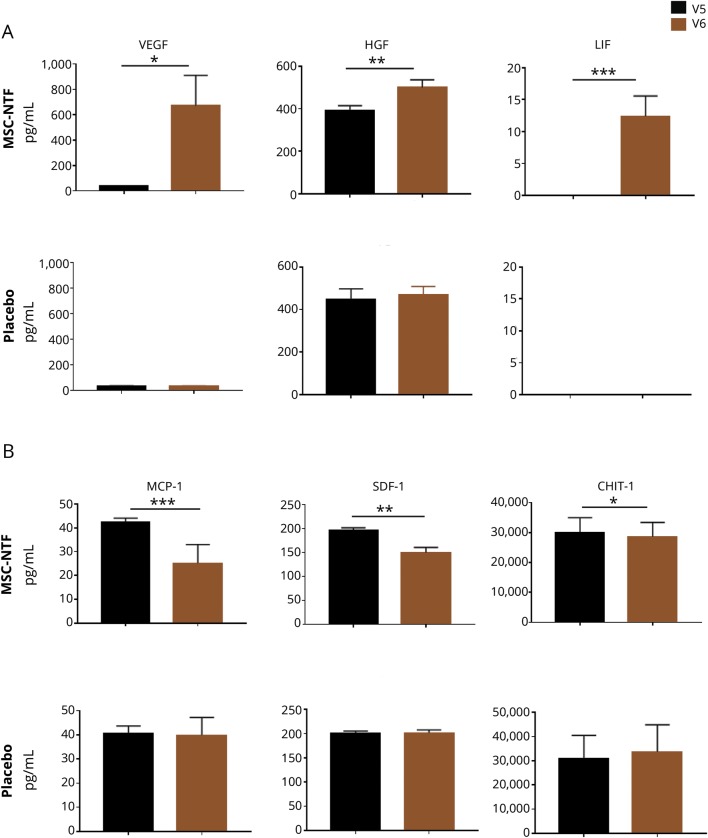
The study met its primary safety endpoint. The rate of disease progression (Revised ALS Functional Rating Scale [ALSFRS-R] slope change) in the overall study population was similar in treated and placebo participants. In a prespecified rapid progressor subgroup (n = 21), rate of disease progression was improved at early time points ( < 0.05). To address heterogeneity, a responder analysis showed that a higher proportion of treated participants experienced ≥1.5 points/month ALSFRS-R slope improvement compared to placebo at all time points, and was significant in rapid progressors at 4 and 12 weeks ( = 0.004 and 0.046, respectively). CSF neurotrophic factors increased and CSF inflammatory biomarkers decreased in treated participants ( < 0.05) post-transplantation. CSF monocyte chemoattractant protein-1 levels correlated with ALSFRS-R slope improvement up to 24 weeks ( < 0.05).
A single-dose transplantation of MSC-NTF cells is safe and demonstrated early promising signs of efficacy. This establishes a clear path forward for a multidose randomized clinical trial of intrathecal autologous MSC-NTF cell transplantation in ALS.
This phase II study provides Class I evidence.
在一项 2 期随机对照试验中,确定鞘内和肌肉内联合给药间充质干细胞(MSC)-神经营养因子(NTF)细胞(NurOwn ® ,自体骨髓来源的 MSC,诱导分泌 NTF)对肌萎缩侧索硬化症(ALS)患者的安全性和有效性。
该研究纳入了 48 名参与者,按照 3:1(治疗:安慰剂)随机分组。在移植前 3 个月,参与者接受了 1 次 MSC-NTF 细胞(n = 36)或安慰剂(n = 12)治疗,并随访 6 个月。在移植前和移植后 2 周收集 CSF。
该研究达到了主要的安全性终点。治疗组和安慰剂组的整体研究人群疾病进展率(修订后的 ALS 功能评定量表 [ALSFRS-R] 斜率变化)相似。在预先指定的快速进展者亚组(n = 21)中,疾病进展率在早期时间点(<0.05)有所改善。为了解决异质性,应答者分析显示,与安慰剂组相比,治疗组在所有时间点上,有更高比例的患者 ALSFRS-R 斜率改善≥1.5 分/月,在快速进展者中,在 4 周和 12 周时差异具有统计学意义(=0.004 和 0.046)。移植后,治疗组 CSF 神经营养因子增加,CSF 炎症生物标志物减少(<0.05)。CSF 单核细胞趋化蛋白-1 水平与 ALSFRS-R 斜率改善相关,直至 24 周(<0.05)。
单次移植 MSC-NTF 细胞是安全的,并显示出早期有希望的疗效迹象。这为鞘内自体 MSC-NTF 细胞移植治疗 ALS 的多剂量随机临床试验奠定了明确的基础。
这项 2 期研究提供了 1 级证据。