Laboratory for Genetic Code, Graduate School of Life and Medical Sciences, Doshisha University, Kyotanabe, Japan.
Department of Life and Medical Sciences, Doshisha University, Kyotanabe, Japan.
Cancer Sci. 2020 Jan;111(1):6-14. doi: 10.1111/cas.14244. Epub 2019 Dec 14.
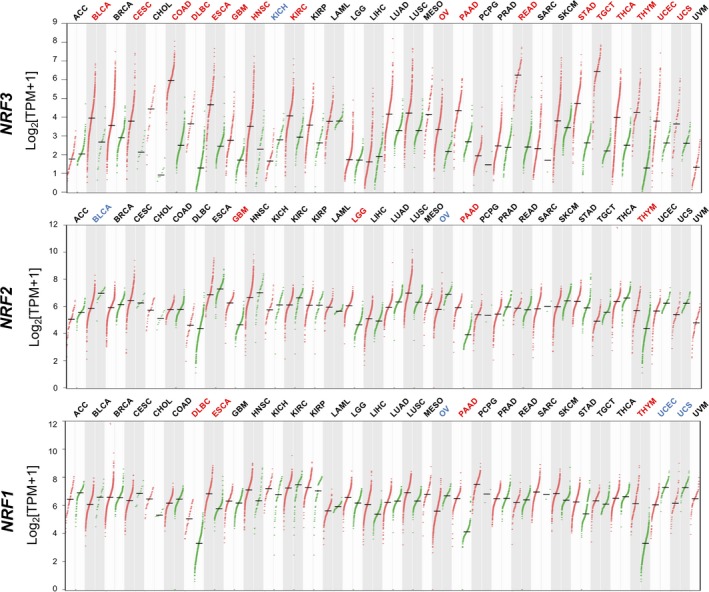
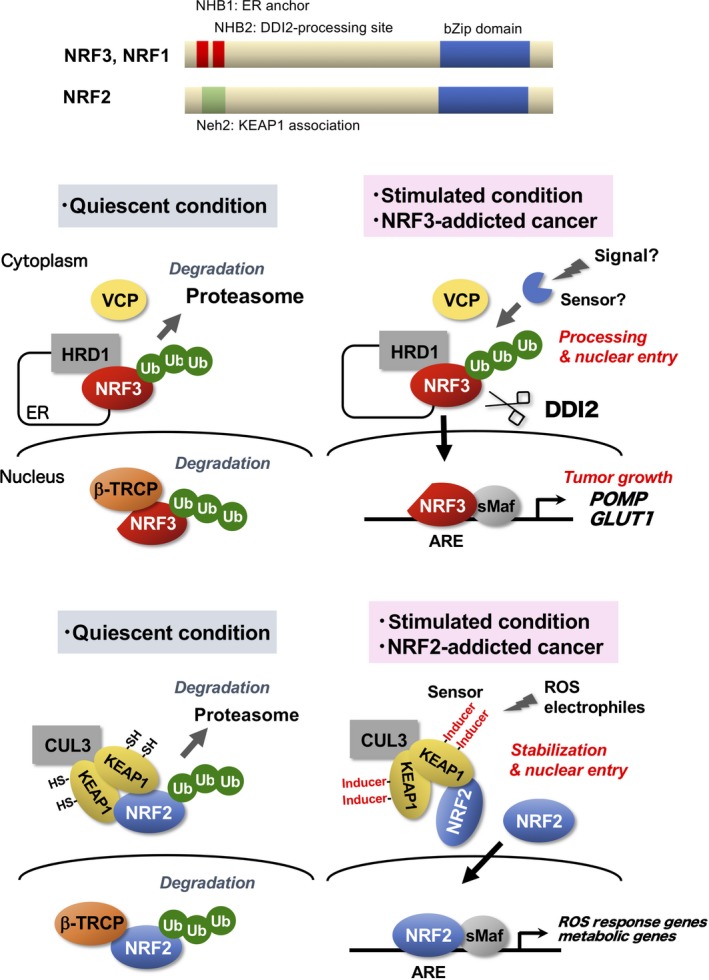
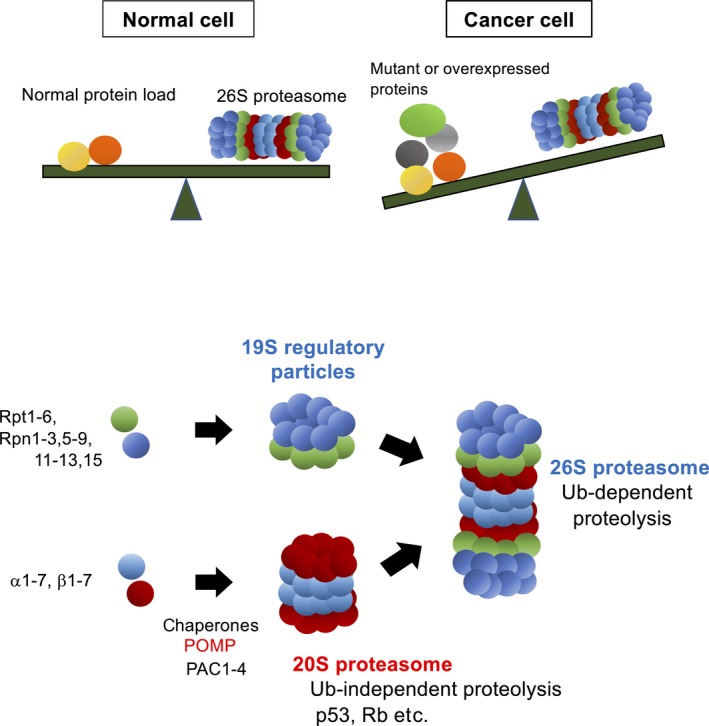
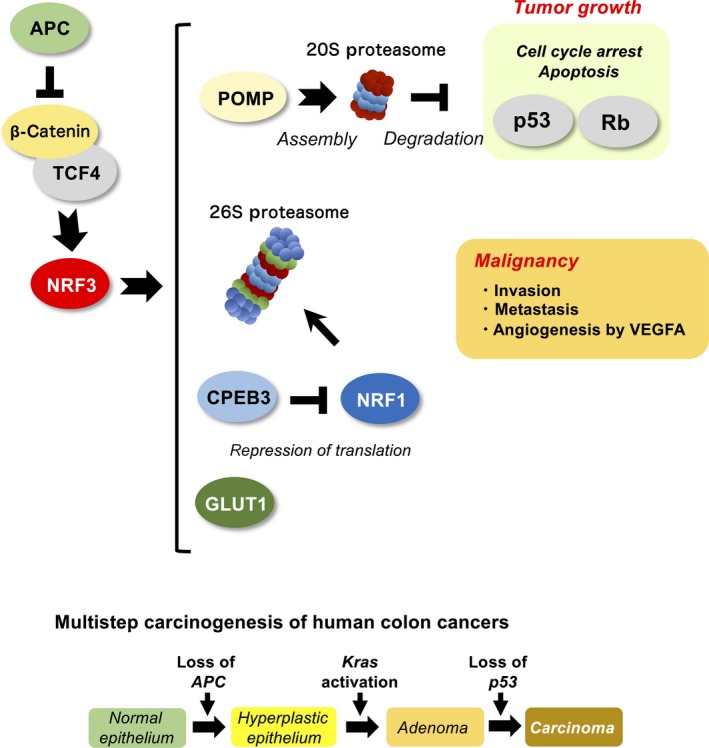
Accumulating evidence has revealed that human cancers develop by sequentially mutating pivotal genes, including driver genes, and acquiring cancer hallmarks. For instance, cancer cells are addicted to the transcription factor NRF2 (NFE2L2), which is a driver gene that utilizes the cellular cytoprotection system against oxidative stress and metabolic pathway reprogramming for sustaining high growth. Our group has recently discovered a new addiction to the NRF2-related factor NRF3 (NFE2L3) in cancer. For many years, the physiological function of NRF3 remained obscure, in part because Nrf3-deficient mice do not show apparent abnormalities. Nevertheless, human cancer genome databases suggest critical roles of NRF3 in cancer because of high NRF3 mRNA induction in several cancer types, such as colorectal cancer and pancreatic adenocarcinoma, with a poor prognosis. We found that NRF3 promotes tumor growth and malignancy by activating ubiquitin-independent 20S proteasome assembly through inducing the expression of the proteasome maturation protein (POMP) chaperone and thereby degrading the tumor suppressors p53 and Rb. The NRF3-POMP-20S proteasome axis has an entirely different effect on cancer than NRF2. In this review, we describe recent research advances regarding the new cancer effector NRF3, including unclarified ubiquitin-independent proteolysis by the NRF3-POMP-20S proteasome axis. The expected development of cancer therapeutic interventions for this axis is also discussed.
越来越多的证据表明,人类癌症的发生是通过依次突变关键基因,包括驱动基因,并获得癌症特征来实现的。例如,癌细胞对转录因子 NRF2(NFE2L2)有依赖性,NRF2 是一种驱动基因,它利用细胞细胞保护系统来对抗氧化应激和代谢途径的重新编程,以维持高生长。我们的小组最近在癌症中发现了对 NRF2 相关因子 NRF3(NFE2L3)的新依赖性。多年来,NRF3 的生理功能仍然不清楚,部分原因是 Nrf3 缺陷小鼠没有表现出明显的异常。然而,人类癌症基因组数据库表明 NRF3 在癌症中具有关键作用,因为几种癌症类型(如结直肠癌和胰腺腺癌)中 NRF3mRNA 的诱导水平较高,预后较差。我们发现,NRF3 通过诱导蛋白酶体成熟蛋白(POMP)伴侣的表达,激活非泛素依赖的 20S 蛋白酶体组装,从而降解肿瘤抑制因子 p53 和 Rb,促进肿瘤生长和恶性转化。NRF3-POMP-20S 蛋白酶体轴对癌症的影响与 NRF2 完全不同。在这篇综述中,我们描述了关于新的癌症效应因子 NRF3 的最新研究进展,包括 NRF3-POMP-20S 蛋白酶体轴的未阐明的非泛素依赖的蛋白水解。还讨论了针对该轴的癌症治疗干预措施的预期发展。