Department of Clinical Sciences, Intervention and Technology, Division of Gynecology and Reproductive Medicine, Karolinska Institutet and Karolinska University Hospital, Stockholm, Sweden.
Ming Wai Lau Centre for Reparative Medicine, Karolinska Institutet, Stockholm, Sweden.
Hum Reprod. 2019 Nov 1;34(11):2297-2310. doi: 10.1093/humrep/dez134.
Does the X chromosome inactivation (XCI) of Klinefelter syndrome (KS)-derived human induced pluripotent stem cells (hiPSCs) correspond to female human pluripotent stem cells (hPSCs) and reflect the KS genotype?
Our results demonstrate for the first time that KS-derived hiPSCs show similar XCI behavior to female hPSCs in culture and show biological relevance to KS genotype-related clinical features.
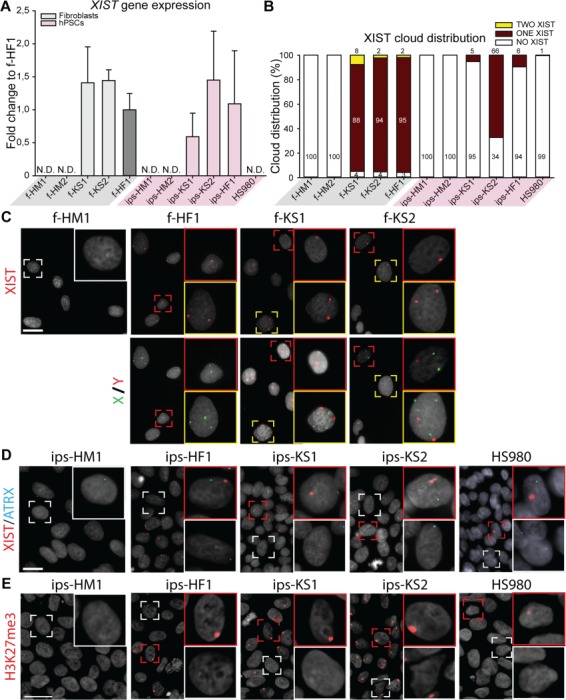
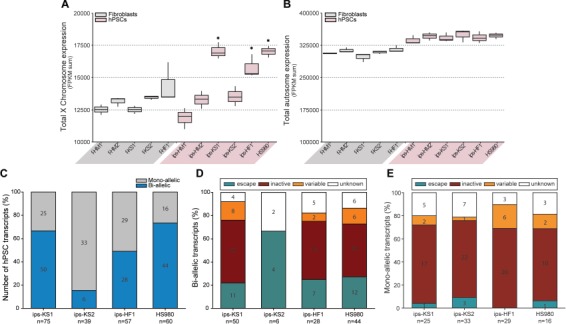
So far, assessment of XCI of KS-derived hiPSCs was based on H3K27me3 staining and X-inactive specific transcript gene expression disregarding the at least three XCI states (XaXi with XIST coating, XaXi lacking XIST coating, and XaXe (partially eroded XCI)) that female hPSCs display in culture.
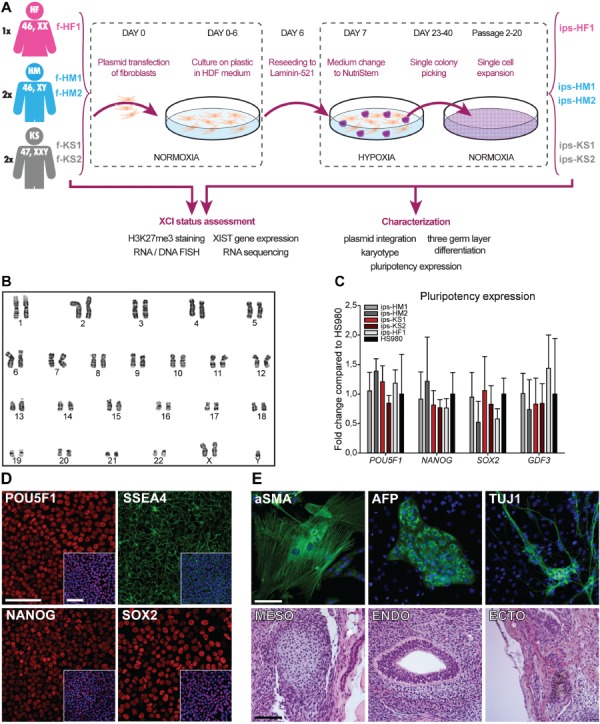
STUDY DESIGN, SIZE, DURATION: The study used hiPSC lines generated from two azoospermic patients with KS and included two healthy male (HM) and one healthy female donor.
PARTICIPANTS/MATERIALS, SETTING, METHODS: In this study, we derived hiPSCs by reprograming fibroblasts with episomal plasmids and applying laminin 521 as culture substrate. hiPSCs were characterized by karyotyping, immunocytochemistry, immunohistochemistry, quantitative PCR, teratoma formation, and embryoid body differentiation. XCI and KS hiPSC relevance were assessed by whole genome transcriptomics analysis and immunocytochemistry plus FISH of KS, HM and female fibroblast, and their hiPSC derivatives.
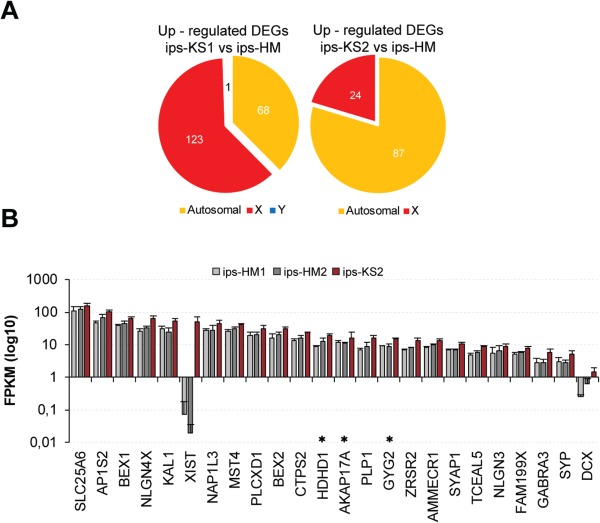
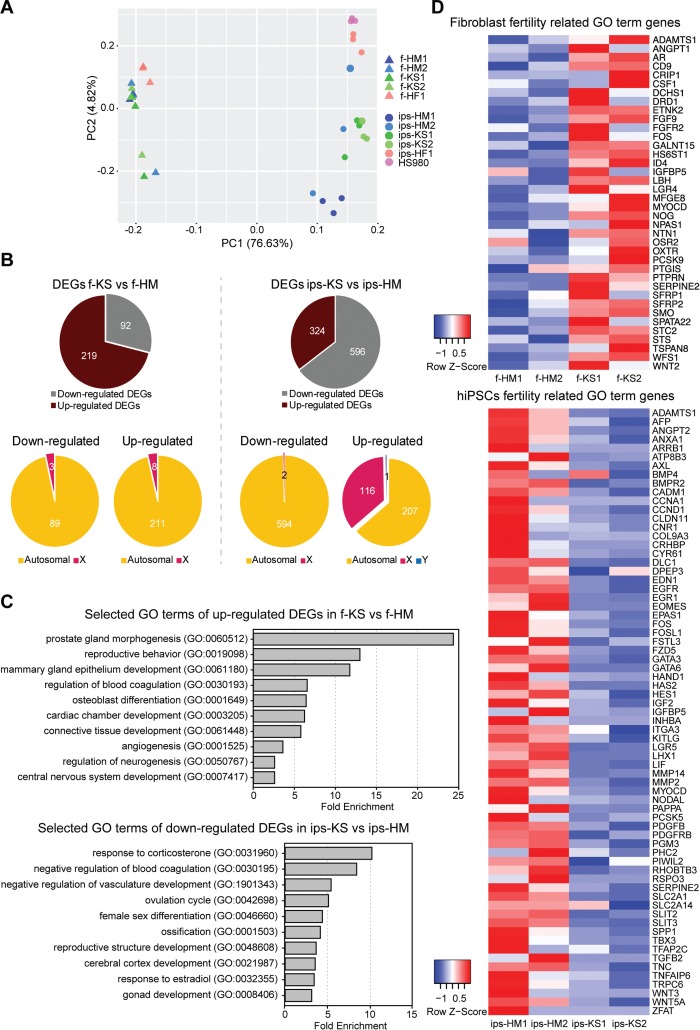
Applying whole genome transcriptomics analysis, we could identify differentially expressed genes (DEGs) between KS and HM donors with enrichment in gene ontology terms associated with fertility, cardiovascular development, ossification, and brain development, all associated with KS genotype-related clinical features. Furthermore, XCI analysis based on transcriptomics data, RNA FISH, and H3K27me3 staining revealed variable XCI states of KS hiPSCs similar to female hiPSCs, showing either normal (XaXi) or eroded (XaXe) XCI. KS hiPSCs with normal XCI showed nevertheless upregulated X-linked genes involved in nervous system development as well as synaptic transmission, supporting the potential use of KS-derived hiPSCs as an in vitro model for KS.
LIMITATIONS, REASONS FOR CAUTION: Detailed clinical information for patients included in this study was not available. Although a correlation between DEGs and the KS genotype could be observed, the biological relevance of these cells has to be confirmed with further experiments. In addition, karyotype analysis for two hiPSC lines was performed at passage 12 but not repeated at a later passage. Nevertheless, since all XCI experiments for those lines were performed between passage 11 and 15 the authors expect no karyotypic changes for those experiments.
As KS patients have variable clinical phenotypes that are influenced by the grade of aneuploidy, mosaicism, origin of the X chromosome, and XCI 'escapee' genes, which vary not only among individuals but also among different tissues within the same individual, differentiated KS hiPSCs could be used for a better understanding of KS pathogenesis.
STUDY FUNDING/COMPETING INTEREST(S): This study was supported by grants from the Knut and Alice Wallenberg Foundation (2016.0121 and 2015.0096), Ming Wai Lau Centre for Reparative Medicine (2-343/2016), Ragnar Söderberg Foundation (M67/13), Swedish Research Council (2013-32485-100360-69), the Centre for Innovative Medicine (2-388/2016-40), Kronprinsessan Lovisas Förening För Barnasjukvård/Stiftelsen Axel Tielmans Minnesfond, Samariten Foundation, Jonasson Center at the Royal Institute of Technology, Sweden, and Initial Training Network Marie Curie Program 'Growsperm' (EU-FP7-PEOPLE-2013-ITN 603568). The authors declare no conflicts of interest.
克氏综合征(KS)衍生的人诱导多能干细胞(hiPSC)的 X 染色体失活(XCI)是否与女性人类多能干细胞(hPSC)相对应,并反映 KS 基因型?
我们的研究结果首次表明,KS 衍生的 hiPSC 在培养过程中表现出与女性 hPSC 相似的 XCI 行为,并与 KS 基因型相关的临床特征具有生物学相关性。
到目前为止,对 KS 衍生的 hiPSC 的 XCI 评估是基于 H3K27me3 染色和 X 失活特异性转录本基因表达进行的,而忽略了女性 hPSC 在培养中显示的至少三种 XCI 状态(带有 XIST 涂层的 XaXi、缺乏 XIST 涂层的 XaXi 和部分侵蚀的 XaXe(部分侵蚀的 XCI))。
研究设计、规模、持续时间:本研究使用来自两名无精子症 KS 患者的 hiPSC 系,包括两名健康男性(HM)和一名健康女性供体。
参与者/材料、设置、方法:在这项研究中,我们通过使用附加型质粒重编程成纤维细胞,并应用层粘连蛋白 521 作为培养底物来产生 hiPSC。通过核型分析、免疫细胞化学、免疫组织化学、定量 PCR、畸胎瘤形成和类胚体分化对 hiPSC 进行鉴定。通过全基因组转录组分析和 KS、HM 和女性成纤维细胞及其 hiPSC 衍生物的免疫细胞化学加 FISH,评估 XCI 和 KS hiPSC 的相关性。
通过全基因组转录组分析,我们可以识别出 KS 和 HM 供体之间的差异表达基因(DEGs),这些基因富集在与生育、心血管发育、骨化和大脑发育相关的基因本体术语中,这些术语都与 KS 基因型相关的临床特征相关。此外,基于转录组数据、RNA FISH 和 H3K27me3 染色的 XCI 分析显示,KS hiPSC 的 XCI 状态存在差异,类似于女性 hiPSC,表现为正常(XaXi)或侵蚀(XaXe)XCI。具有正常 XCI 的 KS hiPSC 仍然表现出上调的与神经系统发育和突触传递相关的 X 连锁基因,支持使用 KS 衍生的 hiPSC 作为 KS 的体外模型。
局限性、谨慎的原因:本研究中包含的患者的详细临床信息不可用。尽管可以观察到 DEGs 与 KS 基因型之间的相关性,但这些细胞的生物学相关性需要通过进一步的实验来证实。此外,对两条 hiPSC 系的核型分析在第 12 代进行,但在以后的代没有重复。然而,由于这些系的所有 XCI 实验都在第 11 代和第 15 代之间进行,作者预计这些实验不会发生核型变化。
由于 KS 患者具有不同的临床表型,这些表型受到非整倍体、嵌合体、X 染色体来源和 XCI“逃逸”基因的程度的影响,这些基因不仅在个体之间而且在同一个体的不同组织之间都存在差异,因此分化的 KS hiPSC 可用于更好地理解 KS 的发病机制。
研究资金/竞争利益:本研究得到了 Knut 和 Alice Wallenberg 基金会(2016.0121 和 2015.0096)、明华娄中心修复医学(2-343/2016)、Ragnar Söderberg 基金会(M67/13)、瑞典研究委员会(2013-32485-100360-69)、创新医学中心(2-388/2016-40)、 Kronprinsessan Lovisas Förening För Barnasjukvård/Stiftelsen Axel Tielmans Minnesfond、 Samariten 基金会、皇家理工学院 Jonasson 中心以及欧盟 FP7-PEOPLE-2013-ITN 603568 的初始培训网络“Growsperm”的支持。作者没有利益冲突。