Department of Physical Chemistry, Medical University of Lublin, Chodźki 4a, 20-093, Lublin, Poland.
Sci Rep. 2019 Nov 19;9(1):17103. doi: 10.1038/s41598-019-53468-9.
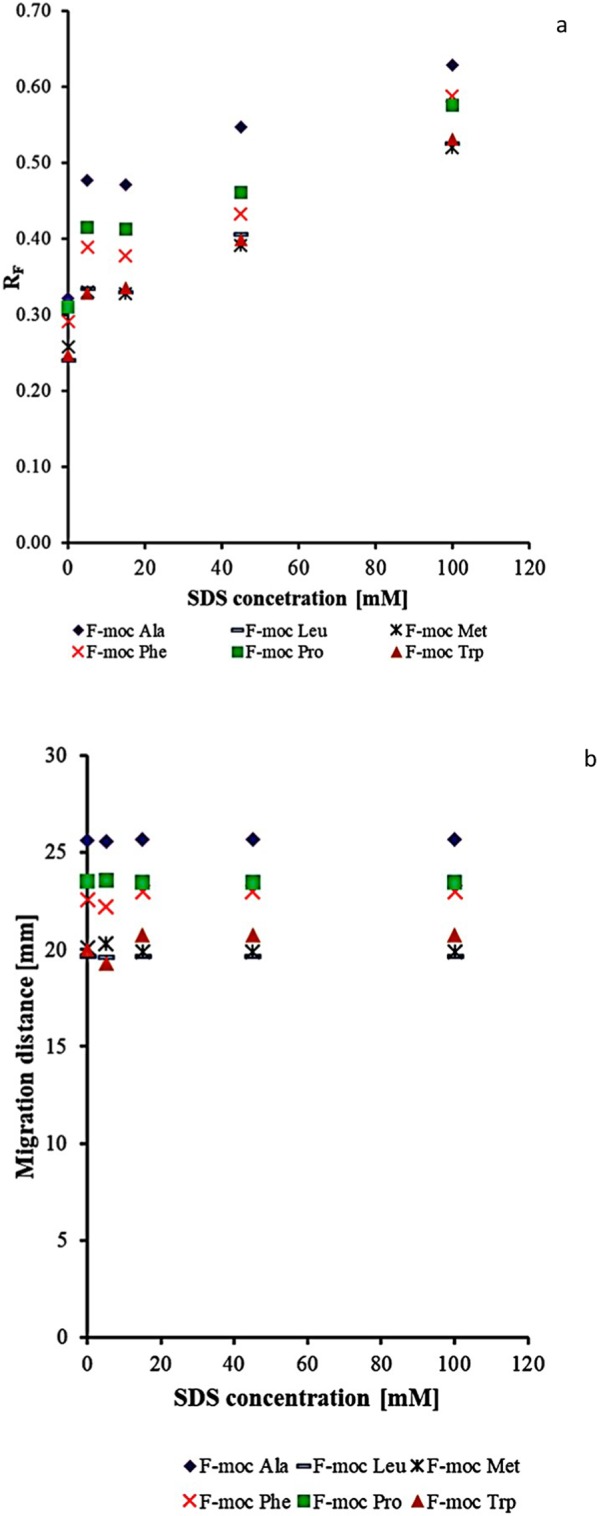
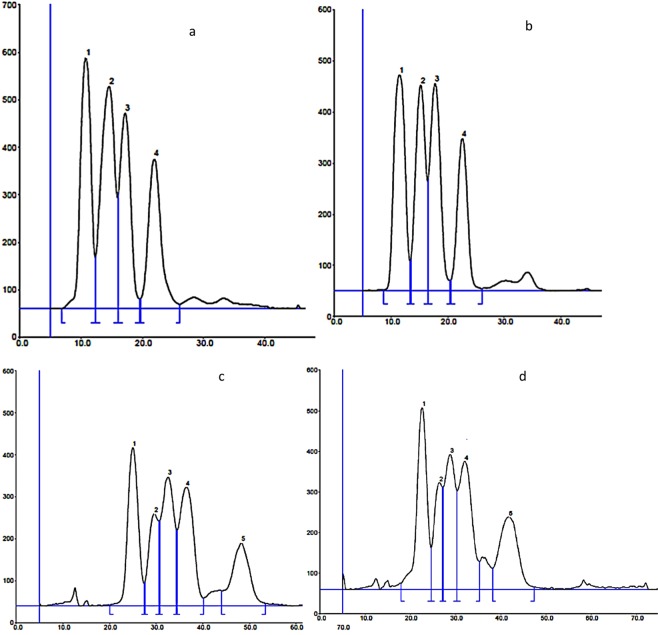
The problems with separation of amino acid mixtures in reversed-phase mode are the result of their hydrophilic nature. The derivatisation of the amino group of mentioned above solutes leads to their solution. For this purpose, 9-fluorenylmethoxycarbonyl chloroformate (f-moc-Cl) as the derivatisation reagent is often used. In our study, the separation of some f-moc- amino acid derivatives (alanine, phenylalanine, leucine, methionine, proline and tryptophan) with the use of micellar systems of reversed-phase high-performance thin-layer chromatography (HPTLC) and pressurized planar electrochromatography (PPEC) is investigated. The effect of surfactant concentration, its type (anionic, cationic and non-ionic) and mobile phase buffer pH on the discussed above solute migration distances are presented. Our work reveals that the increase of sodium dodecylsulphate concentration in the mobile phase has a different effect on solute retention in HPTLC and PPEC. Moreover, it also affects the order of solutes in both techniques. In PPEC, in contrast to the HPTLC technique, the mobile phase pH affects solute retention. The type of surfactant in the mobile phase also impacts solute retention and migration distances. A mobile phase containing SDS improves system efficiency in both techniques. Herein, such an effect is presented for the first time.
反相模式下氨基酸混合物分离存在问题的原因在于其亲水性。上述溶质氨基的衍生化可使其溶解。为此,通常使用 9-芴甲氧羰基氯甲酸酯(FMOC-Cl)作为衍生化试剂。在我们的研究中,考察了胶束体系反相高效薄层色谱(HPTLC)和加压平面电色谱(PPEC)分离一些 FMOC-氨基酸衍生物(丙氨酸、苯丙氨酸、亮氨酸、蛋氨酸、脯氨酸和色氨酸)的情况。研究了表面活性剂浓度、类型(阴离子型、阳离子型和非离子型)和流动相缓冲液 pH 对上述溶质迁移距离的影响。我们的工作表明,流动相中十二烷基硫酸钠浓度的增加对 HPTLC 和 PPEC 中溶质保留的影响不同。此外,它还影响两种技术中溶质的顺序。与 HPTLC 技术相反,在 PPEC 中,流动相 pH 会影响溶质保留。流动相中表面活性剂的类型也会影响溶质保留和迁移距离。含有 SDS 的流动相可提高两种技术的系统效率。本文首次报道了这种效应。