Nisbet Haylea, Migdisov Artas A, Williams-Jones Anthony E, Xu Hongwu, van Hinsberg Vincent J, Roback Robert
Earth and Environmental Sciences Division, Los Alamos National Laboratory, Los Alamos, NM, 87545, USA.
Department of Earth and Planetary Sciences, McGill University, 3450 University Street, Montreal, QC, H3A 0E8, Canada.
Sci Rep. 2019 Nov 19;9(1):17035. doi: 10.1038/s41598-019-53571-x.
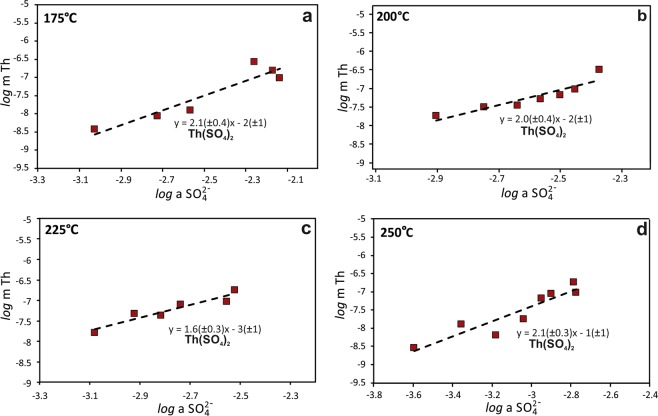
Thorium is the most abundant actinide in the Earth's crust and has universally been considered one of the most immobile elements in natural aqueous systems. This view, however, is based almost exclusively on solubility data obtained at low temperature and their theoretical extrapolation to elevated temperature. The occurrence of hydrothermal deposits with high concentrations of Th challenges the Th immobility paradigm and strongly suggests that Th may be mobilized by some aqueous fluids. Here, we demonstrate experimentally that Th, indeed, is highly mobile at temperatures between 175 and 250 °C in sulfate-bearing aqueous fluids due to the formation of the highly stable Th(SO) aqueous complex. The results of this study indicate that current models grossly underestimate the mobility of Th in hydrothermal fluids, and thus the behavior of Th in ore-forming systems and the nuclear fuel cycle needs to be re-evaluated.
钍是地壳中含量最丰富的锕系元素,一直被普遍认为是天然水体系中最不易迁移的元素之一。然而,这一观点几乎完全基于低温下获得的溶解度数据及其向高温的理论外推。富含钍的热液矿床的存在对钍不易迁移的范式提出了挑战,并有力地表明钍可能会被某些含水流体迁移。在此,我们通过实验证明,由于形成了高度稳定的Th(SO)水络合物,钍在175至250°C的含硫酸盐水流体中确实具有很高的迁移性。这项研究的结果表明,目前的模型严重低估了钍在热液流体中的迁移性,因此需要重新评估钍在成矿系统和核燃料循环中的行为。