Bennaghmouch N, de Veer A J W M, Zivelonghi C, van Dijk L, Ten Berg J M
Department of Cardiology, St. Antonius Hospital, Nieuwegein, The Netherlands.
Department of Pharmaceutical Care, Netherlands Institute for Health Services Research (NIVEL), Utrecht, The Netherlands.
Neth Heart J. 2019 Dec;27(12):596-604. doi: 10.1007/s12471-019-01331-x.
Non-vitamin‑K oral anticoagulants (NOACs) are recommended as the first-choice therapy for stroke prevention in patients with non-valvular atrial fibrillation (AF). However, the lack of monitoring may impact patients' adherence, and non-adherence to medication is a potential hazard to safe and efficacious use. This is the first report with a 'comparative patient-oriented perspective' regarding the use of anticoagulant medication in the NOACs era. Our aim was to compare patients' self-reported practical problems, adverse events and non-adherence to anticoagulation therapy.
A survey was conducted among patients with AF on either NOACs or vitamin‑K antagonists (VKAs). The outcomes were self-reported non-adherence to anticoagulant medication, and patients' experiences, adverse events and practical problems correlated with the intake of the drug itself.
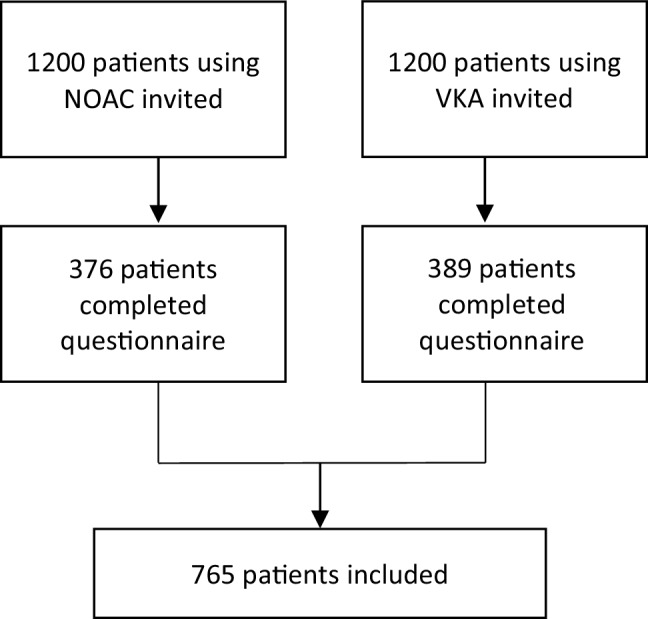
A total of 765 patients filled out the questionnaire, of which 389 (50.9%) were on VKAs and 376 (49.1%) on NOACs. Age (70.6 ± 8.8 vs 70.3 ± 9.1 years) and male gender (70.4% vs 64.6%) were similar in the two groups. A significantly higher proportion of VKA users than NOAC users reported having frequent (16.2% vs 3.7%, p > 0.001) or occasional (4.1% vs 1.3%, p > 0.001) practical issues with medication intake. Self-reported non-adherence was significantly higher (24.4% vs 18.1%, p = 0.03) among VKA users. The incidence of self-reported adverse events was similar.
Patient experiences support the current guideline recommendations for NOACs as the first-choice therapy: NOAC therapy resulted in a higher practical feasibility and better adherence when compared with VKA therapy, with a similar incidence of adverse events in both groups.
非维生素K口服抗凝药(NOACs)被推荐作为非瓣膜性心房颤动(AF)患者预防中风的首选治疗方法。然而,缺乏监测可能会影响患者的依从性,而不坚持服药对安全有效地使用药物是一个潜在危害。这是关于NOACs时代抗凝药物使用的首份具有“以患者为导向的比较视角”的报告。我们的目的是比较患者自我报告的实际问题、不良事件以及对抗凝治疗的不依从情况。
对服用NOACs或维生素K拮抗剂(VKAs)的AF患者进行了一项调查。结果是自我报告的抗凝药物不依从情况,以及与药物摄入本身相关的患者经历、不良事件和实际问题。
共有765名患者填写了问卷,其中389名(50.9%)服用VKAs,376名(49.1%)服用NOACs。两组患者的年龄(70.6±8.8岁 vs 70.3±9.1岁)和男性比例(70.4% vs 64.6%)相似。报告在药物摄入方面经常(16.2% vs 3.7%,p>0.001)或偶尔(4.1% vs 1.3%,p>0.001)出现实际问题的VKA使用者比例显著高于NOAC使用者。VKA使用者中自我报告的不依从率显著更高(24.4% vs 18.1%,p=0.03)。自我报告的不良事件发生率相似。
患者的经历支持当前指南将NOACs作为首选治疗方法的建议:与VKA治疗相比,NOAC治疗具有更高的实际可行性和更好的依从性,两组不良事件发生率相似。