Internal Medicine Clinic, Sundsvall hospital, 856 43, Sundsvall, Sweden.
Department of Public Health and Clinical Medicine, Umeå University, Umeå, 981 87, Sweden.
J Thromb Thrombolysis. 2023 Jul;56(1):55-64. doi: 10.1007/s11239-023-02797-8. Epub 2023 Apr 29.
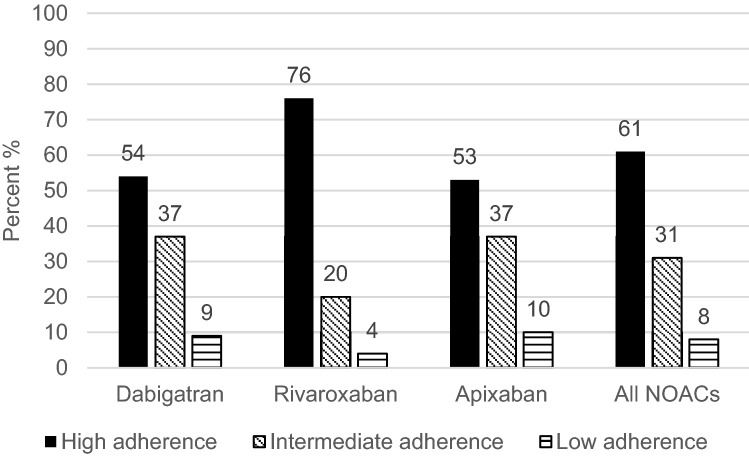
Data regarding adherence and minor bleeding on direct oral anticoagulants in everyday life are still sparse. Inclusion criteria: treatment initiated with dabigatran, rivaroxaban or apixaban in non-valvular atrial fibrillation patients from a center in northern Sweden between 2011 and 2019 (n = 668). Exclusion criteria: cognitive impairment, dose dispensing, need of interpreter or hospital admission (n = 67). By a telephone interview adherence was measured in 569 patients (response rate 94.8%) using the 8-item Morisky medication adherence scale and minor bleeding was asked for. CHADS-VASc and HAS-BLED scores were collected from medical records. The number (n), mean age, mean treatment duration, mean (points) CHADS-VASc and HAS-BLED scores was with dabigatran (n = 175, 73.3 years, 17.8 months, 3.6 p and 2.2 p), rivaroxaban (n = 198, 73.7 years, 21months, 3.8 p and 2.1 p) and apixaban (n = 196, 72.7 years, 15.2 months, 3.4 p and 2.1 p). Adherence was high for dabigatran, rivaroxaban and apixaban in 54%, 76% and 53%; intermediate in 37%, 20% and 37% or low in 9%, 4% and 10% respectively. High adherence (Morisky score 8) distinguished rivaroxaban (p < 0.0001) and in patients with CHADS-VASc ≥ 4 p, (p < 0.0001). Patients on rivaroxaban/apixaban reported more minor bleedings (37% / 28%) compared to dabigatran (13%), (p < 0.001). Only 61% of the patients followed prescription. Adherence to rivaroxaban was significantly better, maybe due to the once daily dosing regimen, and furthermore among patients with higher risk for stroke. Minor bleedings were less common in the dabigatran group. The impact of minor bleedings on adherence and a possible relationship to clinical outcomes need to be further studied.
关于直接口服抗凝剂在日常生活中的依从性和轻微出血的数据仍然很少。纳入标准:2011 年至 2019 年期间,在瑞典北部的一个中心,用达比加群、利伐沙班或阿哌沙班治疗非瓣膜性心房颤动患者(n=668)。排除标准:认知障碍、剂量配给、需要翻译或住院治疗(n=67)。通过电话访谈,对 569 名患者(应答率 94.8%)进行了依从性测量,使用 8 项 Morisky 药物依从性量表,并询问了轻微出血情况。从病历中收集 CHADS-VASc 和 HAS-BLED 评分。达比加群(n=175,73.3 岁,17.8 个月,3.6 分和 2.2 分)、利伐沙班(n=198,73.7 岁,21 个月,3.8 分和 2.1 分)和阿哌沙班(n=196,72.7 岁,15.2 个月,3.4 分和 2.1 分)的患者人数(n)、平均年龄、平均治疗持续时间、平均(分)CHADS-VASc 和 HAS-BLED 评分。达比加群、利伐沙班和阿哌沙班的依从性分别为 54%、76%和 53%;中间组分别为 37%、20%和 37%或低组分别为 9%、4%和 10%。达比加群、利伐沙班和阿哌沙班中,高依从性(Morisky 评分 8)分别为瑞伐沙班(p<0.0001)和 CHADS-VASc≥4 分(p<0.0001)。与达比加群(13%)相比,服用利伐沙班/阿哌沙班的患者(37%/28%)报告的轻微出血更多(p<0.001)。只有 61%的患者遵循处方。利伐沙班的依从性明显更好,这可能是由于其每日一次的给药方案,而且在中风风险较高的患者中更是如此。达比加群组的轻微出血较少。轻微出血对依从性的影响以及与临床结果的可能关系需要进一步研究。