First Department of Medicine, Faculty of Medicine, University Medical Centre Mannheim (UMM), University of Heidelberg, Mannheim, Germany.
DZHK (German Center for Cardiovascular Research), Partner Site, Heidelberg-Mannheim, Mannheim, Germany.
Ann Noninvasive Electrocardiol. 2020 May;25(3):e12723. doi: 10.1111/anec.12723. Epub 2019 Nov 20.
The Brugada syndrome is associated with arrhythmic events, which may even lead to sudden cardiac death (SCD) as it causes arrhythmic events. A typical Brugada syndrome ECG type I can be triggered at fever situations. The aim of this pooled meta-analysis is to further explore the baseline characteristics and the association of fever to BrS-related arrhythmic events.
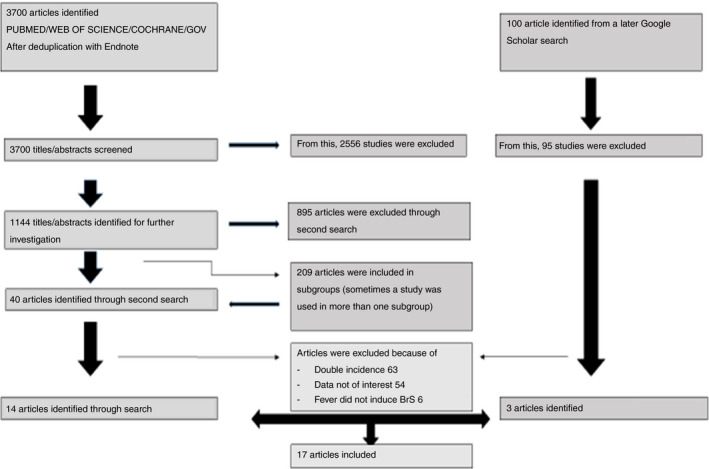
We compiled data from a search of databases (PubMed, Web of Science, Cochrane Library, and Google Scholar). We included 17 studies including 14 case reports and a total of 53 patients.
Our population including 53 patients showed a male predominance of 92% with a mean age of 40.6 ± 17.7 years. 58% of patients had a family history of SCD or BrS. Genetic screening was performed in 14 patients (26%) and revealed a SCN5A mutation in 21% of the patients. ICD implantation was initiated in six patients. 75% (n = 39) of patients did not have symptoms before the fever event. Symptoms at fever included life-threatening arrhythmia such as ventricular fibrillation (VF) or ventricular tachycardia (VT; 17%), syncope (13%), and cardiac arrest or aborted SCD (13%). One patient developed electrical storm which led to not aborted SCD.
Fever is a great risk factor for arrhythmia events in BrS patients. Patients with known fever triggered Brugada syndrome should be surveilled closely during fever and be started on antipyretic therapy as soon as possible.
Brugada 综合征与心律失常事件相关,可能导致心脏性猝死(SCD),因为它会引发心律失常事件。典型的 Brugada 综合征心电图 I 型可在发热情况下被触发。本荟萃分析旨在进一步探讨基础特征以及发热与 BrS 相关心律失常事件的关系。
我们从数据库(PubMed、Web of Science、Cochrane Library 和 Google Scholar)中搜索数据。我们纳入了 17 项研究,包括 14 例病例报告,共计 53 例患者。
我们的研究人群包括 53 例患者,其中男性占 92%,平均年龄为 40.6±17.7 岁。58%的患者有 SCD 或 BrS 家族史。对 14 名患者(26%)进行了基因筛查,发现 21%的患者存在 SCN5A 突变。6 名患者植入了 ICD。75%(n=39)的患者在发热事件前无症状。发热时的症状包括危及生命的心律失常,如心室颤动(VF)或室性心动过速(VT;17%)、晕厥(13%)、心脏骤停或 SCD 中止(13%)。1 名患者发生电风暴,导致 SCD 中止。
发热是 BrS 患者心律失常事件的一个重要危险因素。已知发热触发 Brugada 综合征的患者在发热期间应密切监测,并尽快开始退热治疗。