Division of Endocrinology and Metabolism, Chang Gung Memorial Hospital Linkou Main Branch, Taoyuan, Taiwan.
Southwestern Academic Limb Salvage Alliance (SALSA), Department of Surgery, Keck School of Medicine of University of Southern California (USC), Los Angeles, California, USA.
BMJ Open Diabetes Res Care. 2019 Oct 11;7(1):e000795. doi: 10.1136/bmjdrc-2019-000795. eCollection 2019.
To study the prevalence and trends of lower extremity complications of diabetes over an 8-year period in a single nation.
Nationwide data for people with type 2 diabetes (T2D) and diabetic foot complications (DFCs) were analyzed over an 8-year period (2007-2014) from National Health Insurance Research Database using the International Classification of Diseases, Ninth Revision disease coding. The DFCs were defined as ulcers, infections, gangrene, and hospitalization for peripheral arterial disease (PAD). Trends of patient characteristics, foot presentation, and the execution of major procedures were studied, including lower-extremity amputations (LEAs).
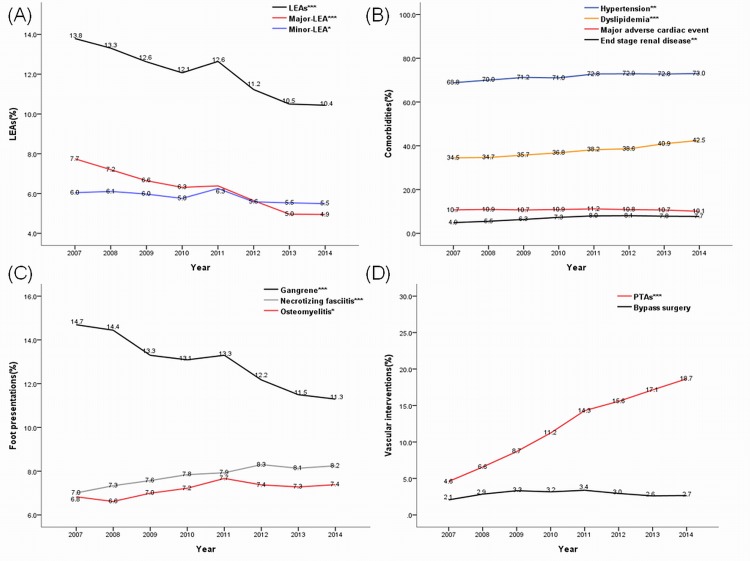
Along with the T2D population increasing over time, the absolute number of people with DFCs increased by 33.4%, but retained a prevalence of around 2% per year. The annual incident of LEAs decreased from 2.85 to 2.06 per 1000 T2D population (p=0.001) with the major LEA proportion decreasing from 56.2% to 47.4% (p<0.001).The mean age of patients increased from 65.3 to 66.3 years and most of the associated comorbidities of diabetes were increased. For example, end-stage renal disease increased from 4.9% to 7.7% (p=0.008). The incidence of gangrene on presentation decreased from 14.7% to 11.3% (p<0.001) with a concomitant increase in vascular interventions (6.2% to 19.5%, p<0.001).
DFCs remain a sustained major medical problem. These nationwide long-term data suggest trends toward older people with greater comorbidities such as PAD and renal disease. Nevertheless, promising trends of reducing gangrene on presentation paired with increases in vascular interventions support continued vigilance and rapid, coordinated interdisciplinary diabetic foot care.
研究一个国家在 8 年内下肢糖尿病并发症的患病率和趋势。
利用国家健康保险研究数据库中的国际疾病分类第 9 版疾病编码,对 8 年内(2007-2014 年)的 2 型糖尿病(T2D)患者和糖尿病足并发症(DFC)患者进行全国范围内的数据分析。DFC 定义为溃疡、感染、坏疽和外周动脉疾病(PAD)住院。研究了患者特征、足部表现以及主要手术的执行情况,包括下肢截肢(LEA)。
随着 T2D 人群的增加,DFC 患者的绝对数量增加了 33.4%,但每年的患病率仍保持在 2%左右。LEA 的年发病率从每 1000 例 T2D 人群 2.85 例降至 2.06 例(p=0.001),主要 LEA 比例从 56.2%降至 47.4%(p<0.001)。患者的平均年龄从 65.3 岁增至 66.3 岁,大多数糖尿病相关合并症也有所增加。例如,终末期肾病从 4.9%增加到 7.7%(p=0.008)。就诊时坏疽的发生率从 14.7%降至 11.3%(p<0.001),同时血管介入治疗的比例也从 6.2%增加到 19.5%(p<0.001)。
DFC 仍然是一个持续存在的重大医疗问题。这些全国范围内的长期数据表明,患者人群呈现出年龄更大、合并症更多的趋势,如 PAD 和肾脏疾病。然而,在就诊时减少坏疽的趋势以及增加血管介入治疗的趋势表明,需要继续保持警惕,采取快速、协调的跨学科糖尿病足护理措施。