IEEE Trans Neural Syst Rehabil Eng. 2020 Jan;28(1):350-358. doi: 10.1109/TNSRE.2019.2955029. Epub 2019 Nov 21.
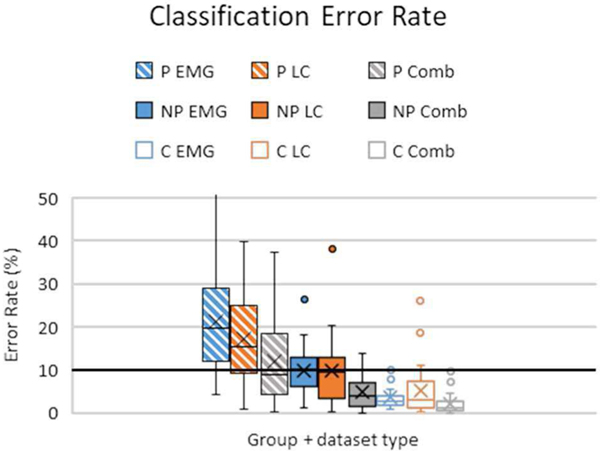
Stroke remains the leading cause of long-term disability in the US. Although therapy can achieve limited improvement of paretic arm use and performance, weakness and abnormal muscle synergies-which cause unintentional elbow, wrist, and finger flexion during shoulder abduction-contribute significantly to limb disuse and compound rehabilitation efforts. Emerging wearable exoskeleton technology could provide powered abduction support for the paretic arm, but requires a clinically feasible, robust control scheme capable of differentiating multiple shoulder degrees-of-freedom. This study examines whether pattern recognition of sensor data can accurately identify user intent for 9 combinations of 1- and 2- degree-of-freedom shoulder tasks. Participants with stroke (n = 12) used their paretic and non-paretic arms, and healthy controls (n = 12) used their dominant arm to complete tasks on a lab-based robot involving combinations of abduction, adduction, and internal and external rotation of the shoulder. We examined the effect of arm (paretic, non-paretic), load level (25% vs 50% maximal voluntary torque), and dataset (electromyography, load cell, or combined) on classifier performance. Results suggest that paretic arm, lower load levels, and using load cell or EMG data alone reduced classifier accuracy. However, this method still shows promise. Further work will examine classifier-user interaction during active control of a robotic device and optimization/minimization of sensors.
中风仍然是美国长期残疾的主要原因。尽管治疗可以实现对瘫痪手臂使用和性能的有限改善,但手臂无力和异常肌肉协同作用(导致在肩部外展期间无意识地弯曲肘部、手腕和手指)极大地导致肢体废用和影响康复效果。新兴的可穿戴式外骨骼技术可以为瘫痪的手臂提供外展支撑,但需要一种临床可行的、强大的控制方案,能够区分多个肩部自由度。本研究探讨了传感器数据的模式识别是否可以准确识别 9 种 1 至 2 自由度肩部任务组合的用户意图。中风患者(n=12)使用他们的瘫痪侧和非瘫痪侧手臂,健康对照组(n=12)使用他们的优势手臂在实验室机器人上完成涉及肩部外展、内收以及内旋和外旋的组合任务。我们研究了手臂(瘫痪侧、非瘫痪侧)、负载水平(最大自主扭矩的 25%与 50%)以及数据集(肌电图、负载传感器或组合)对分类器性能的影响。结果表明,瘫痪侧手臂、较低的负载水平以及单独使用负载传感器或肌电图数据会降低分类器的准确性。然而,这种方法仍然具有潜力。进一步的研究将检查在机器人设备的主动控制过程中分类器与用户的交互以及传感器的优化/最小化。