MTA-DE Public Health Research Group of the Hungarian Academy of Sciences, Public Health Research Institute, University of Debrecen, 4028 Debrecen, Hungary.
Doctorial School of Health Sciences, University of Debrecen, 4028 Debrecen, Hungary.
Genes (Basel). 2019 Nov 19;10(11):942. doi: 10.3390/genes10110942.
In a previous survey, an elevated fasting glucose level (FG) and/or known type 2 diabetes mellitus (T2DM) were significantly more frequent in the Roma population than in the Hungarian general population. We assessed whether the distribution of 16 single nucleotide polymorphisms (SNPs) with unequivocal effects on the development of T2DM contributes to this higher prevalence.
Genetic risk scores, unweighted (GRS) and weighted (wGRS), were computed and compared between the study populations. Associations between GRSs and FG levels and T2DM status were investigated in separate and combined study populations.
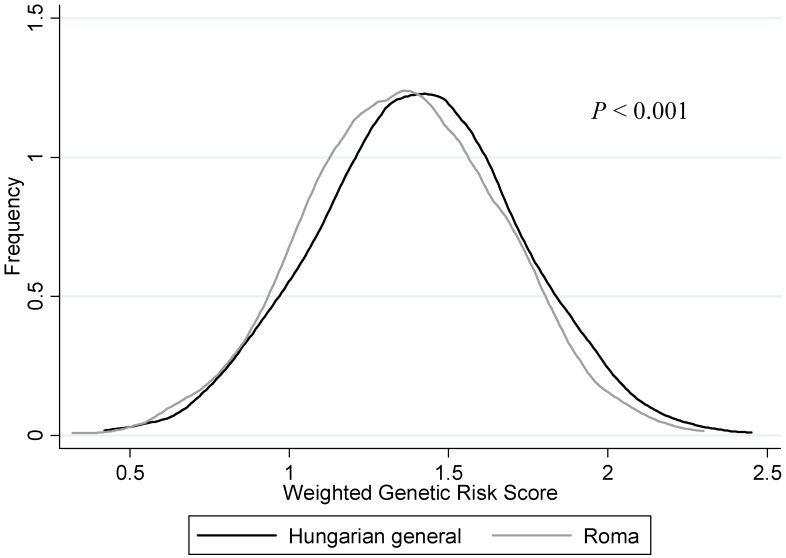
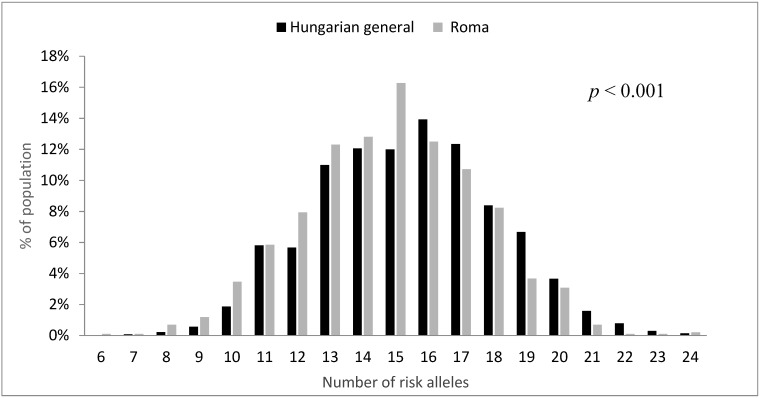
The Hungarian general population carried a greater genetic risk for the development of T2DM (GRS = 15.38 ± 2.70 vs. GRS = 14.80 ± 2.68, < 0.001; wGRS = 1.41 ± 0.32 vs. wGRS = 1.36 ± 0.31, < 0.001). In the combined population models, GRSs and wGRSs showed significant associations with elevated FG ( < 0.001) and T2DM ( < 0.001) after adjusting for ethnicity, age, sex, body mass index (BMI), high-density Lipoprotein Cholesterol (HDL-C), and triglyceride (TG). In these models, the effect of ethnicity was relatively strong on both outcomes (FG levels: βethnicity = 0.918, < 0.001; T2DM status: OR = 2.484, < 0.001).
The higher prevalence of elevated FG and/or T2DM among Roma does not seem to be directly linked to their increased genetic load but rather to their environmental/cultural attributes. Interventions targeting T2DM prevention among Roma should focus on harmful environmental exposures related to their unhealthy lifestyle.
在之前的一项调查中,与匈牙利普通人群相比,罗姆人族群的空腹血糖水平(FG)升高和/或已知的 2 型糖尿病(T2DM)更为常见。我们评估了 16 个单核苷酸多态性(SNP)的分布情况,这些 SNP 对 T2DM 的发生有明确的影响,其是否有助于这一更高的患病率。
计算了研究人群的遗传风险评分(GRS),未加权(GRS)和加权(wGRS),并对其进行了比较。在单独和联合研究人群中,研究了 GRS 与 FG 水平和 T2DM 状态之间的关系。
与匈牙利普通人群相比,匈牙利普通人群携带的 T2DM 发展遗传风险更大(GRS = 15.38 ± 2.70 与 GRS = 14.80 ± 2.68,< 0.001;wGRS = 1.41 ± 0.32 与 wGRS = 1.36 ± 0.31,< 0.001)。在联合人群模型中,调整了种族、年龄、性别、体重指数(BMI)、高密度脂蛋白胆固醇(HDL-C)和甘油三酯(TG)后,GRS 和 wGRS 与 FG 升高(< 0.001)和 T2DM(< 0.001)显著相关。在这些模型中,种族对这两个结果的影响相对较强(FG 水平:βethnicity = 0.918,< 0.001;T2DM 状态:OR = 2.484,< 0.001)。
罗姆人 FG 升高和/或 T2DM 患病率较高的原因似乎并不是由于他们遗传负荷的增加,而是由于他们的环境/文化特征。针对罗姆人 T2DM 预防的干预措施应侧重于与他们不健康的生活方式有关的有害环境暴露。