Di Mola Ida, Ottaiano Lucia, Cozzolino Eugenio, Senatore Mauro, Giordano Maria, El-Nakhel Christophe, Sacco Adriana, Rouphael Youssef, Colla Giuseppe, Mori Mauro
Department of Agricultural Sciences, University of Naples Federico II, 80055 Portici, Italy.
Council for Agricultural Research and Economics (CREA)-Research Center for Cereal and Industrial Crops, 81100 Caserta, Italy.
Plants (Basel). 2019 Nov 19;8(11):522. doi: 10.3390/plants8110522.
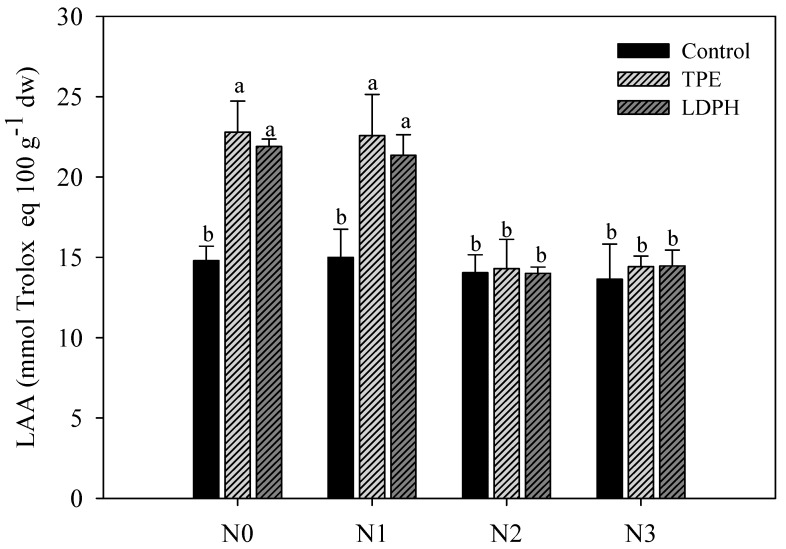
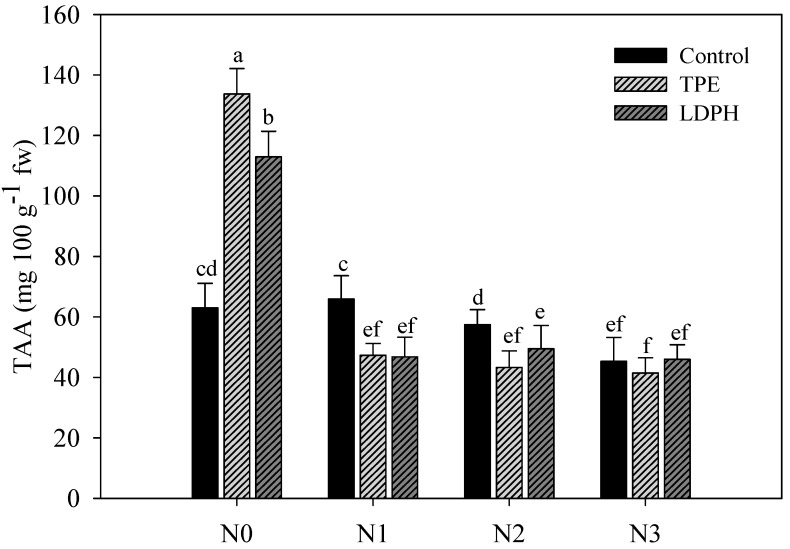
Nitrogen is the primary technical means responsible for food production increase, but on the other hand, wise management is needed because its excessive use can have a negative impact on the environment and on green leafy vegetable quality, such as that rocket. Rocket has the characteristics of accumulating nitrate in leaves with possible impacts on human health. In order to overcome this issue, researchers are focusing their attention on the use of alternative means, such as plant biostimulant application. The scope of this study was to assess the effect of legume-derived protein hydrolysate(LDPH) and tropical plant extract(TPE), combined with various doses of nitrogen (0 kg ha non-fertilized; N0); 60 kg ha (sub-optimal; N1); 80 kg ha (optimal; N2); and 100 kg ha (supra-optimal; N3)), in order to reduce nitrogen use, boost yield, and enhance the chemical and nutritional value of leaves without significantly accumulating nitrate. Both vegetal-based plant biostimulants enhanced plant growth, boosted the marketable yield (especially at N0 and N1 levels, by 38.2% and 28.2%, respectively, compared to the non-treated control), and increased the SPAD (Soil Plant Analysis Development) index and leaf pigments content, such as chlorophyll and carotenoids, especially in treated-LDPH rocket. The plant-based biostimulants also produced a major amplification in lipophilic antioxidant activity (+ 48%) and total ascorbic acid content (average + 95.6%), especially at low nitrogen fertilization levels, and maintained nitrate content under the legal European Comission limits.
氮是粮食产量增加的主要技术手段,但另一方面,由于过度使用氮会对环境和绿叶蔬菜质量产生负面影响,如芝麻菜,因此需要明智地管理。芝麻菜具有在叶片中积累硝酸盐的特性,可能会对人体健康产生影响。为了克服这个问题,研究人员将注意力集中在使用替代手段上,如施用植物生物刺激剂。本研究的目的是评估豆科植物衍生的蛋白水解物(LDPH)和热带植物提取物(TPE),与不同剂量的氮(0千克/公顷不施肥;N0);60千克/公顷(次优;N1);80千克/公顷(最优;N2);和100千克/公顷(超优;N3))相结合的效果,以减少氮的使用、提高产量,并在不显著积累硝酸盐的情况下提高叶片的化学和营养价值。两种基于植物的植物生物刺激剂都促进了植物生长,提高了可销售产量(特别是在N0和N1水平,与未处理的对照相比,分别提高了38.2%和28.2%),并提高了土壤植物分析发展(SPAD)指数和叶片色素含量,如叶绿素和类胡萝卜素,尤其是在经LDPH处理的芝麻菜中。基于植物的生物刺激剂还显著提高了亲脂性抗氧化活性(+48%)和总抗坏血酸含量(平均+95.6%),特别是在低氮肥水平下,并将硝酸盐含量维持在欧盟委员会规定的法定限值以下。