Department of Medicine, Division of Gastroenterology and Hepatology, Thomas Jefferson University, Philadelphia, PA 19107, USA.
Nutrients. 2019 Nov 19;11(11):2837. doi: 10.3390/nu11112837.
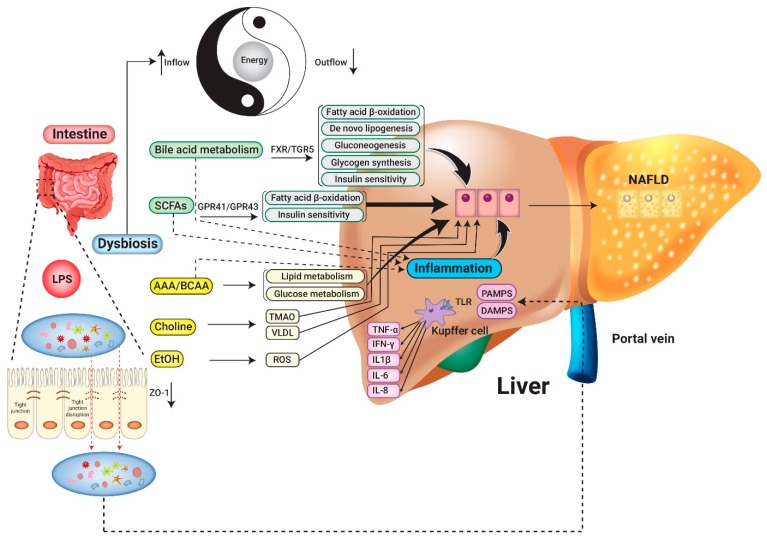
Non-alcoholic fatty liver disease (NAFLD) is the hepatic consequence of metabolic syndrome, which often also includes obesity, diabetes, and dyslipidemia. The connection between gut microbiota (GM) and NAFLD has attracted significant attention in recent years. Data has shown that GM affects hepatic lipid metabolism and influences the balance between pro/anti-inflammatory effectors in the liver. Although studies reveal the association between GM dysbiosis and NAFLD, decoding the mechanisms of gut dysbiosis resulting in NAFLD remains challenging. The potential pathophysiology that links GM dysbiosis to NAFLD can be summarized as: (1) disrupting the balance between energy harvest and expenditure, (2) promoting hepatic inflammation (impairing intestinal integrity, facilitating endotoxemia, and initiating inflammatory cascades with cytokines releasing), and (3) altered biochemistry metabolism and GM-related metabolites (i.e., bile acid, short-chain fatty acids, aromatic amino acid derivatives, branched-chain amino acids, choline, ethanol). Due to the hypothesis that probiotics/synbiotics could normalize GM and reverse dysbiosis, there have been efforts to investigate the therapeutic effect of probiotics/synbiotics in patients with NAFLD. Recent randomized clinical trials suggest that probiotics/synbiotics could improve transaminases, hepatic steatosis, and reduce hepatic inflammation. Despite these promising results, future studies are necessary to understand the full role GM plays in NAFLD development and progression. Additionally, further data is needed to unravel probiotics/synbiotics efficacy, safety, and sustainability as a novel pharmacologic approaches to NAFLD.
非酒精性脂肪性肝病 (NAFLD) 是代谢综合征的肝脏后果,代谢综合征通常还包括肥胖、糖尿病和血脂异常。近年来,肠道微生物群 (GM) 与 NAFLD 之间的联系引起了广泛关注。数据表明,GM 影响肝脏脂质代谢,并影响肝脏中促炎/抗炎效应物之间的平衡。尽管研究揭示了 GM 失调与 NAFLD 之间的关联,但解码导致 NAFLD 的肠道失调机制仍然具有挑战性。将 GM 失调与 NAFLD 联系起来的潜在病理生理学可以概括为:(1) 破坏能量收获和支出之间的平衡,(2) 促进肝脏炎症(损害肠道完整性、促进内毒素血症,并通过细胞因子释放引发炎症级联反应),以及 (3) 改变生化代谢和 GM 相关代谢物(即胆汁酸、短链脂肪酸、芳香族氨基酸衍生物、支链氨基酸、胆碱、乙醇)。由于益生菌/合生菌可以使 GM 正常化并逆转失调的假说,因此人们一直在努力研究益生菌/合生菌在 NAFLD 患者中的治疗效果。最近的随机临床试验表明,益生菌/合生菌可以改善转氨酶、肝脂肪变性,并减少肝脏炎症。尽管取得了这些有希望的结果,但仍需要进一步的研究来了解 GM 在 NAFLD 发展和进展中的全部作用。此外,需要进一步的数据来揭示益生菌/合生菌作为治疗 NAFLD 的新型药物方法的疗效、安全性和可持续性。