Duseja Ajay, Acharya Subrat K, Mehta Manu, Chhabra Shruti, Rana Satyavati, Das Ashim, Dattagupta Siddhartha, Dhiman Radha K, Chawla Yogesh K
Department of Hepatology, Post Graduate Institute of Medical Education and Research, Chandigarh, India.
Department of Gastroenterology, All India Institute of Medical Sciences, New Delhi, India.
BMJ Open Gastroenterol. 2019 Aug 7;6(1):e000315. doi: 10.1136/bmjgast-2019-000315. eCollection 2019.
Pharmacological treatment of non-alcoholic fatty liver disease (NAFLD) is still evolving. Probiotics could be a promising treatment option, but their effectiveness needs to be established. The present study aimed to evaluate the efficacy of a high potency multistrain probiotic in adult patients with NAFLD.
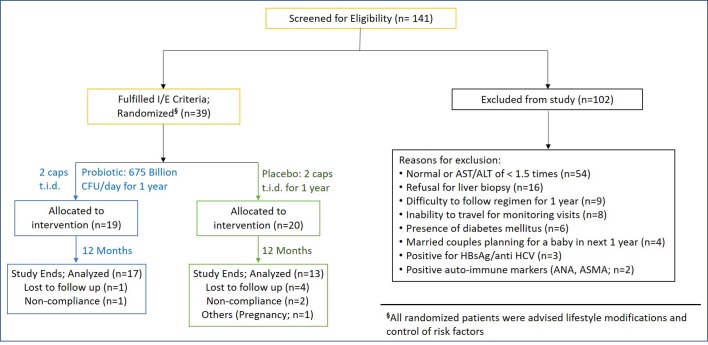
Thirty-nine liver biopsy-proven patients with NAFLD were randomised in a double-blind fashion to either lifestyle modifications plus an oral multistrain probiotic (675 billion bacteria daily, n=19) or identical placebo (n=20) for 1 year. Lifestyle modifications included regular exercise for all and control of overweight/obesity (with additional dietary restrictions), hypertension and hyperlipidaemia in those with these risk factors. Primary objective of the study was the histological improvement in NAFLD activity score (NAS) and its components and secondary objectives were improvement in alanine transaminase (ALT) and cytokine profile.
Thirty (76.9%) out of 39 patients with NAFLD completed the study with 1 year of follow-up. A repeat liver biopsy at 1 year could be done in 10 patients (52.6%) in probiotic group and five patients (25%) in placebo group. In comparison to baseline, hepatocyte ballooning (p=0.036), lobular inflammation (p=0.003) and NAS score (p=0.007) improved significantly at 1 year in the probiotic group. When compared with placebo, the NAS score improved significantly in the probiotic group (p=0.004), along with improvements in hepatocyte ballooning (p=0.05) and hepatic fibrosis (p=0.018). A significant improvement in levels of ALT (p=0.046), leptin (p=0.006), tumour necrosis factor-α (p=0.016) and endotoxins (p=0.017) was observed in probiotic group in comparison to placebo at 1 year. No significant adverse events were reported in the study.
Patients with NAFLD managed with lifestyle modifications and multistrain probiotic showed significant improvement in liver histology, ALT and cytokines.
The clinical trial is registered with CLINICAL TRIAL REGISTRYINDIA (CTRI); http://ctri.nic.in, No. CTRI/2008/091/000074.
非酒精性脂肪性肝病(NAFLD)的药物治疗仍在不断发展。益生菌可能是一种有前景的治疗选择,但其有效性尚需确定。本研究旨在评估一种高效多菌株益生菌对成年NAFLD患者的疗效。
39例经肝活检证实的NAFLD患者被随机分为两组,采用双盲方式,一组接受生活方式干预加口服多菌株益生菌(每日6750亿个细菌,n = 19),另一组接受相同的安慰剂(n = 20),为期1年。生活方式干预包括所有人定期锻炼,以及对有超重/肥胖(额外进行饮食限制)、高血压和高脂血症等危险因素的患者进行相应控制。本研究的主要目标是NAFLD活动评分(NAS)及其组成部分的组织学改善,次要目标是丙氨酸转氨酶(ALT)和细胞因子谱的改善。
39例NAFLD患者中有30例(76.9%)完成了为期1年的随访研究。益生菌组10例患者(52.6%)和安慰剂组5例患者(25%)在1年后进行了重复肝活检。与基线相比,益生菌组在1年后肝细胞气球样变(p = 0.036)、小叶炎症(p = 0.003)和NAS评分(p = 0.007)均有显著改善。与安慰剂组相比,益生菌组的NAS评分显著改善(p = 0.004),同时肝细胞气球样变(p = 0.05)和肝纤维化(p = 0.018)也有所改善。与安慰剂组相比,益生菌组在1年后ALT水平(p = 0.046)、瘦素(p = 0.006)、肿瘤坏死因子-α(p = 0.016)和内毒素(p = 0.017)均有显著改善。本研究中未报告明显不良事件。
接受生活方式干预和多菌株益生菌治疗的NAFLD患者在肝脏组织学、ALT和细胞因子方面有显著改善。
该临床试验已在印度临床试验注册中心(CTRI)注册;http://ctri.nic.in,注册号CTRI/2008/091/000074。