Oliver Robert J, Purohit Dvijen C, Kharidia Khush M, Mandyam Chitra D
VA San Diego Healthcare System, San Diego, CA 92161, USA.
Department of Anesthesiology, University of California San Diego, La Jolla, CA 92161, USA.
Brain Sci. 2019 Nov 19;9(11):330. doi: 10.3390/brainsci9110330.
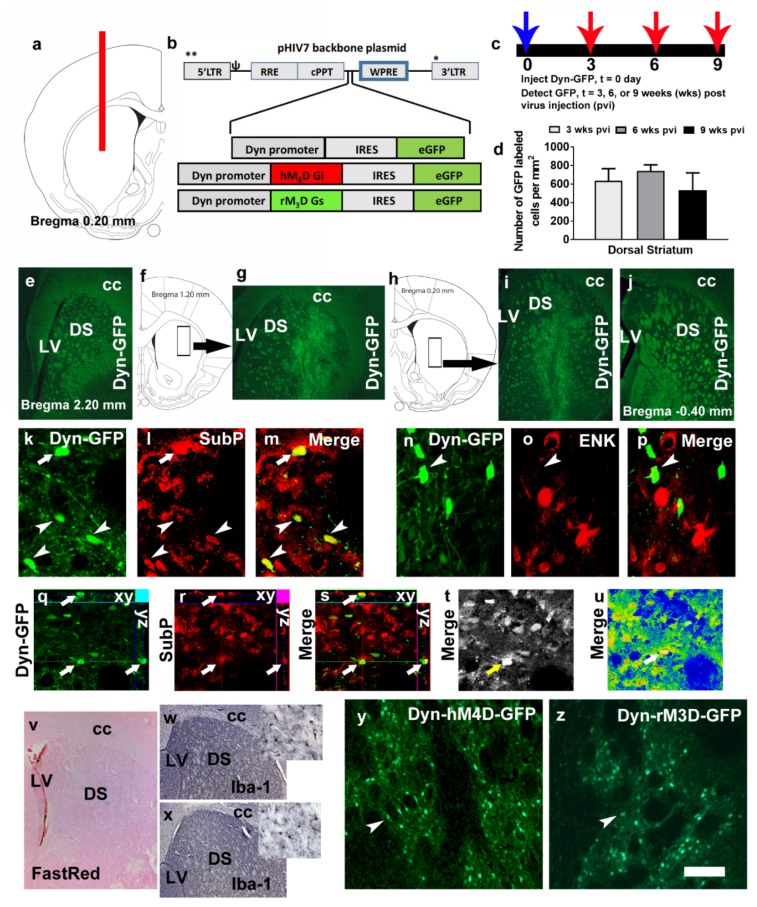
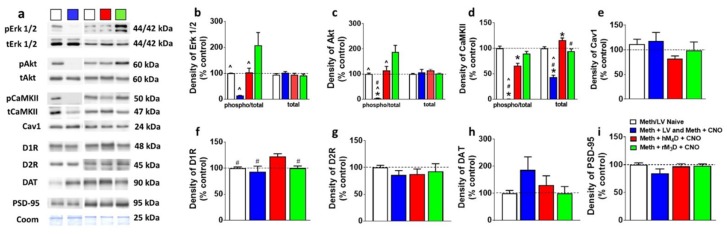
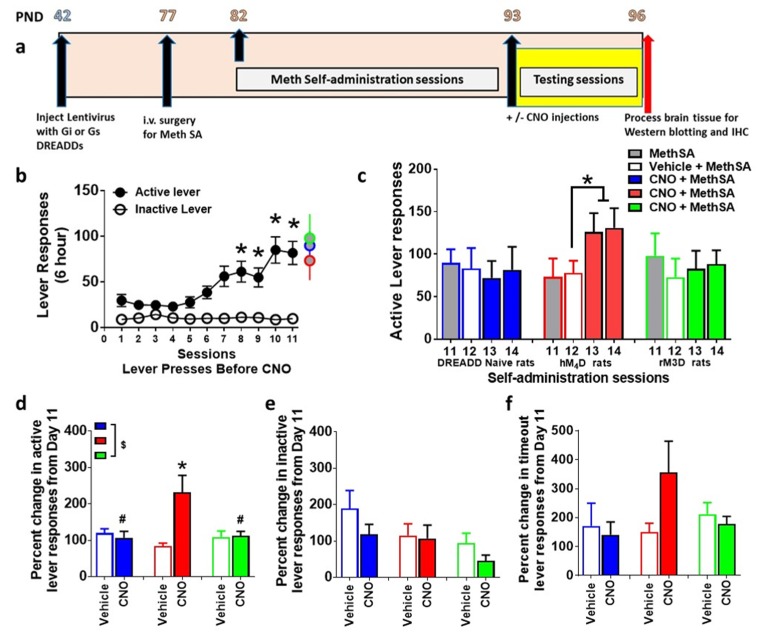
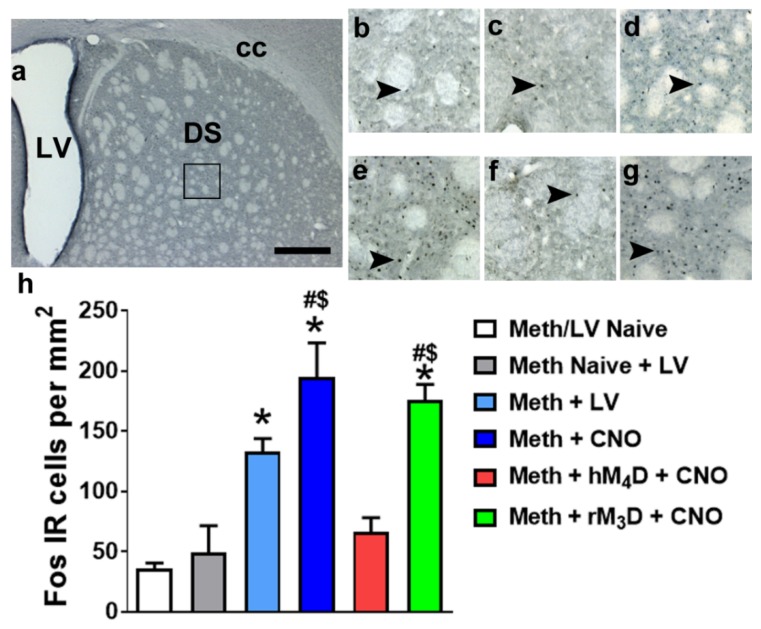
The dorsal striatum is important for the development of drug addiction; however, the role of dopamine D1 receptor (D1R) expressing medium-sized spiny striatonigral (direct pathway) neurons (D1-MSNs) in regulating excessive methamphetamine intake remains elusive. Here we seek to determine if modulating D1-MSNs in the dorsal striatum alters methamphetamine self-administration in animals that have demonstrated escalation of self-administration. A viral vector-mediated approach was used to induce expression of the inhibitory (G coupled-hMD) or stimulatory (G coupled-rMD) designer receptors exclusively activated by designer drugs (DREADDs) engineered to specifically respond to the exogenous ligand clozapine-N-oxide (CNO) selectively in D1-MSNs in the dorsal striatum. CNO in animals expressing hMD increased responding for methamphetamine compared to vehicle in a within subject treatment paradigm. CNO in animals that did not express DREADDs (DREADD naïve-CNO) or expressed rMD did not alter responding for methamphetamine, demonstrating specificity for hMD-CNO interaction in increasing self-administration. Postmortem tissue analysis reveals that hMD-CNO animals had reduced Fos immunoreactivity in the dorsal striatum compared to rMD-CNO animals and DREADD naïve-CNO animals. Cellular mechanisms in the dorsal striatum in hMD-CNO animals reveal enhanced expression of D1R and Ca/calmodulin-dependent kinase II (CaMKII). Conversely, rMD-CNO animals had enhanced activity of extracellular signal-regulated kinase (Erk1/2) and Akt in the dorsal striatum, supporting rMD-CNO interaction in these animals compared with drug naïve controls, DREADD naïve-CNO and hMD-CNO animals. Our studies indicate that transient inhibition of D1-MSNs-mediated strengthening of methamphetamine addiction-like behavior is associated with cellular adaptations that support dysfunctional dopamine signaling in the dorsal striatum.
背侧纹状体对药物成瘾的发展很重要;然而,表达多巴胺D1受体(D1R)的中等大小棘状纹状体黑质(直接通路)神经元(D1-MSNs)在调节过量甲基苯丙胺摄入中的作用仍不清楚。在这里,我们试图确定调节背侧纹状体中的D1-MSNs是否会改变已表现出自发性给药量增加的动物的甲基苯丙胺自我给药行为。采用病毒载体介导的方法,在背侧纹状体的D1-MSNs中特异性诱导表达仅由设计药物(DREADDs)激活的抑制性(G偶联-hMD)或刺激性(G偶联-rMD)设计受体,这些受体经工程改造可特异性响应外源性配体氯氮平-N-氧化物(CNO)。在受试者内治疗范式中,与给予赋形剂相比,表达hMD的动物给予CNO后对甲基苯丙胺的反应增加。未表达DREADDs的动物(未接触过DREADD的CNO组)或表达rMD的动物给予CNO后,对甲基苯丙胺的反应没有改变,这表明hMD-CNO相互作用在增加自我给药方面具有特异性。死后组织分析显示,与rMD-CNO动物和未接触过DREADD的CNO动物相比,hMD-CNO动物背侧纹状体中的Fos免疫反应性降低。hMD-CNO动物背侧纹状体中的细胞机制显示D1R和钙/钙调蛋白依赖性激酶II(CaMKII)的表达增强。相反,rMD-CNO动物背侧纹状体中的细胞外信号调节激酶(Erk1/2)和Akt活性增强,与未接触药物的对照组、未接触过DREADD的CNO组和hMD-CNO动物相比,支持rMD-CNO在这些动物中的相互作用。我们的研究表明,D1-MSNs介导的甲基苯丙胺成瘾样行为强化的短暂抑制与支持背侧纹状体中多巴胺信号功能失调的细胞适应性有关。