Heart Diseases Research Institute, Dr. Jeong's Heart Clinic, Jeonju, Republic of Korea.
Department of Cardiology, Cardiovascular Center, Korea University Anam Hospital, 126-1, 5ka, Anam-dong, Sungbuk-ku, Seoul, 136-705, Republic of Korea.
Cardiovasc Diabetol. 2019 Nov 21;18(1):162. doi: 10.1186/s12933-019-0969-z.
Statin therapy reduces the risk of cardiovascular events across a broad spectrum of patients; however, it increases the risk of new-onset diabetes (NOD). Although the highest dose pitavastatin is considered to not be associated with NOD, there are limited data regarding the impact of long-term highest dose pitavastatin use on the development of NOD in patients at high risk of developing diabetes. Therefore, we prospectively compared the differences in the development of NOD between the lowest and the highest dose of pitavastatin in patients at high risk of developing diabetes during a 3-year follow-up.
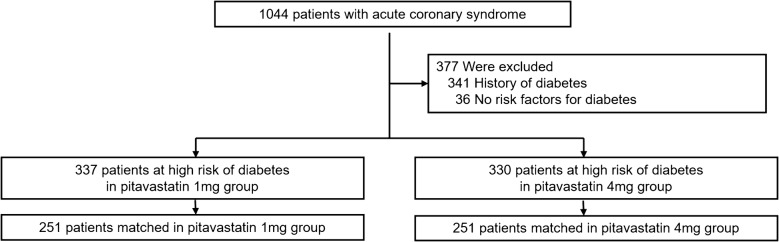
This post hoc analysis of a prospective, single-blinded, randomized study compared the risk of NOD between the highest dose of pitavastatin (4 mg) and the lowest dose of pitavastatin (1 mg) over a 3-year follow-up in patients with acute coronary syndrome. Among 1044 patients of the original study, 667 patients at high risk of developing type 2 diabetes mellitus were in the subgroup analysis. The primary endpoint was a comparison of the differences in the cumulative incidence of NOD in the pitavastatin 1 mg and 4 mg groups during a 3-year follow-up.
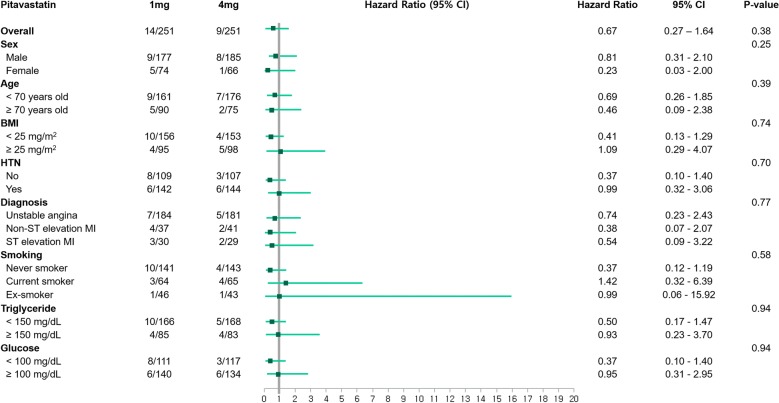
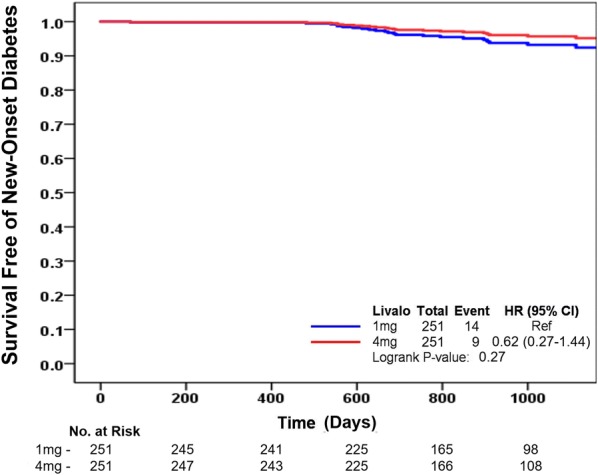
With propensity score matching, there were no significant differences in baseline demographic characteristics between the 2 groups. Incidence of NOD was similar between the pitavastatin 1 mg and 4 mg groups [12 of 289 patients (4.2%) and 8 of 289 patients (2.8%), respectively; p = 0.36]. In a prespecified analysis, there were no significant differences in NOD events according to sex, age, diagnosis, body mass index, glucose intolerance, or dyslipidemia.
Administration of highest-dose pitavastatin did not increase the risk of NOD in patients at high risk of developing diabetes during the 3-year follow-up. Moreover, various risk factors for NOD such as metabolic syndrome components, glucose intolerance, dyslipidemia, obesity, or hypertension did not affect the development of NOD during pitavastatin administration. Thus, the highest dose pitavastatin can be safely used in patients with metabolic syndrome who are at high risk of developing diabetes. Trial registration Clinical Trial registration information. URL: https://clinicaltrials.gov/ct2/show/NCT02545231. Unique identifier: NCT02545231.
他汀类药物治疗可降低各类患者发生心血管事件的风险;然而,其会增加新发糖尿病(NOD)的风险。虽然最高剂量的匹伐他汀被认为与 NOD 无关,但有关长期使用最高剂量匹伐他汀对发生糖尿病风险较高的患者 NOD 发展的影响的数据有限。因此,我们前瞻性地比较了在 3 年随访期间,发生糖尿病风险较高的患者中,最低和最高剂量匹伐他汀治疗对 NOD 发展的影响。
这是一项前瞻性、单盲、随机研究的事后分析,比较了在急性冠脉综合征患者中,3 年随访期间,匹伐他汀最高剂量(4mg)和最低剂量(1mg)治疗发生 NOD 的风险。在原始研究的 1044 名患者中,有 667 名患者发生 2 型糖尿病的风险较高,被纳入亚组分析。主要终点是比较匹伐他汀 1mg 和 4mg 组在 3 年随访期间的 NOD 累积发生率的差异。
经倾向评分匹配后,两组患者的基线人口统计学特征无显著差异。匹伐他汀 1mg 和 4mg 组的 NOD 发生率相似[289 例患者中分别为 12 例(4.2%)和 8 例(2.8%);p=0.36]。在预先指定的分析中,NOD 事件在性别、年龄、诊断、体重指数、葡萄糖耐量异常或血脂异常方面无显著差异。
在 3 年随访期间,高危糖尿病患者使用最高剂量匹伐他汀不会增加 NOD 的风险。此外,NOD 的各种危险因素,如代谢综合征成分、葡萄糖耐量异常、血脂异常、肥胖或高血压,在匹伐他汀治疗期间并未影响 NOD 的发生。因此,最高剂量的匹伐他汀可安全用于代谢综合征且发生糖尿病风险较高的患者。
临床试验注册信息。网址:https://clinicaltrials.gov/ct2/show/NCT02545231。独特标识符:NCT02545231。