College of Animal Science and Veterinary Medicine, Henan Agricultural University, Zhengzhou, 450002, Henan Province, China.
International Joint Research Laboratory for Zoonotic Diseases of Henan, Zhengzhou, 450002, Henan Province, China.
BMC Vet Res. 2019 Nov 21;15(1):417. doi: 10.1186/s12917-019-2172-6.
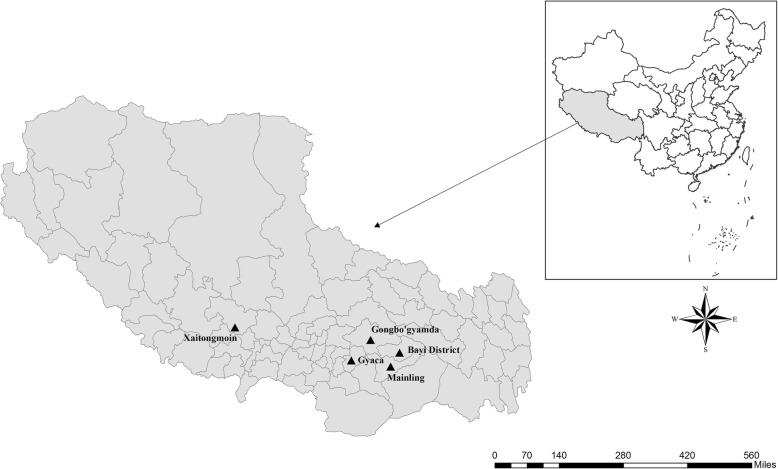
With worldwide distribution and importance for veterinary medicine, Cryptosporidium spp., Giardia duodenalis, and Enterocytozoon bieneusi have been found in a wide variety of vertebrate hosts. At present, few available molecular data can be used to understand the features of genetic diversity of these pathogens in areas without or less intensive farming. Dominated by grazing, Tibet is a separate geographic unit in China and yaks are in frequent contact with local herdsmen and necessary for their daily life. Therefore, to investigate the distribution of these pathogens in yaks of Tibet, 577 fecal specimens were screened using nested PCR for the presence and genotypes of the three intestinal pathogens.
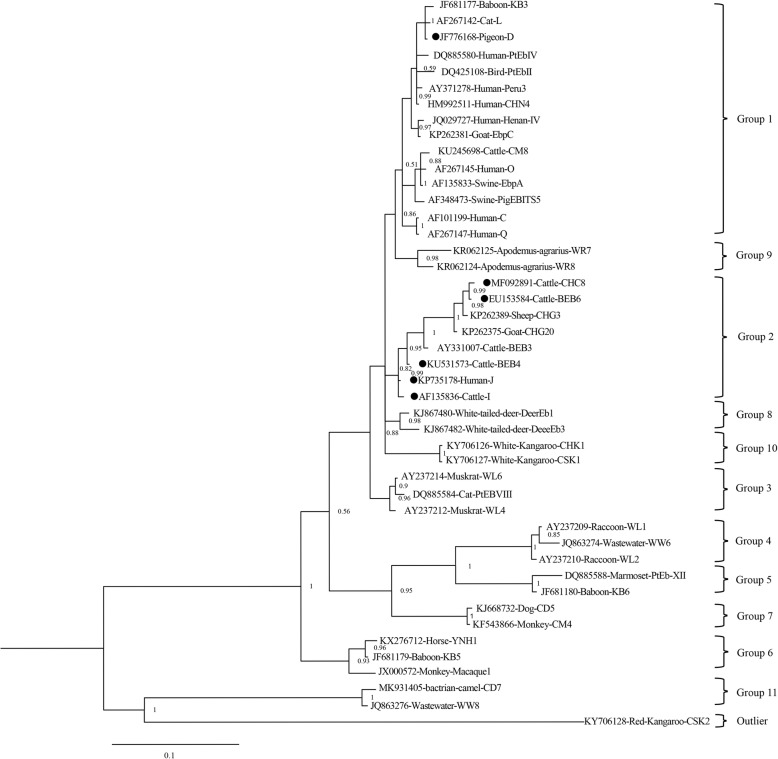
The overall prevalence of Cryptosporidium spp., G. duodenalis, and E. bieneusi were 1.4% (8/577), 1.7% (10/577), and 5.0% (29/577), respectively. Cryptosporidium andersoni (n = 7) and Cryptosporidium bovis (n = 1) were detected by sequence analysis of the SSU rRNA gene. Genotyping at the SSU rRNA and triosephosphate isomerase genes suggested that all G. duodenalis positive specimens belonged to assemblage E. Sequence analysis of the internal transcribed spacer gene identified six known E. bieneusi genotypes: BEB4 (n = 11), I (n = 6), D (n = 5), J (n = 2), CHC8 (n = 1), and BEB6 (n = 1). One subtype (A5,A4,A2,A1) for C. andersoni and three multilocus genotypes for E. bieneusi were identified by multilocus sequence typing.
We report for the first time the status of three enteric pathogens infection simultaneously for grazing yaks in Tibet. Yaks in our study are likely to impose a low zoonotic risk for humans. The molecular epidemiology data add to our knowledge of the characteristics of distribution and transmission for these pathogens in Tibet and their zoonotic potential and public health significance.
隐孢子虫、蓝氏贾第鞭毛虫和肠微孢子虫分布广泛,对兽医医学具有重要意义,已在多种脊椎动物宿主中发现。目前,在没有或较少集约化养殖的地区,可用的分子数据很少,无法用于了解这些病原体遗传多样性的特征。西藏以放牧为主,是中国一个独立的地理单元,牦牛与当地牧民频繁接触,是他们日常生活所必需的。因此,为了调查西藏牦牛中这些病原体的分布情况,采用巢式 PCR 法对 577 份粪便标本进行了三种肠道病原体的存在和基因型检测。
隐孢子虫、蓝氏贾第鞭毛虫和肠微孢子虫的总流行率分别为 1.4%(8/577)、1.7%(10/577)和 5.0%(29/577)。通过 SSU rRNA 基因序列分析检测到 7 株和 1 株和安德森隐孢子虫和牛隐孢子虫。SSU rRNA 和三磷酸甘油异构酶基因的基因分型表明,所有 G. duodenalis 阳性标本均属于 E 组。内部转录间隔区基因序列分析鉴定了 6 种已知的肠微孢子虫基因型:BEB4(n=11)、I(n=6)、D(n=5)、J(n=2)、CHC8(n=1)和 BEB6(n=1)。通过多位点序列分型鉴定了和安德森隐孢子虫的一个亚型(A5,A4,A2,A1)和肠微孢子虫的三个多基因座基因型。
我们首次报道了放牧牦牛同时感染三种肠道病原体的情况。我们研究中的牦牛对人类可能造成的人畜共患病风险较低。分子流行病学数据增加了我们对这些病原体在西藏的分布和传播特征及其人畜共患病潜力和公共卫生意义的认识。