AP-HP, Sorbonne Université, Hôpital Pitié-Salpêtrière, Service de Pneumologie, Médecine intensive - Réanimation (Département "R3S"), F-75013, Paris, France.
AP-HP, Groupe Hospitalier Pitié-Salpêtrière Charles Foix, Intensive Care Unit and Respiratory Division (Département "R3S"), F-75013, Paris, France.
Crit Care. 2019 Nov 21;23(1):370. doi: 10.1186/s13054-019-2650-z.
Intensive care unit (ICU)-acquired weakness (ICU-AW) and ICU-acquired diaphragm dysfunction (ICU-DD) occur frequently in mechanically ventilated (MV) patients. It is unknown whether they have different risk factors and different impacts on outcome. This study was designed to (1) describe the respective risk factors associated with ICU-AW and severe ICU-DD and (2) evaluate the respective impact of ICU-AW and severe ICU-DD on outcome.
Post hoc analysis of two prospective cohort studies conducted in two ICUs. In patients mechanically ventilated for at least 24 h undergoing a first spontaneous breathing trial, severe ICU-DD was defined as diaphragm twitch pressure < 7 cmHO and ICU-AW was defined as Medical Research Council Score < 48.
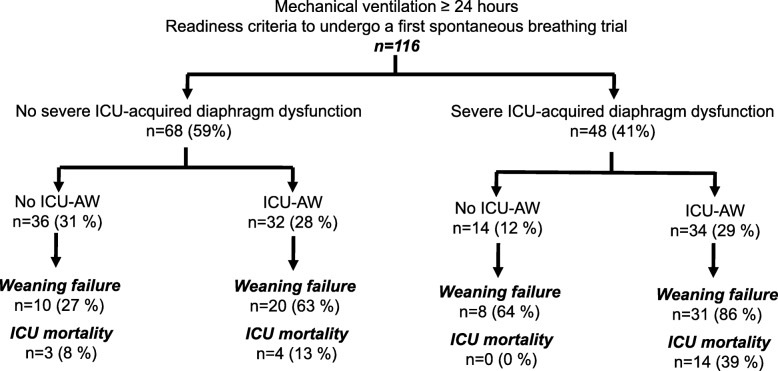
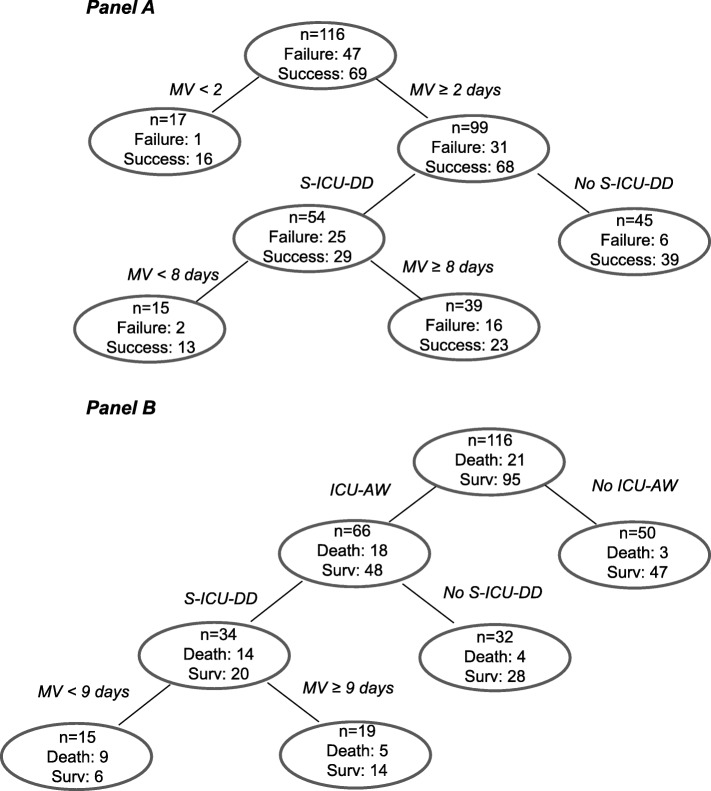
One hundred sixteen patients were assessed. Factors independently associated with severe ICU-DD were age, longer duration of MV, and exposure to sufentanil, and those factors associated with ICU-AW were longer duration of MV and exposure to norepinephrine. Severe ICU-DD (OR 3.56, p = 0.008), but not ICU-AW, was independently associated with weaning failure (59%). ICU-AW (OR 4.30, p = 0.033), but not severe ICU-DD, was associated with ICU mortality. Weaning failure and mortality rate were higher in patients with both severe ICU-DD and ICU-AW (86% and 39%, respectively) than in patients with either severe ICU-DD (64% and 0%) or ICU-AW (63% and 13%).
Severe ICU-DD and ICU-AW have different risk factors and different impacts on weaning failure and mortality. The impact of the combination of ICU-DD and ICU-AW is more pronounced than their individual impact.
在接受机械通气(MV)的患者中,重症加强护理病房(ICU)获得性肌无力(ICU-AW)和 ICU 获得性膈肌功能障碍(ICU-DD)很常见。目前尚不清楚它们是否有不同的危险因素,以及对预后的影响是否不同。本研究旨在:(1)描述与 ICU-AW 和严重 ICU-DD 相关的各自危险因素;(2)评估 ICU-AW 和严重 ICU-DD 对预后的各自影响。
对在两个 ICU 中进行的两项前瞻性队列研究进行了事后分析。在接受至少 24 小时 MV 并进行首次自主呼吸试验的患者中,严重 ICU-DD 定义为膈肌 twitch 压力 <7cmHO,ICU-AW 定义为医学研究委员会评分 <48。
共评估了 116 例患者。与严重 ICU-DD 独立相关的因素是年龄、MV 时间较长、舒芬太尼暴露,与 ICU-AW 相关的因素是 MV 时间较长和去甲肾上腺素暴露。严重 ICU-DD(OR 3.56,p=0.008),但不是 ICU-AW,与脱机失败独立相关(59%)。ICU-AW(OR 4.30,p=0.033),但不是严重 ICU-DD,与 ICU 死亡率相关。同时患有严重 ICU-DD 和 ICU-AW 的患者(分别为 86%和 39%)的脱机失败和死亡率均高于仅患有严重 ICU-DD(64%和 0%)或 ICU-AW(63%和 13%)的患者。
严重 ICU-DD 和 ICU-AW 有不同的危险因素,对脱机失败和死亡率的影响也不同。ICU-DD 和 ICU-AW 联合的影响比其各自的影响更明显。