Department of Anesthesia, Critical Care and Emergency, Fondazione IRCCS Ca' Granda Ospedale Maggiore Policlinico, University of Milan, Via F. Sforza 35, 20122, Milan, Italy.
Deparment of Anesthesia and Critical Care Medicine, Humanitas Clinical and Research Center, Rozzano, MI, Italy.
Crit Care. 2019 Nov 21;23(1):369. doi: 10.1186/s13054-019-2641-0.
High inspiratory flow might damage the lungs by mechanisms not fully understood yet. We hypothesized that increasing inspiratory flow would increase lung stress, ventilation heterogeneity, and pendelluft in ARDS patients undergoing volume-controlled ventilation with constant tidal volume and that higher PEEP levels would reduce this phenomenon.
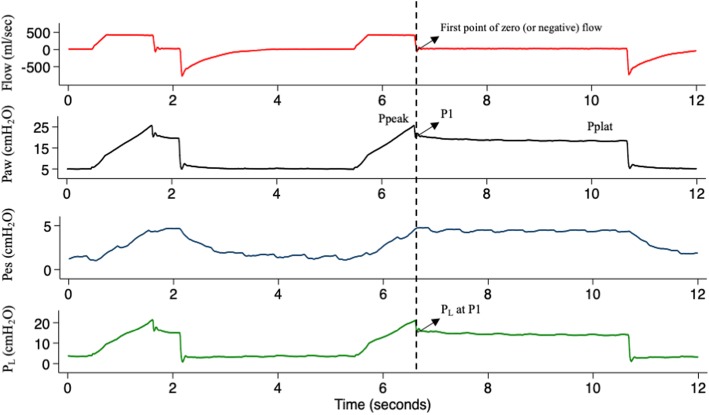
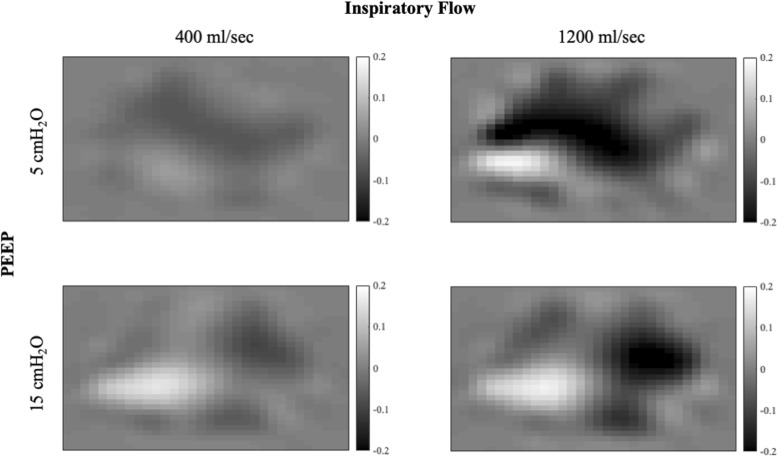
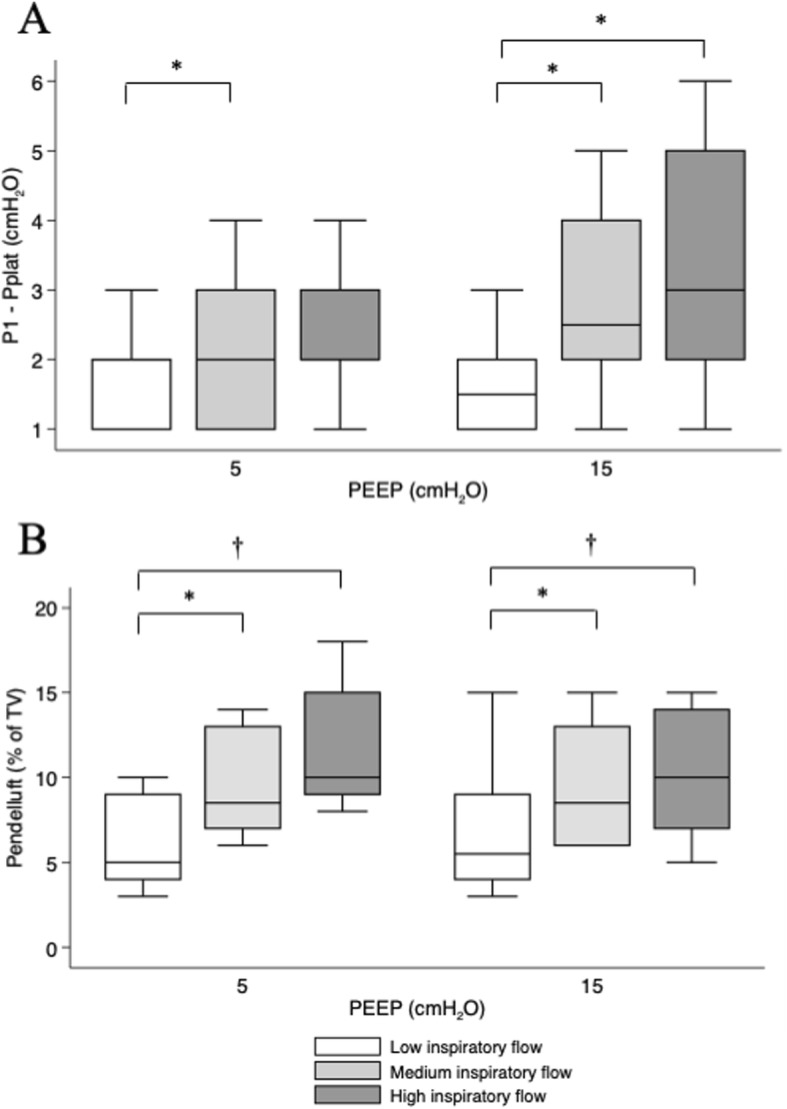
Ten ARDS patients were studied during protective volume-controlled ventilation. Three inspiratory flows (400, 800, and 1200 ml/s) and two PEEP levels (5 and 15 cmHO) were applied in random order to each patient. Airway and esophageal pressures were recorded, end-inspiratory and end-expiratory holds were performed, and ventilation distribution was measured with electrical impedance tomography. Peak and plateau airway and transpulmonary pressures were recorded, together with the airway and transpulmonary pressure corresponding to the first point of zero end-inspiratory flow (P1). Ventilation heterogeneity was measured by the EIT-based global inhomogeneity (GI) index. Pendelluft was measured as the absolute difference between pixel-level inflation measured at plateau pressure minus P1.
Plateau airway and transpulmonary pressure was not affected by inspiratory flow, while P1 increased at increasing inspiratory flow. The difference between P1 and plateau pressure was higher at higher flows at both PEEP levels (p < 0.001). While higher PEEP reduced heterogeneity of ventilation, higher inspiratory flow increased GI (p = 0.05), irrespective of the PEEP level. Finally, gas volume undergoing pendelluft was larger at higher inspiratory flow (p < 0.001), while PEEP had no effect.
The present exploratory analysis suggests that higher inspiratory flow increases additional inspiratory pressure, heterogeneity of ventilation, and pendelluft while PEEP has negligible effects on these flow-dependent phenomena. The clinical significance of these findings needs to be further clarified.
高吸气流量可能通过尚未完全了解的机制损害肺部。我们假设,在接受恒定潮气量的容量控制通气的 ARDS 患者中,增加吸气流量会增加肺应力、通气异质性和 Pendelluft,而较高的 PEEP 水平会降低这种现象。
对 10 名 ARDS 患者进行保护性容量控制通气研究。以随机顺序向每位患者应用三种吸气流量(400、800 和 1200 ml/s)和两种 PEEP 水平(5 和 15 cmHO)。记录气道和食管压力,进行吸气末和呼气末保持,并使用电阻抗断层扫描测量通气分布。记录峰压和平台压气道和跨肺压,以及对应于零吸气末流量第一点的气道和跨肺压(P1)。通气异质性通过基于 EIT 的全局不均匀性(GI)指数进行测量。Pendelluft 测量为在平台压下测量的像素级膨胀与 P1 之间的绝对值差。
吸气流量不影响平台压气道和跨肺压,而 P1 在吸气流量增加时增加。在两种 PEEP 水平下,较高的吸气流量增加了 P1 与平台压之间的差异(p<0.001)。虽然较高的 PEEP 降低了通气异质性,但无论 PEEP 水平如何,较高的吸气流量都会增加 GI(p=0.05)。最后,在较高的吸气流量下,经历 Pendelluft 的气体量更大(p<0.001),而 PEEP 没有影响。
本探索性分析表明,较高的吸气流量会增加额外的吸气压力、通气异质性和 Pendelluft,而 PEEP 对这些依赖于流量的现象几乎没有影响。这些发现的临床意义需要进一步阐明。