Arellano Daniel H, Brito Roberto, Morais Caio C A, Ruiz-Rudolph Pablo, Gajardo Abraham I J, Guiñez Dannette V, Lazo Marioli T, Ramirez Ivan, Rojas Verónica A, Cerda María A, Medel Juan N, Illanes Victor, Estuardo Nivia R, Bruhn Alejandro R, Brochard Laurent J, Amato Marcelo B P, Cornejo Rodrigo A
Departamento de Medicina, Unidad de Pacientes Críticos, Hospital Clínico Universidad de Chile, Dr. Carlos Lorca Tobar 999, 8380456, Santiago, Chile.
Departamento de Kinesiología, Facultad de Medicina, Universidad de Chile, Santiago, Chile.
Ann Intensive Care. 2023 Dec 20;13(1):131. doi: 10.1186/s13613-023-01230-w.
Internal redistribution of gas, referred to as pendelluft, is a new potential mechanism of effort-dependent lung injury. Neurally-adjusted ventilatory assist (NAVA) and proportional assist ventilation (PAV +) follow the patient's respiratory effort and improve synchrony compared with pressure support ventilation (PSV). Whether these modes could prevent the development of pendelluft compared with PSV is unknown. We aimed to compare pendelluft magnitude during PAV + and NAVA versus PSV in patients with resolving acute respiratory distress syndrome (ARDS).
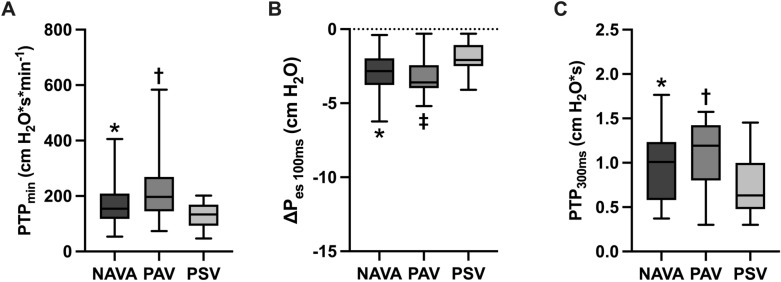
Patients received either NAVA, PAV + , or PSV in a crossover trial for 20-min using comparable assistance levels after controlled ventilation (> 72 h). We assessed pendelluft (the percentage of lost volume from the non-dependent lung region displaced to the dependent region during inspiration), drive (as the delta esophageal swing of the first 100 ms [ΔP ]) and inspiratory effort (as the esophageal pressure-time product per minute [PTP]). We performed repeated measures analysis with post-hoc tests and mixed-effects models.
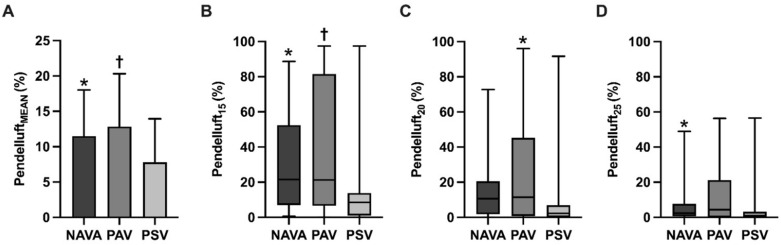
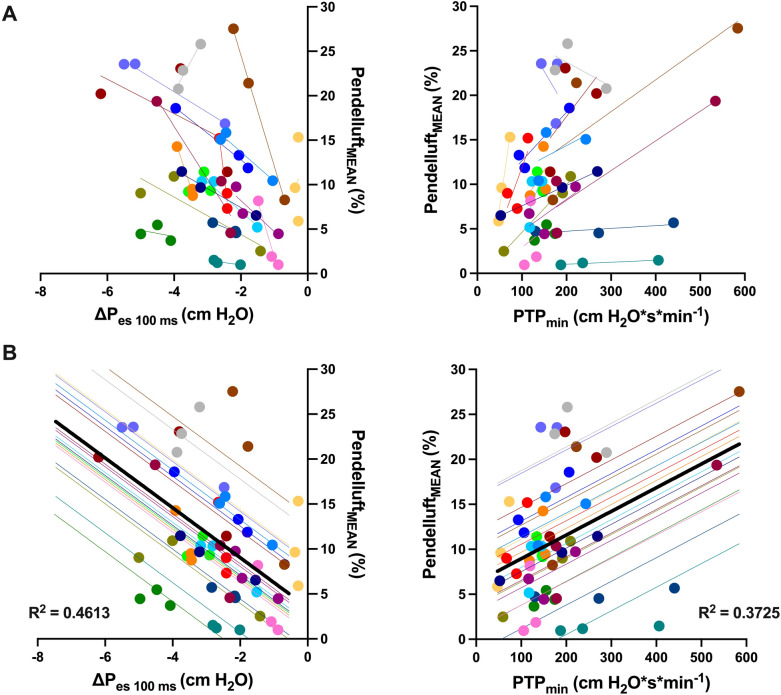
Twenty patients mechanically ventilated for 9 [5-14] days were monitored. Despite matching for a similar tidal volume, respiratory drive and inspiratory effort were slightly higher with NAVA and PAV + compared with PSV (ΔP of -2.8 [-3.8--1.9] cm HO, -3.6 [-3.9--2.4] cm HO and -2.1 [-2.5--1.1] cm HO, respectively, p < 0.001 for both comparisons; PTP of 155 [118-209] cm HO s/min, 197 [145-269] cm HO s/min, and 134 [93-169] cm HO s/min, respectively, p < 0.001 for both comparisons). Pendelluft magnitude was higher in NAVA (12 ± 7%) and PAV + (13 ± 7%) compared with PSV (8 ± 6%), p < 0.001. Pendelluft magnitude was strongly associated with respiratory drive (β = -2.771, p-value < 0.001) and inspiratory effort (β = 0.026, p < 0.001), independent of the ventilatory mode. A higher magnitude of pendelluft in proportional modes compared with PSV existed after adjusting for PTP (β = 2.606, p = 0.010 for NAVA, and β = 3.360, p = 0.004 for PAV +), and only for PAV + when adjusted for respiratory drive (β = 2.643, p = 0.009 for PAV +).
Pendelluft magnitude is associated with respiratory drive and inspiratory effort. Proportional modes do not prevent its occurrence in resolving ARDS compared with PSV.
气体的内部再分布,即pendelluft,是用力依赖性肺损伤的一种新的潜在机制。与压力支持通气(PSV)相比,神经调节通气辅助(NAVA)和比例辅助通气(PAV +)可跟随患者的呼吸用力并改善同步性。与PSV相比,这些模式是否能预防pendelluft的发生尚不清楚。我们旨在比较急性呼吸窘迫综合征(ARDS)缓解期患者在PAV +和NAVA与PSV期间的pendelluft幅度。
在一项交叉试验中,患者在控制通气(> 72小时)后使用可比的辅助水平接受NAVA、PAV +或PSV通气20分钟。我们评估了pendelluft(吸气期间从非依赖肺区域转移到依赖区域的丢失容积百分比)、驱动力(作为前100毫秒的食管摆动幅度[ΔP])和吸气用力(作为每分钟食管压力-时间乘积[PTP])。我们使用事后检验和混合效应模型进行重复测量分析。
对20例机械通气9[5 - 14]天的患者进行了监测。尽管潮气量相似,但与PSV相比,NAVA和PAV +的呼吸驱动力和吸气用力略高(ΔP分别为-2.8[-3.8 - -1.9]cm H₂O、-3.6[-3.9 - -2.4]cm H₂O和-2.1[-2.5 - -1.1]cm H₂O,两项比较p均<0.001;PTP分别为155[118 - 209]cm H₂O s/min、197[145 - 269]cm H₂O s/min和134[93 - 169]cm H₂O s/min,两项比较p均<0.001)。与PSV(8±6%)相比,NAVA(12±7%)和PAV +(13±7%)的pendelluft幅度更高,p<0.001。pendelluft幅度与呼吸驱动力(β = -2.771,p值<0.001)和吸气用力(β = 0.026,p<0.001)密切相关,与通气模式无关。在调整PTP后,与PSV相比,比例模式下的pendelluft幅度更高(NAVA的β = 2.606,p = 0.010;PAV +的β = 3.360,p = 0.004),而在调整呼吸驱动力后,仅PAV +存在这种情况(PAV +的β = 2.643,p = 0.009)。
pendelluft幅度与呼吸驱动力和吸气用力相关。与PSV相比,比例模式并不能预防ARDS缓解期pendelluft的发生。