Dietz Steffen, Christopoulos Petros, Gu Lisa, Volckmar Anna-Lena, Endris Volker, Yuan Zhao, Ogrodnik Simon J, Zemojtel Tomasz, Heussel Claus-Peter, Schneider Marc A, Meister Michael, Muley Thomas, Reck Martin, Schlesner Matthias, Thomas Michael, Stenzinger Albrecht, Sültmann Holger
Division of Cancer Genome Research, German Cancer Research Center (DKFZ), German Cancer Consortium (DKTK), and National Center for Tumor Diseases (NCT), 69120 Heidelberg, Germany.
German Center for Lung Research (DZL), TLRC Heidelberg, 69120 Heidelberg, Germany.
Cold Spring Harb Mol Case Stud. 2019 Dec 13;5(6). doi: 10.1101/mcs.a004630. Print 2019 Dec.
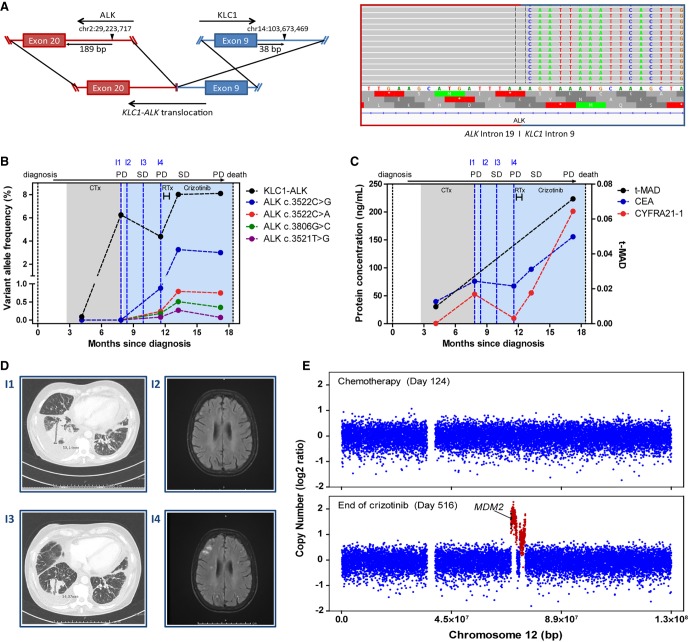
Genetic rearrangements involving the anaplastic lymphoma kinase () gene confer sensitivity to ALK tyrosine kinase inhibitors (TKIs) and superior outcome in non-small-cell lung cancer (NSCLC). However, clinical courses vary widely, and recent studies suggest that molecular profiling of ALK NSCLC can provide additional predictors of therapy response that could assist further individualization of patient management. As repeated tissue biopsies often pose technical difficulties and significant procedural risk, analysis of tumor constituents circulating in the blood, including ctDNA and various proteins, is increasingly recognized as an alternative method of tumor sampling ("liquid biopsy"). Here, we report the case of a -rearranged NSCLC patient responding to crizotinib treatment and demonstrate how analysis of plasma and serum biomarkers can be used to identify the fusion partner and monitor therapy over time. Results of ctDNA sequencing and copy-number alteration profiling as well as serum protein concentrations at various time points during therapy reflected the current remission status and could predict the subsequent clinical course. At the time of disease progression, we identified four distinct secondary mutations in the gene in ctDNA potentially causing treatment failure, accompanied by rising levels of CEA and CYFRA 21-1. Moreover, several copy-number variations were detected at the end of the treatment, including an amplification of a region on Chromosome 12 encompassing the TP53 regulator In summary, our findings illustrate the utility of noninvasive longitudinal molecular profiling for assessing remission status, exploring mechanisms of treatment failure, predicting subsequent clinical course, and dissecting dynamics of drug-resistant clones in ALK lung cancer.
涉及间变性淋巴瘤激酶(ALK)基因的基因重排赋予非小细胞肺癌(NSCLC)对ALK酪氨酸激酶抑制剂(TKIs)的敏感性及更好的预后。然而,临床病程差异很大,最近的研究表明,ALK NSCLC的分子谱分析可以提供更多治疗反应预测指标,有助于进一步实现患者管理的个体化。由于重复组织活检常常存在技术困难和显著的操作风险,对血液中循环的肿瘤成分(包括ctDNA和各种蛋白质)进行分析越来越被认为是一种肿瘤取样的替代方法(“液体活检”)。在此,我们报告一例ALK重排的NSCLC患者对克唑替尼治疗有反应的病例,并展示如何通过分析血浆和血清生物标志物来鉴定ALK融合伴侣并随时间监测治疗情况。治疗期间不同时间点的ctDNA测序结果、拷贝数改变分析以及血清蛋白浓度反映了当前的缓解状态,并可预测随后的临床病程。在疾病进展时,我们在ctDNA中鉴定出ALK基因的四个不同的继发突变,可能导致治疗失败,同时癌胚抗原(CEA)和细胞角蛋白19片段(CYFRA 21-1)水平升高。此外,在治疗结束时检测到几个拷贝数变异,包括12号染色体上一个包含TP53调节因子的区域的扩增。总之,我们的研究结果说明了无创纵向分子谱分析在评估缓解状态、探索治疗失败机制、预测后续临床病程以及剖析ALK肺癌耐药克隆动态方面的实用性。