Centre for Cancer Research and Cell Biology, Queen's University Belfast, Belfast, United Kingdom.
Department of Histopathology and Morbid Anatomy, Trinity Translational Medicine Institute, Trinity College Dublin, Dublin, Ireland.
Clin Cancer Res. 2020 Mar 1;26(5):1086-1093. doi: 10.1158/1078-0432.CCR-19-2853. Epub 2019 Nov 21.
Statins are associated with lower risk of aggressive prostate cancer, but lethal prostate cancer is understudied and contributing mechanisms are unclear. We prospectively examined statins and lethal prostate cancer risk in the Health Professionals Follow-up Study (HPFS), tested associations with molecular subtypes, and integrated gene expression profiling to identify putative mechanisms.
Our study included 44,126 men cancer-free in 1990, followed for prostate cancer incidence through 2014, with statin use recorded on biennial questionnaires. We used multivariable Cox regression to examine associations between statins and prostate cancer risk overall, by measures of clinically significant disease, and by ERG and PTEN status. In an exploratory analysis, age-adjusted gene set enrichment analysis identified statin-associated pathways enriched in tumor and adjacent normal prostate tissue.
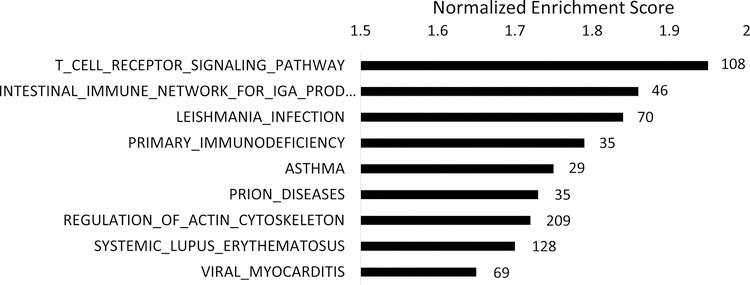
During 24 years of follow-up, 6,305 prostate cancers were diagnosed and 801 (13%) were lethal (metastatic at diagnosis or metastatic/fatal during follow-up). Relative to never/past use, current statin use was inversely associated with risk of lethal prostate cancer [HR, 0.76; 95% confidence interval (CI), 0.60-0.96] but not overall disease. We found a strong inverse association for risk of PTEN-null cancers (HR, 0.40; 95% CI, 0.19-0.87) but not PTEN-intact cancers (HR, 1.18; 95% CI, 0.95-1.48; heterogeneity = 0.01). Associations did not differ by ERG. Inflammation and immune pathways were enriched in normal prostate tissue of statin ever ( = 10) versus never users ( = 103).
Molecular tumor classification identified PTEN and inflammation/immune activation as potential mechanisms linking statins with lower lethal prostate cancer risk. These findings support a potential causal association and could inform selection of relevant biomarkers for statin clinical trials.
他汀类药物与侵袭性前列腺癌风险降低相关,但致命性前列腺癌研究较少,其发病机制尚不清楚。我们前瞻性地在健康专业人员随访研究(HPFS)中研究了他汀类药物与致命性前列腺癌风险的关系,检测了与分子亚型的关联,并整合了基因表达谱分析以确定潜在的机制。
我们的研究包括 1990 年无癌症的 44126 名男性,通过 2014 年的前列腺癌发病率随访,使用每两年一次的问卷调查记录他汀类药物的使用情况。我们使用多变量 Cox 回归来研究他汀类药物与前列腺癌总体风险、有临床意义疾病的衡量标准以及 ERG 和 PTEN 状态之间的关联。在一项探索性分析中,年龄调整后的基因集富集分析确定了在肿瘤和相邻正常前列腺组织中富集的与他汀类药物相关的途径。
在 24 年的随访中,诊断出 6305 例前列腺癌,801 例(13%)为致命性(诊断时转移或随访期间转移/致死)。与从未/过去使用相比,当前使用他汀类药物与致命性前列腺癌风险呈负相关[风险比(HR),0.76;95%置信区间(CI),0.60-0.96],但与总体疾病无关。我们发现,PTEN 缺失型癌症的风险呈强烈负相关(HR,0.40;95%CI,0.19-0.87),而 PTEN 完整型癌症的风险无显著差异(HR,1.18;95%CI,0.95-1.48;异质性=0.01)。与 ERG 无关。在他汀类药物使用者(n=10)和非使用者(n=103)的正常前列腺组织中,炎症和免疫途径被富集。
分子肿瘤分类确定了 PTEN 和炎症/免疫激活作为他汀类药物与致命性前列腺癌风险降低相关的潜在机制。这些发现支持了潜在的因果关系,并为他汀类药物临床试验中相关生物标志物的选择提供了信息。