Department of Nutrition, University of North Carolina at Chapel Hill, Chapel Hill, NC, USA.
Department of Surgery, Duke University Medical Center, Durham, NC, USA.
Prostate Cancer Prostatic Dis. 2018 Jun;21(2):196-203. doi: 10.1038/s41391-018-0045-x. Epub 2018 May 23.
Some, but not all, epidemiologic evidence supports a role for cholesterol, the precursor for steroid hormone synthesis, in prostate cancer. Using a PTEN-null transgenic mouse model of prostate cancer, we tested the effect of modifying serum cholesterol levels on prostate tumor development and growth. We hypothesized that serum cholesterol reduction would lower tumor androgens and slow prostate cancer growth.
PTEN-Cre mice consuming ad libitum high fat, high cholesterol diets (40% fat, 1.25% cholesterol) were randomized after weaning to receive the cholesterol uptake inhibitor, ezetimibe (30 mg/kg/day), or no intervention, and sacrificed at 2, 3, or 4 months of age. Serum cholesterol and testosterone were measured by ELISA and intraprostatic androgens by mass spectrometry. Prostate histology was graded, and proliferation and apoptosis in tumor epithelium and stroma was assessed by Ki67 and TUNEL, respectively.
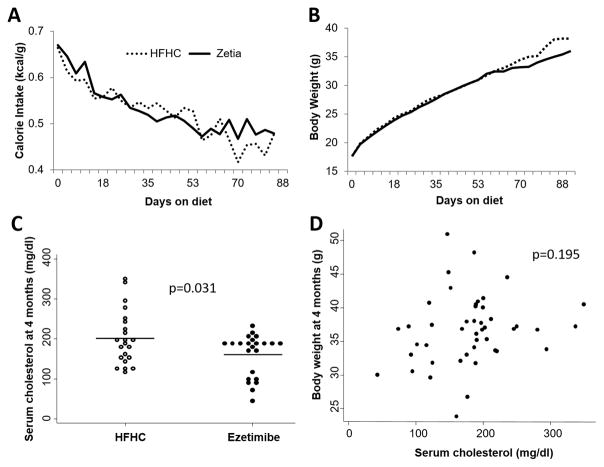
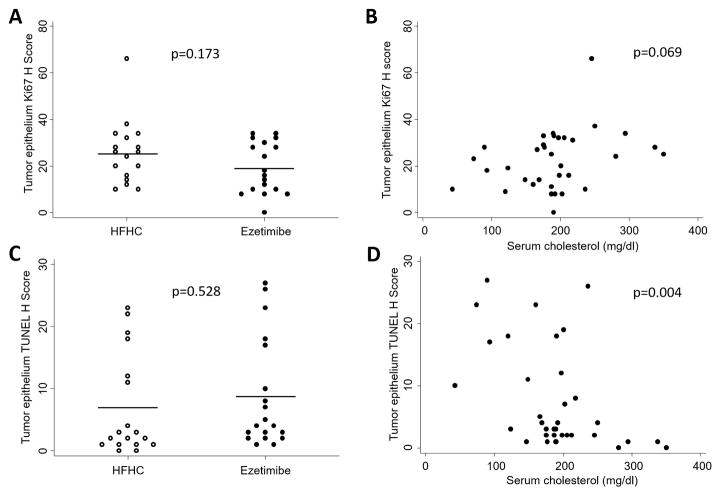
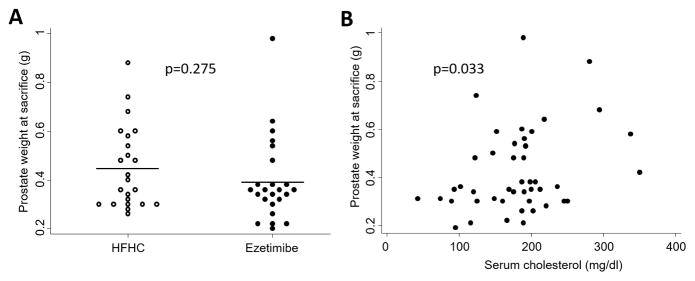
Ezetimibe-treated mice had lower serum cholesterol at 4 months (p = 0.031). Serum cholesterol was positively correlated with prostate weight (p = 0.033) and tumor epithelial proliferation (p = 0.069), and negatively correlated with tumor epithelial apoptosis (p = 0.004). Serum cholesterol was unrelated to body weight (p = 0.195). Tumor stromal cell proliferation was reduced in the ezetimibe group (p = 0.010). Increased serum cholesterol at 4 months was associated with elevated intraprostatic DHEA, testosterone, and androstenedione (p = 0.043, p = 0.074, p = 0.031, respectively). However, cholesterol reduction did not significantly affect adenocarcinoma development at 2, 3, or 4 months of age (0, 78, and 100% in ezetimibe-treated vs. 0, 80, and 100% in mice not receiving ezetimibe).
Though serum cholesterol reduction did not significantly affect the rate of adenocarcinoma development in the PTEN-null transgenic mouse model of prostate cancer, it lowered intraprostatic androgens and slowed tumor growth. These findings support a role for serum cholesterol in promoting prostate cancer growth, potentially via enhanced tumor androgen signaling, and may provide new insight into cholesterol-lowering interventions for prostate cancer treatment.
一些但不是所有的流行病学证据表明胆固醇(甾体激素合成的前体)在前列腺癌中起作用。我们使用前列腺癌的 PTEN 缺失转基因小鼠模型,测试了改变血清胆固醇水平对前列腺肿瘤发展和生长的影响。我们假设血清胆固醇降低会降低肿瘤雄激素并减缓前列腺癌的生长。
PTEN-Cre 小鼠自由摄入高脂肪、高胆固醇饮食(40%脂肪,1.25%胆固醇),断奶后随机接受胆固醇摄取抑制剂依折麦布(30mg/kg/天)或不干预,并在 2、3 或 4 个月时处死。通过 ELISA 测量血清胆固醇和睾酮,通过质谱法测量前列腺内雄激素。通过组织学分级评估前列腺组织学,通过 Ki67 和 TUNEL 分别评估肿瘤上皮和基质的增殖和凋亡。
依折麦布治疗组小鼠在 4 个月时血清胆固醇较低(p=0.031)。血清胆固醇与前列腺重量呈正相关(p=0.033)和肿瘤上皮增殖呈正相关(p=0.069),与肿瘤上皮凋亡呈负相关(p=0.004)。血清胆固醇与体重无关(p=0.195)。依折麦布组肿瘤基质细胞增殖减少(p=0.010)。4 个月时血清胆固醇升高与前列腺内 DHEA、睾酮和雄烯二酮升高相关(p=0.043、p=0.074、p=0.031)。然而,胆固醇降低并未显著影响 2、3 或 4 个月时腺癌的发展(依折麦布治疗组为 0、78%和 100%,未接受依折麦布治疗组为 0、80%和 100%)。
虽然血清胆固醇降低并未显著影响前列腺癌的 PTEN 缺失转基因小鼠模型中腺癌的发展速度,但它降低了前列腺内雄激素并减缓了肿瘤生长。这些发现支持血清胆固醇在促进前列腺癌生长中的作用,可能通过增强肿瘤雄激素信号传导,为胆固醇降低干预治疗前列腺癌提供新的见解。