Liu Jue, Liu Min, Zhang Shikun, Ma Qiuyue, Wang Qiaomei
Department of Epidemiology and Biostatistics, School of Public Health, Peking University, Beijing, China.
Department of Epidemiology and Biostatistics, School of Public Health, Peking University, Beijing, China
BMJ Sex Reprod Health. 2019 Nov 21;46(1):59-66. doi: 10.1136/bmjsrh-2018-200197.
China's one-child policy was replaced by a new universal two-child policy in 2015; however, few studies have addressed the intent to have a second child and resulting related issues.
We performed a cross-sectional study on 11 991 Chinese women, 18-49 years of age, from 11 provinces in 2016-2017, in order to assess the intent for a second child among Chinese women of childbearing age and other related factors after the introduction of China's new universal two-child policy.
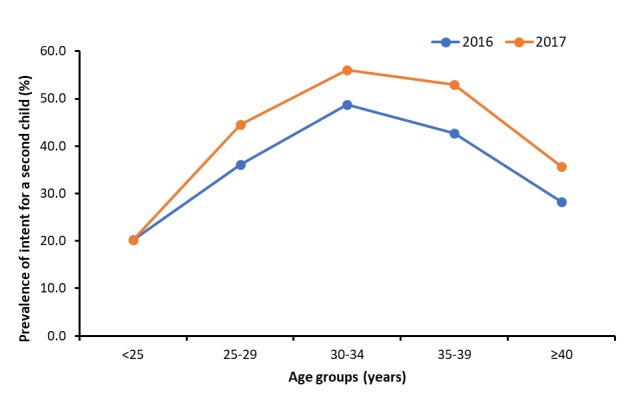
We found that the overall prevalence of the intent to have a second child was 39.4% and that economic, childrearing, and health barriers affected fertility intent. Multivariate logistic regression models showed that the age range of 25-39 years (aOR 1.28-1.30), living in Eastern (aOR 1.28, 95% CI 1.10 to 1.50) or Central China (aOR 1.52, 95% CI 1.27 to 1.78), living in a rural area (aOR 1.62, 95% CI 1.47 to 1.78), being a farmer (aOR 1.43, 95% CI 1.09 to 1.88), having a higher household income (aOR 1.13, 95% CI 1.00 to 1.28), having a history of abortion (aOR 1.18, 95% CI 1.05 to 1.31), and already having one child (aOR 3.65 for girls, aOR 2.70 for boys) were associated with a greater intent to have a second child (all p<0.05). Conversely, economic, health, childrearing, and educational barriers were associated with a lower intent to have a second child (aOR 0.65-0.75).
Four in ten women of childbearing age demonstrated an intent for a second child. We maintain that fertility-related factors be given full consideration when promoting the two-child policy.
中国的独生子女政策于2015年被新的全面二孩政策所取代;然而,很少有研究探讨生育二孩的意愿及由此产生的相关问题。
2016 - 2017年,我们对来自11个省份的11991名年龄在18 - 49岁的中国女性进行了一项横断面研究,以评估中国新的全面二孩政策实施后育龄女性生育二孩的意愿及其他相关因素。
我们发现生育二孩意愿的总体患病率为39.4%,经济、育儿和健康障碍影响生育意愿。多因素logistic回归模型显示,年龄在25 - 39岁(调整后比值比[aOR]为1.28 - 1.30)、居住在东部(aOR为1.28,95%置信区间[CI]为1.10至1.50)或中部地区(aOR为1.52,95% CI为1.27至1.78)、居住在农村地区(aOR为1.62,95% CI为1.47至1.78)、是农民(aOR为1.43,95% CI为1.09至1.88)、家庭收入较高(aOR为1.13,95% CI为1.00至1.28)、有流产史(aOR为1.18,95% CI为1.05至1.31)以及已经育有一个孩子(女孩的aOR为3.65,男孩的aOR为2.70)与生育二孩的意愿更强相关(所有p<0.05)。相反,经济、健康、育儿和教育障碍与生育二孩的意愿较低相关(aOR为0.65 - 0.75)。
十分之四的育龄女性有生育二孩的意愿。我们认为在推行二孩政策时应充分考虑与生育相关的因素。