Department of Obstetrics and Gynecology, International Peace Maternity and Child Health Hospital, School of Medicine, Shanghai Jiao Tong University, Shanghai, China.
Shanghai Key Laboratory Embryo Original Diseases, Shanghai, China.
Front Public Health. 2022 Jun 9;10:879672. doi: 10.3389/fpubh.2022.879672. eCollection 2022.
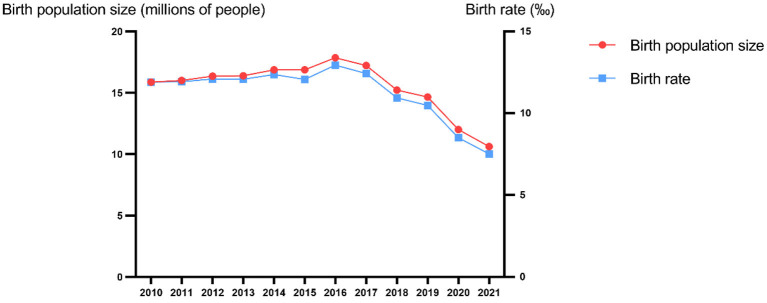
As the global fertility rate declines, China has issued two and three-child policies in the past 10 years. Therefore, this study serves to evaluate fertility intention rates and related factors in couples intending to have a second child and third child.
A cross-sectional survey was conducted in mainland China from July to August 2021. Couples with one or two children were invited to participate in our study in order to collect information about more than one child fertility intention and the possibly related factors. Odds ratios (ORs) and their corresponding 95% confidence intervals (CIs) were calculated and adjusted for potential confounding factors.
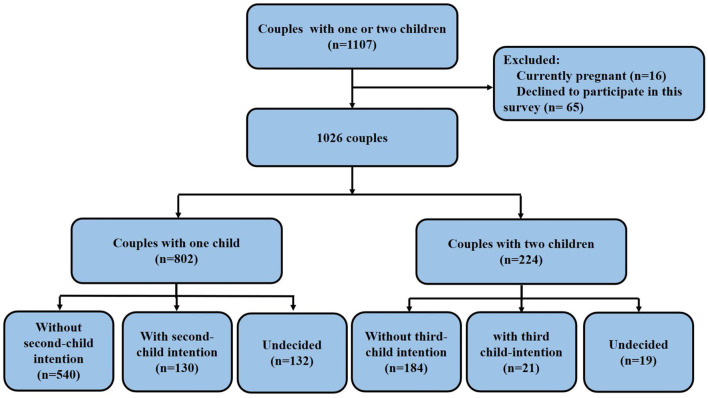
Data was collected from a total of 1,026 couples. Among couples with one child, 130 (16.2%) couples had the intention to have a second child. Additionally, only 9.4% of couples with two children desired to have third child. The study revealed large differences in socioeconomic and personal factors between the two groups. For couples with intentions for a second-child, a female age >35 years (adjusted odds ratio, aOR 1.92), a first child's age range from 3 to 6 (aOR 3.12), annual child spending as a percentage of household income >30% (aOR 2.62), and children's educational barriers (aOR 1.55) were associated with lack of intent to have a second child. Similarly, among couples with two children, parents with family financial constraints (aOR 6.18) and children's educational barriers (aOR 4.93) are more likely to have lack of intent to have a third child. Here, we report that government policies encouraging fertility (aOR 0.04) can effectly promote couples to pursue a second or third child.
Overall, couples with one or two children in Shanghai had a low intention to give birth to a second or third child. In order to increase the birth rates, it is necessary to implement policies to reduce the burden of raising children and provide relief to parent's pressure of rearing a child with increased free time.
随着全球生育率的下降,中国在过去 10 年中相继出台了二孩和三孩政策。因此,本研究旨在评估有生育二孩和三孩意愿的夫妇的生育意愿率及其相关因素。
本研究于 2021 年 7 月至 8 月在中国内地进行了一项横断面调查。邀请有一孩或二孩的夫妇参与本研究,以收集关于生育二孩和三孩意愿及相关因素的信息。计算了优势比(OR)及其 95%置信区间(CI),并对潜在的混杂因素进行了调整。
共收集了 1026 对夫妇的数据。在有一孩的夫妇中,有 130 对(16.2%)夫妇有生育二孩的意愿。此外,仅有 9.4%的二孩夫妇希望生育三孩。研究表明,两组夫妇在社会经济和个人因素方面存在较大差异。对于有生育二孩意愿的夫妇来说,女性年龄>35 岁(调整后的优势比,aOR 1.92)、第一个孩子的年龄在 3 至 6 岁之间(aOR 3.12)、家庭年收入中子女支出占比>30%(aOR 2.62)和子女教育障碍(aOR 1.55)与生育二孩的意愿不足有关。同样,在有两个孩子的夫妇中,父母有家庭经济困难(aOR 6.18)和子女教育障碍(aOR 4.93)的夫妇更有可能没有生育三孩的意愿。在这里,我们报告政府鼓励生育的政策(aOR 0.04)可以有效地促进夫妇生育二孩或三孩。
总体而言,上海有一孩或二孩的夫妇生育二孩或三孩的意愿较低。为了提高出生率,有必要实施政策来减轻养育子女的负担,为父母提供更多的闲暇时间来缓解养育子女的压力。