Gaylord Brian, Barclay Kristina M, Jellison Brittany M, Jurgens Laura J, Ninokawa Aaron T, Rivest Emily B, Leighton Lindsey R
Bodega Marine Laboratory, University of California at Davis, 2099 Westshore Road, Bodega Bay, CA 94923, USA.
Department of Evolution and Ecology, University of California at Davis, One Shields Avenue, Davis, CA 95616, USA.
Conserv Physiol. 2019 Nov 18;7(1):coz077. doi: 10.1093/conphys/coz077. eCollection 2019.
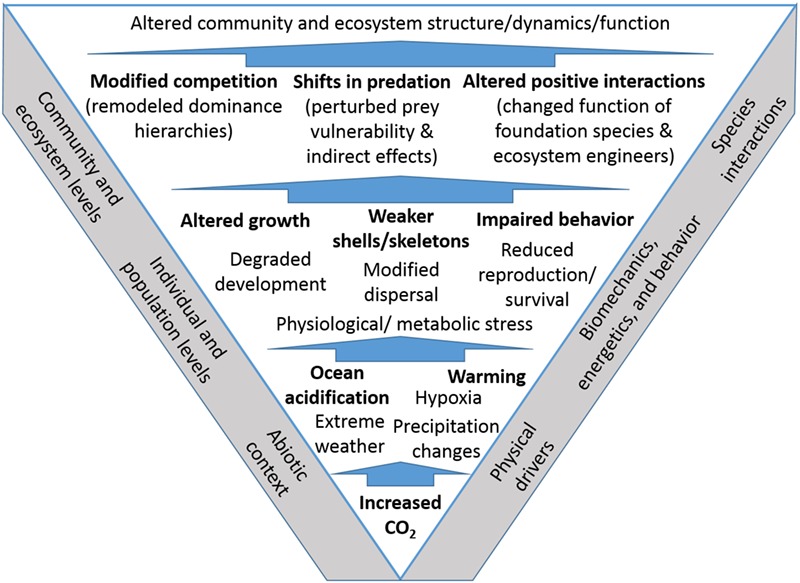
Humans are changing the physical properties of Earth. In marine systems, elevated carbon dioxide concentrations are driving notable shifts in temperature and seawater chemistry. Here, we consider consequences of such perturbations for organism biomechanics and linkages amongst species within communities. In particular, we examine case examples of altered morphologies and material properties, disrupted consumer-prey behaviours, and the potential for modulated positive (i.e. facilitative) interactions amongst taxa, as incurred through increasing ocean acidity and rising temperatures. We focus on intertidal rocky shores of temperate seas as model systems, acknowledging the longstanding role of these communities in deciphering ecological principles. Our survey illustrates the broad capacity for biomechanical and behavioural shifts in organisms to influence the ecology of a transforming world.
人类正在改变地球的物理特性。在海洋系统中,不断升高的二氧化碳浓度正在推动温度和海水化学性质发生显著变化。在此,我们探讨此类扰动对生物生物力学以及群落内物种间联系的影响。特别是,我们研究了形态和材料特性改变、消费者与猎物行为受干扰以及分类群之间潜在的正向(即促进性)相互作用被调节的案例,这些都是由海洋酸度增加和温度上升所导致的。我们将温带海洋的潮间带岩石海岸作为模型系统,认识到这些群落长期以来在解读生态原理方面所起的作用。我们的调查表明,生物的生物力学和行为转变具有广泛的能力来影响一个正在变化的世界的生态。