Säleby Joanna, Bouzina Habib, Ahmed Salaheldin, Lundgren Jakob, Rådegran Göran
Dept of Clinical Sciences Lund, Cardiology, Faculty of Medicine, Lund University, Lund, Sweden.
The Hemodynamic Lab, The Section for Heart Failure and Valvular Disease, VO Heart and Lung Medicine, Skåne University Hospital, Lund, Sweden.
ERJ Open Res. 2019 Nov 15;5(4). doi: 10.1183/23120541.00037-2019. eCollection 2019 Oct.
Pulmonary arterial hypertension (PAH) is a serious disease exhibiting unspecific symptoms, as a result of which diagnosis is often delayed and prognosis is poor. The underlying pathophysiology includes vasoconstriction and remodelling of small pulmonary arteries. As receptor tyrosine kinases (RTKs) and their ligands have been shown to promote PAH remodelling, our aim was to evaluate if their plasma levels may be utilised to differentiate between various causes of pulmonary hypertension.
28 biomarkers involved in RTK signalling were measured using proximity extension assays in venous plasma from patients with PAH (n=48), chronic thromboembolic pulmonary hypertension (CTEPH) (n=20), pulmonary hypertension due to diastolic (n=33) or systolic (n=36) heart failure and heart failure patients without pulmonary hypertension (n=15), as well as healthy controls (n=20).
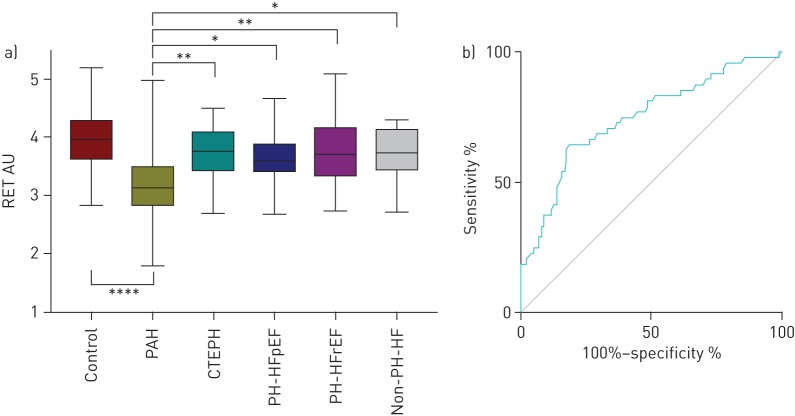
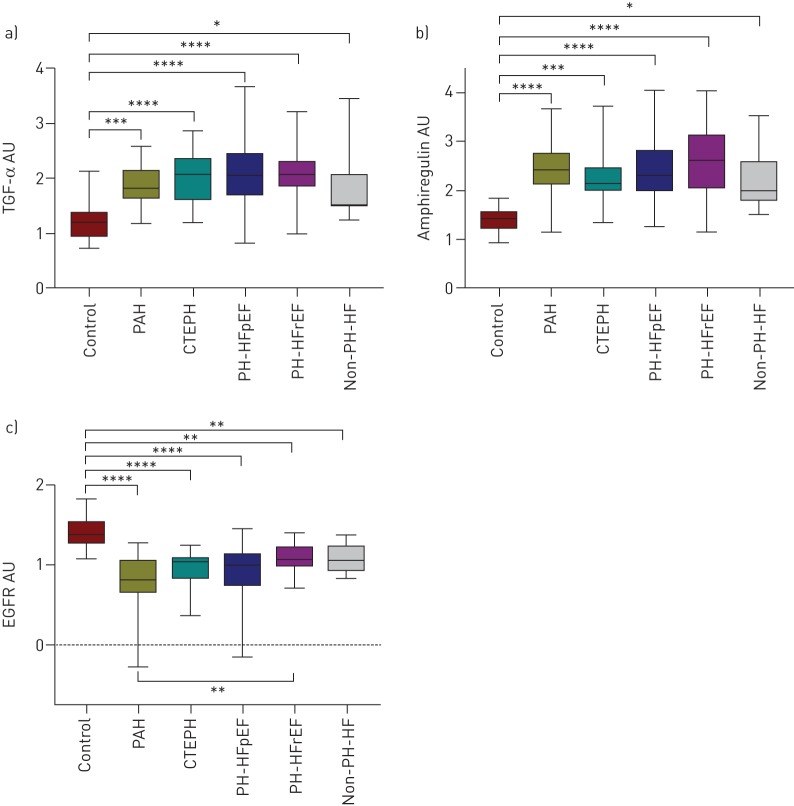
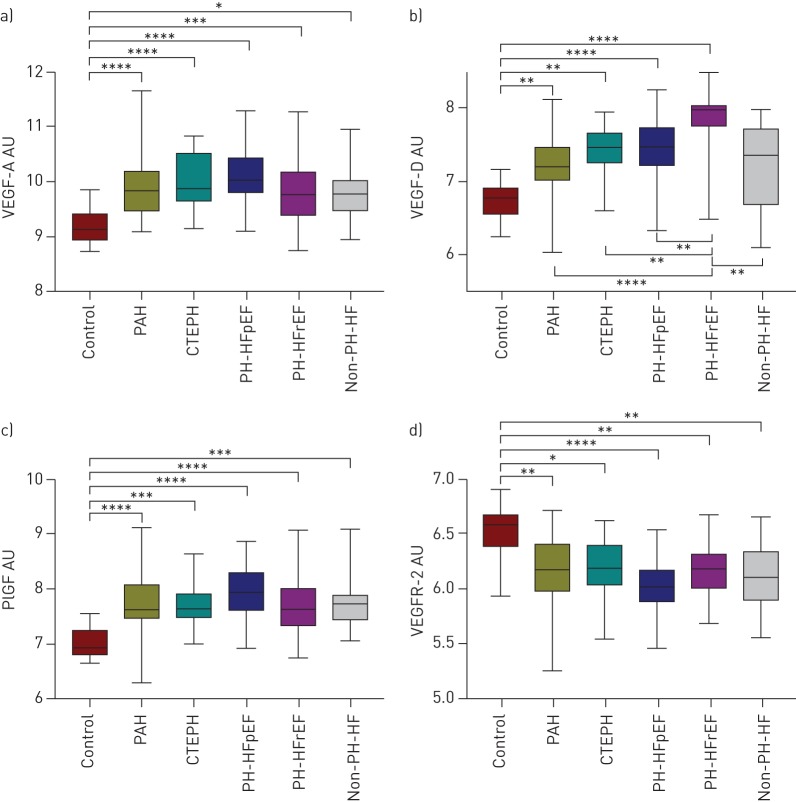
Plasma proto-oncogene tyrosine-protein kinase receptor Ret (RET) was decreased (p<0.04) in PAH compared with all disease groups and controls. RET generated a sensitivity of 64.6% and a specificity of 81.6% for detecting PAH from other disease groups. PAH and the other pulmonary hypertension groups showed elevated plasma tyrosine-protein kinase MER (p<0.01), vascular endothelial growth factor (VEGF)-A (p<0.02), VEGF-D (p<0.01), placental growth factor (p<0.01), amphiregulin (p<0.02), hepatocyte growth factor (p<0.01) and transforming growth factor-α (p<0.05) and decreased VEGF receptor-2 (p<0.04) and epidermal growth factor receptor (p<0.01) levels compared with controls.
Plasma RET differentiates patients with PAH from those with CTEPH, systolic or diastolic heart failure with or without pulmonary hypertension as well as healthy controls. Future studies would be of value to determine the clinical usefulness of RET as a biomarker and its link to PAH pathophysiology.
肺动脉高压(PAH)是一种表现出非特异性症状的严重疾病,因此诊断常常延迟且预后不良。其潜在的病理生理学包括小肺动脉的血管收缩和重塑。由于受体酪氨酸激酶(RTK)及其配体已被证明可促进PAH重塑,我们的目的是评估它们的血浆水平是否可用于区分肺动脉高压的各种病因。
使用邻位延伸分析测定了PAH患者(n = 48)、慢性血栓栓塞性肺动脉高压(CTEPH)患者(n = 20)、舒张期(n = 33)或收缩期(n = 36)心力衰竭导致的肺动脉高压患者以及无肺动脉高压的心力衰竭患者(n = 15)的静脉血浆中涉及RTK信号传导的28种生物标志物,同时测定了健康对照者(n = 20)的这些生物标志物。
与所有疾病组和对照组相比,PAH患者血浆原癌基因酪氨酸蛋白激酶受体Ret(RET)降低(p < 0.04)。RET检测PAH与其他疾病组的敏感性为64.6%,特异性为81.6%。与对照组相比,PAH组和其他肺动脉高压组血浆酪氨酸蛋白激酶MER(p < 0.01)、血管内皮生长因子(VEGF)-A(p < 0.02)、VEGF-D(p < 0.01)、胎盘生长因子(p < 0.01)、双调蛋白(p < 0.02)、肝细胞生长因子(p < 0.01)和转化生长因子-α(p < 0.05)升高,而VEGF受体-2(p < 0.04)和表皮生长因子受体(p < 0.01)水平降低。
血浆RET可将PAH患者与CTEPH患者、有或无肺动脉高压的收缩期或舒张期心力衰竭患者以及健康对照者区分开来。未来的研究对于确定RET作为生物标志物的临床实用性及其与PAH病理生理学的联系具有重要价值。