Choi Jinyeong, Gim Jeong-An, Oh Chiwoo, Ha Seunggyun, Lee Howard, Choi Hongyoon, Im Hyung-Jun
Department of Transdisciplinary Studies, Graduate School of Convergence Science and Technology, Seoul National University, Seoul, Republic of Korea.
Radiation Medicine Research Institute, Seoul National University College of Medicine, Seoul, Republic of Korea.
EJNMMI Res. 2019 Nov 21;9(1):97. doi: 10.1186/s13550-019-0563-0.
The linkage between the genetic and phenotypic heterogeneity of the tumor has not been thoroughly evaluated. Herein, we investigated how the genetic and metabolic heterogeneity features of the tumor are associated with each other in head and neck squamous cell carcinoma (HNSC). We further assessed the prognostic significance of those features.
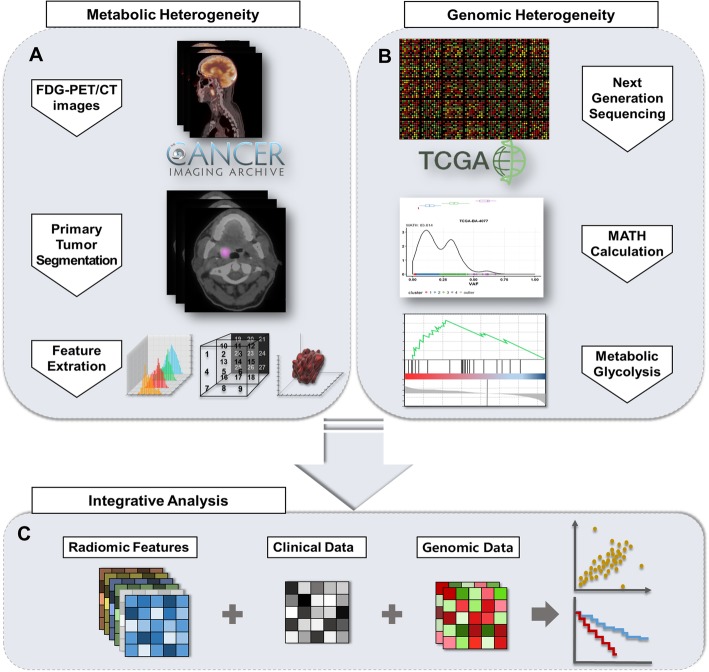
The mutant-allele tumor heterogeneity (MATH) score (n = 508), a genetic heterogeneity feature, and tumor glycolysis feature (GlycoS) (n = 503) were obtained from the HNSC dataset in the cancer genome atlas (TCGA). We identified matching patients (n = 33) who underwent 18F-fluorodeoxyglucose positron emission tomography (FDG PET) from the cancer imaging archive (TCIA) and obtained the following information from the primary tumor: metabolic, metabolic-volumetric, and metabolic heterogeneity features. The association between the genetic and metabolic features and their prognostic values were assessed.
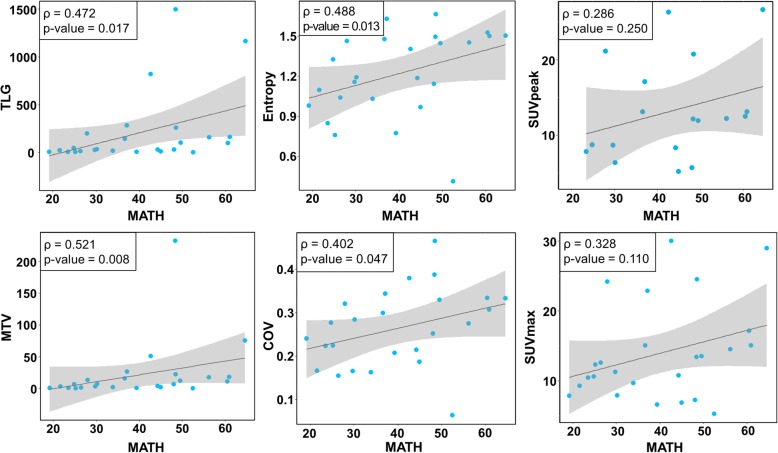
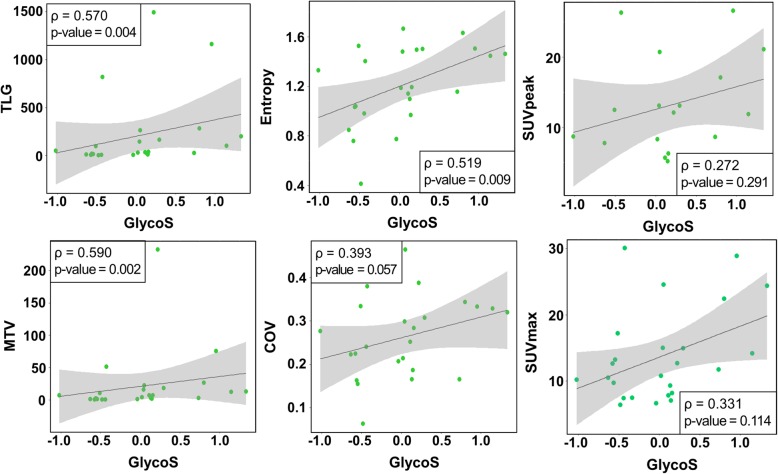
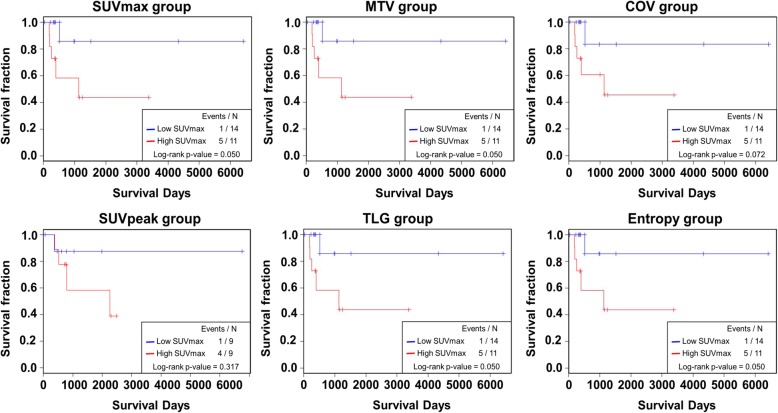
Tumor metabolic heterogeneity and metabolic-volumetric features showed a mild degree of association with MATH (n = 25, ρ = 0.4~0.5, P < 0.05 for all features). The patients with higher FDG PET features and MATH died sooner. Combination of MATH and tumor metabolic heterogeneity features showed a better stratification of prognosis than MATH. Also, higher MATH and GlycoS were associated with significantly worse overall survival (n = 499, P = 0.002 and 0.0001 for MATH and GlycoS, respectively). Furthermore, both MATH and GlycoS independently predicted overall survival after adjusting for clinicopathologic features and the other (P = 0.015 and 0.006, respectively).
Both tumor metabolic heterogeneity and metabolic-volumetric features assessed by FDG PET showed a mild degree of association with genetic heterogeneity in HNSC. Both metabolic and genetic heterogeneity features were predictive of survival and there was an additive prognostic value when the metabolic and genetic heterogeneity features were combined. Also, MATH and GlycoS were independent prognostic factors in HNSC; they can be used for precise prognostication once validated.
肿瘤的基因异质性与表型异质性之间的联系尚未得到充分评估。在此,我们研究了头颈部鳞状细胞癌(HNSC)中肿瘤的基因和代谢异质性特征是如何相互关联的。我们还进一步评估了这些特征的预后意义。
从癌症基因组图谱(TCGA)的HNSC数据集中获取突变等位基因肿瘤异质性(MATH)评分(n = 508),这是一种基因异质性特征,以及肿瘤糖酵解特征(GlycoS)(n = 503)。我们从癌症影像存档(TCIA)中确定了33例接受18F - 氟脱氧葡萄糖正电子发射断层扫描(FDG PET)的匹配患者,并从原发性肿瘤中获取以下信息:代谢、代谢体积和代谢异质性特征。评估基因和代谢特征之间的关联及其预后价值。
肿瘤代谢异质性和代谢体积特征与MATH显示出轻度关联(n = 25,ρ = 0.4~0.5,所有特征P < 0.05)。FDG PET特征较高和MATH较高的患者死亡更早。MATH与肿瘤代谢异质性特征的组合比MATH显示出更好的预后分层。此外,较高的MATH和GlycoS与总体生存率显著较差相关(n = 499,MATH和GlycoS的P值分别为0.002和0.0001)。此外,在调整临床病理特征和另一个因素后,MATH和GlycoS均独立预测总体生存率(P值分别为0.015和0.006)。
通过FDG PET评估的肿瘤代谢异质性和代谢体积特征与HNSC中的基因异质性均显示出轻度关联。代谢和基因异质性特征均为生存的预测指标,并且当代谢和基因异质性特征相结合时具有附加的预后价值。此外,MATH和GlycoS是HNSC中的独立预后因素;一旦得到验证,它们可用于精确预后评估。