Barker Juliet N, Mazis Christopher M, Devlin Sean M, Davis Eric, Maloy Molly A, Naputo Kristine, Nhaissi Melissa, Wells Deborah, Scaradavou Andromachi, Politikos Ioannis
Adult Bone Marrow Transplantation Service, Department of Medicine Memorial Sloan Kettering Cancer Center, New York, New York; Weill Cornell Medical College, New York, New York.
Adult Bone Marrow Transplantation Service, Department of Medicine Memorial Sloan Kettering Cancer Center, New York, New York.
Biol Blood Marrow Transplant. 2020 Apr;26(4):734-744. doi: 10.1016/j.bbmt.2019.11.017. Epub 2019 Nov 19.
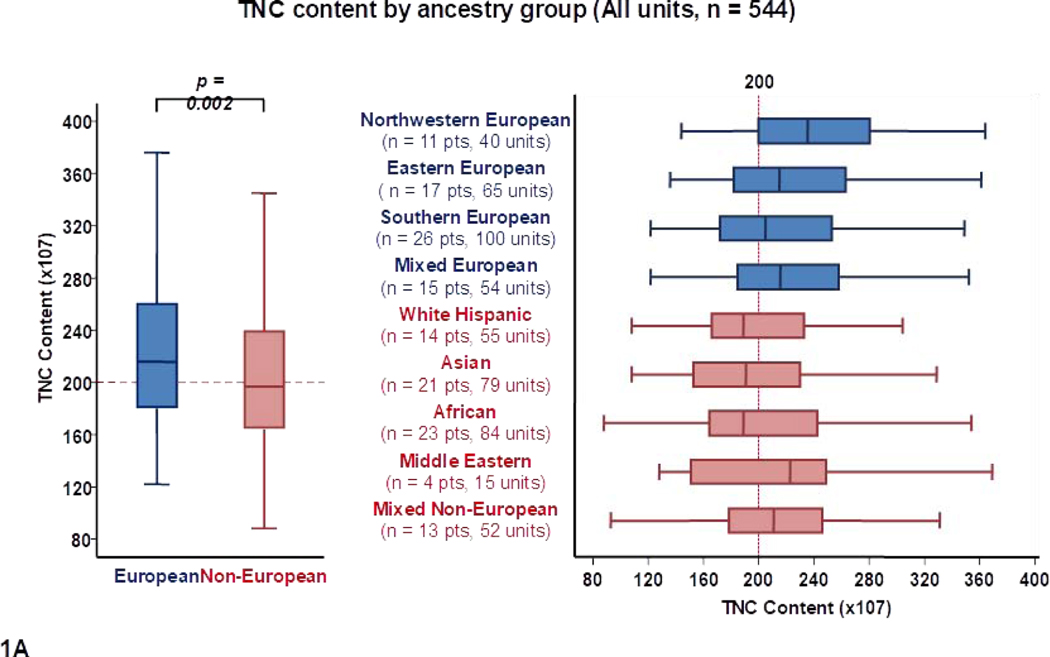
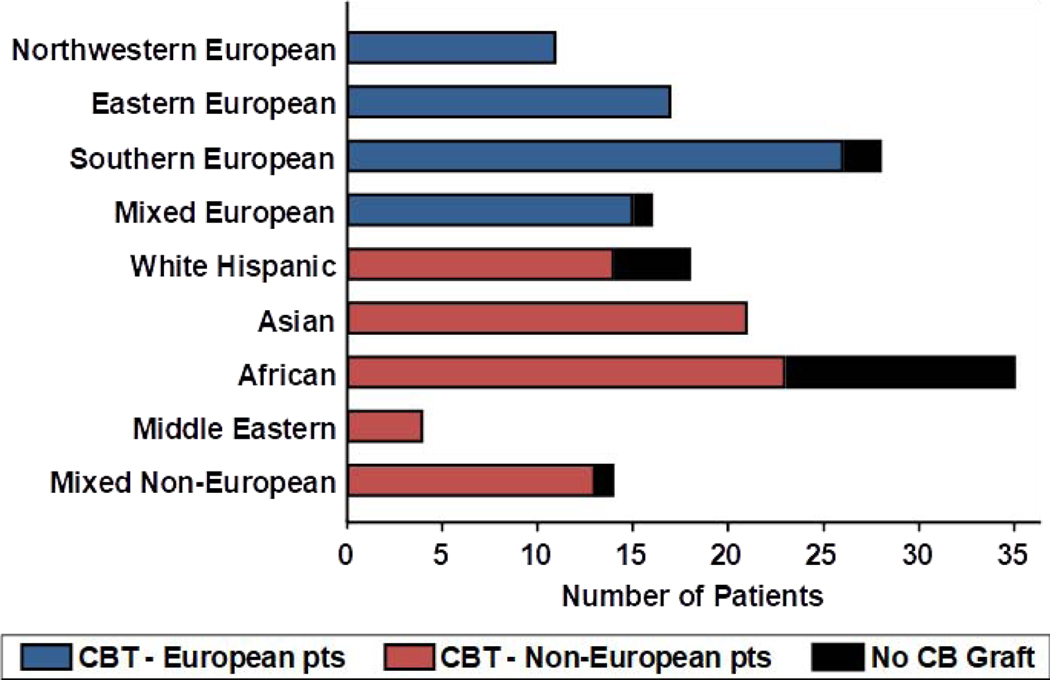
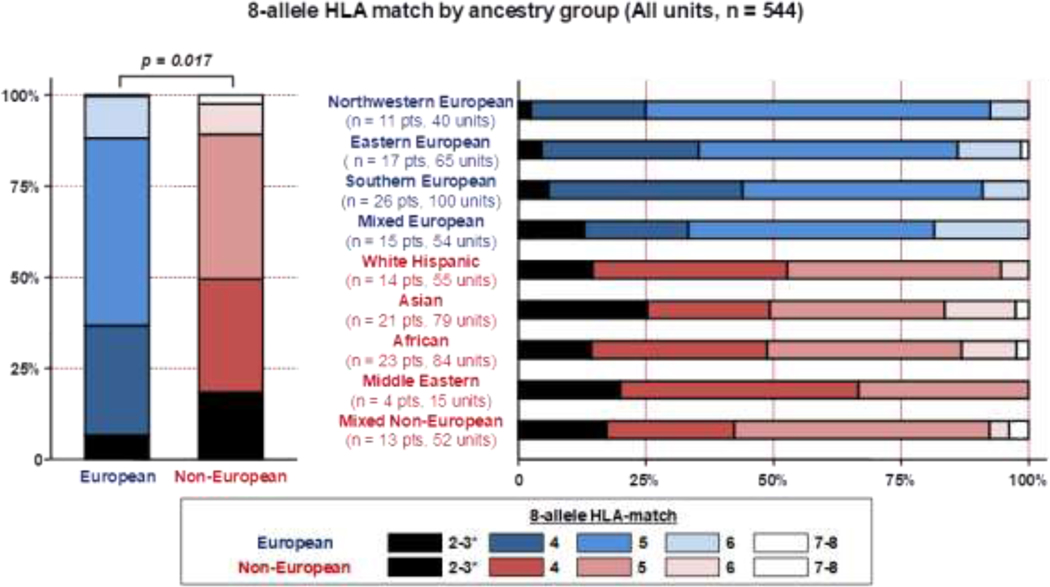
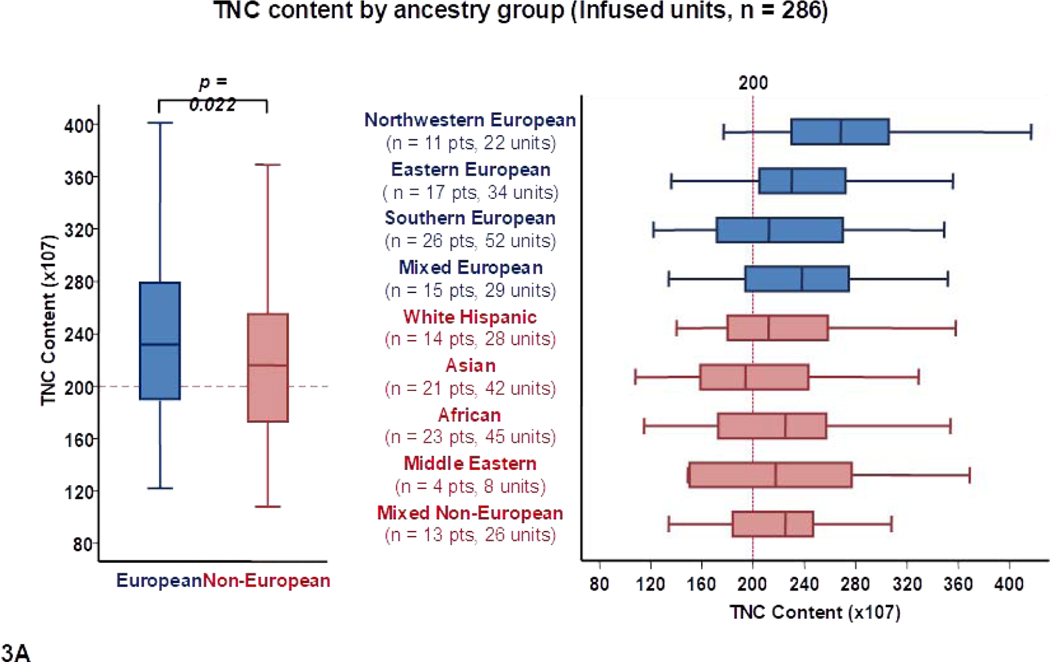
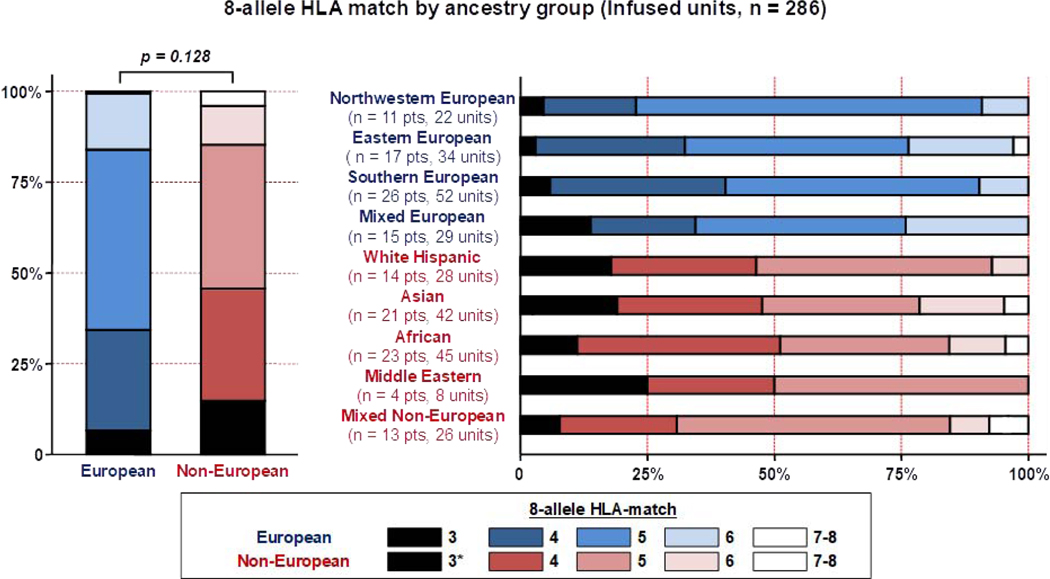
How cord blood (CB) CD34 cell content and dose and 8-allele HLA match vary by patient ancestry is unknown. We analyzed cell content, dose, and high-resolution HLA-match of units selected for CB transplantation (CBT) by recipient ancestry. Of 544 units (286 infused, 258 next-best backups) chosen for 144 racially diverse adult patients (median weight, 81 kg), the median total nucleated cell (TNC) and CD34cell contents were higher for Europeans than for non-Europeans: 216 × 10versus 197 × 10 (P = .002) and 160 × 10 versus 132 × 10 (P = .007), respectively. There were marked cell content disparities among ancestry groups, with units selected for Africans having the lowest TNC (189 × 10) and CD34 cell (122 × 10) contents. Units for non-Europeans were also more HLA-mismatched (P = .017). When only the 286 transplanted units were analyzed, the adverse effect of reduced cell content was exacerbated by the higher weights in some groups. For example, northwestern Europeans (high patient weight, high unit cell content) had the best-dosed units, and Africans (high weight, low unit cell content) had the lowest. In Asians, low cell content was partially compensated for by lower weight. Marked differences in 8-allele HLA-match distribution were also observed by ancestry group; for example, 23% of units for northwestern Europeans were 3/8 to 4/8 HLA-matched, compared with 40% for southern Europeans, 46% for white Hispanics, and 51% for Africans. During the study period, 20 additional patients (17 non-Europeans; median weight, 98 kg) did not undergo CBT owing to the lack of a suitable graft. CB extends transplantation access to most patients, but racial disparities exist in cell content, dose, and HLA match.
脐带血(CB)的CD34细胞含量、剂量以及8个等位基因的HLA配型如何因患者血统而异尚不清楚。我们根据接受者的血统分析了为脐带血移植(CBT)所选单位的细胞含量、剂量和高分辨率HLA配型。在为144名种族多样的成年患者(中位体重81千克)选择的544个单位(286个已输注,258个次优备用单位)中,欧洲人的中位总核细胞(TNC)和CD34细胞含量高于非欧洲人:分别为216×10⁶与197×10⁶(P = 0.002)和160×10⁴与132×10⁴(P = 0.007)。不同血统组之间存在明显的细胞含量差异,为非洲人选择的单位TNC(189×10⁶)和CD34细胞(122×10⁴)含量最低。非欧洲人的单位HLA配型也更不匹配(P = 0.017)。仅分析286个已移植单位时,某些组中较高的体重加剧了细胞含量降低的不利影响。例如,西北欧人(患者体重高,单位细胞含量高)的单位剂量最佳,而非洲人(体重高,单位细胞含量低)的单位剂量最低。在亚洲人中,较低的体重部分弥补了细胞含量低的问题。不同血统组在8个等位基因HLA配型分布上也存在明显差异;例如,西北欧人23%的单位为3/8至4/8 HLA匹配,而南欧人为40%,西班牙裔白人为46%,非洲人为51%。在研究期间,另外20名患者(17名非欧洲人;中位体重98千克)由于缺乏合适的移植物而未接受CBT。脐带血扩大了大多数患者的移植机会,但在细胞含量、剂量和HLA配型方面存在种族差异。