Institute for Translational Epidemiology, Icahn School of Medicine at Mount Sinai, New York, NY 10029, USA.
Int J Environ Res Public Health. 2019 Nov 20;16(23):4605. doi: 10.3390/ijerph16234605.
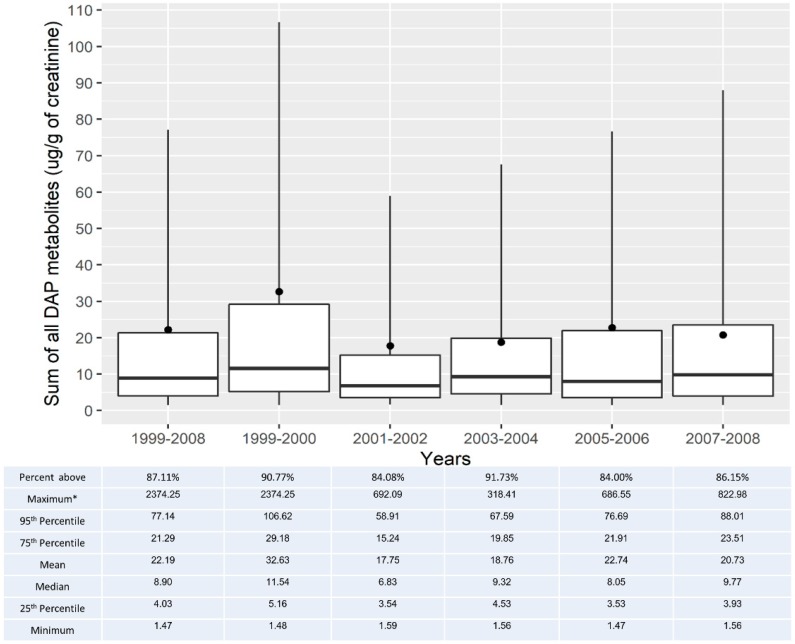
Urinary dialkylphosphate metabolites are considered to be a proxy of the cumulative exposure to organophosphorus pesticides. We analyzed the urinary levels of six dialkylphosphate (DAP) metabolites in US adults, to assess the factors associated with levels of urinary metabolites, and observe the time trends. We analyzed the combined urinary levels of Dimethylphosphate (DMP), Diethylphosphate (DEP), Dimethylthiophosphate (DMTP), Diethylthiophosphate (DETP), Dimethyldithiophosphate (DMDTP), and Diethyldithiophosphate (DEDTP) in the National Health and Nutrition Examination Survey (NHANES) from 1999 and 2008. Increased age and female gender were positively associated with combined levels of urinary DAP metabolites; BMI < 18.5 kg/m, BMI > 25 kg/m, current smoking, and later survey year were inversely associated with combined levels of DAP metabolites. Among those with at least one detectable DAP in their urine, the mean levels decreased starting in 2001, but stayed relatively stable through 2008. Although the maximum combined urinary DAP level was highest in 1999-2000, throughout all years, we observed extremely high levels of exposure for subgroups of individuals. Despite the fact that organophosphorus pesticides were banned for residential use in the US in 2006, there are still opportunities for exposure in the general population. The average urinary DAP levels have decreased over time; however, the decline appears to have plateaued in recent years, and there remains highly exposed individuals.
尿中二烷基磷酸酯代谢物被认为是有机磷农药累积暴露的替代物。我们分析了美国成年人尿中二烷基磷酸酯 (DAP) 代谢物的水平,以评估与尿代谢物水平相关的因素,并观察时间趋势。我们分析了 1999 年和 2008 年全国健康和营养调查 (NHANES) 中二甲磷酸酯 (DMP)、二乙基磷酸酯 (DEP)、二甲基硫代磷酸酯 (DMTP)、二乙基硫代磷酸酯 (DETP)、二甲基二硫代磷酸酯 (DMDTP) 和二乙基二硫代磷酸酯 (DEDTP) 的尿中联合水平。年龄增长和女性性别与尿中二烷基磷酸酯代谢物的联合水平呈正相关;BMI<18.5kg/m、BMI>25kg/m、当前吸烟和较晚的调查年份与尿中二烷基磷酸酯代谢物的联合水平呈负相关。在至少有一种可检测到的 DAP 存在于尿液中的人群中,自 2001 年开始,平均水平开始下降,但到 2008 年仍相对稳定。尽管有机磷农药已于 2006 年在美国被禁止用于住宅用途,但仍有机会在普通人群中接触到它们。尿中二烷基磷酸酯的平均水平随时间呈下降趋势;然而,近年来下降似乎已经趋于平稳,仍然存在高度暴露的个体。