Climate Change Cluster (C3), University of Technology Sydney, Sydney, Australia.
School of Life and Environmental Sciences, University of Sydney, Sydney, Australia.
Sci Rep. 2019 Nov 22;9(1):17395. doi: 10.1038/s41598-019-53552-0.
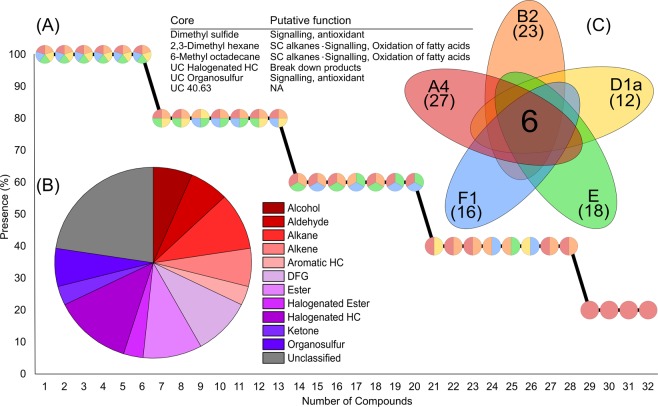
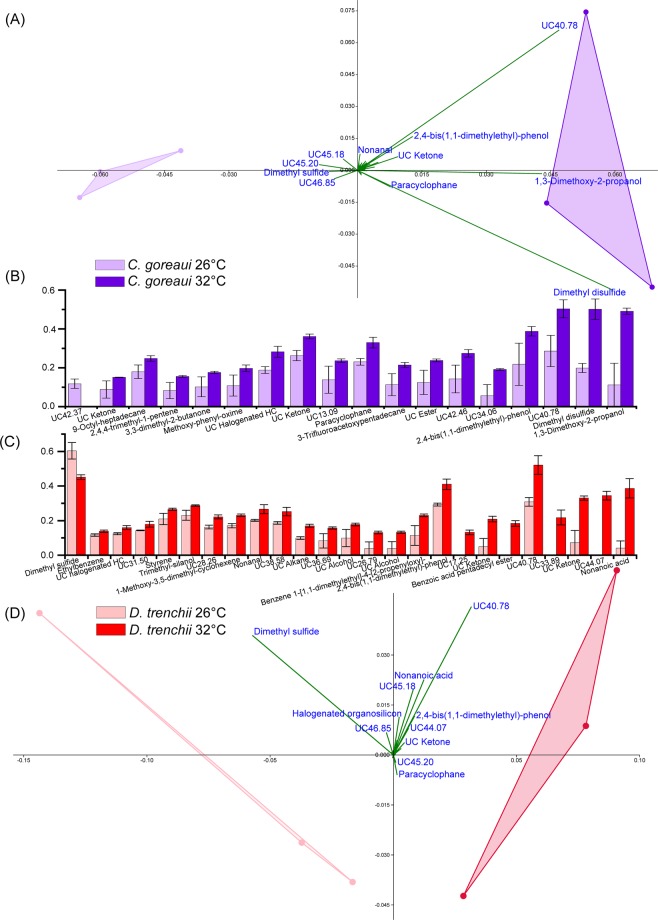
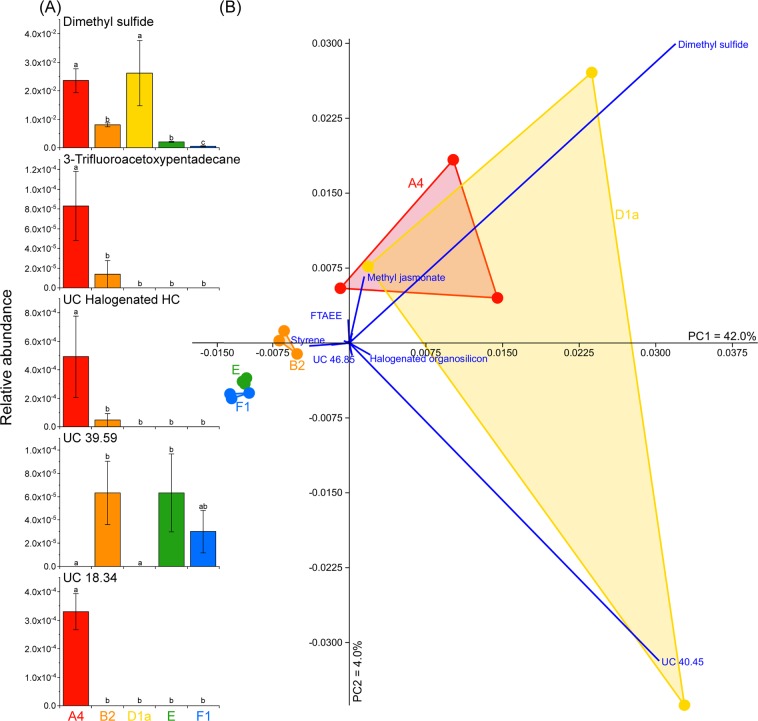
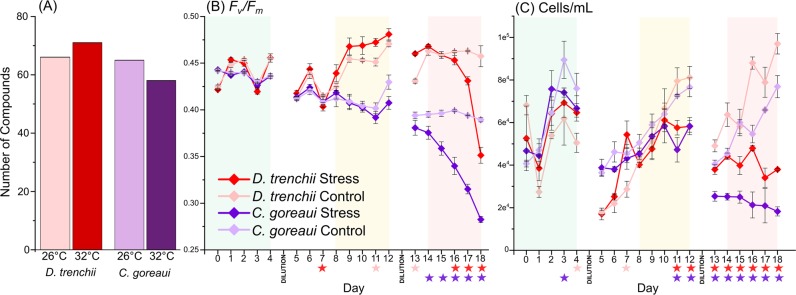
Biogenic volatile organic compounds (BVOCs) influence organism fitness by promoting stress resistance and regulating trophic interactions. Studies examining BVOC emissions have predominantly focussed on terrestrial ecosystems and atmospheric chemistry - surprisingly, highly productive marine ecosystems remain largely overlooked. Here we examined the volatilome (total BVOCs) of the microalgal endosymbionts of reef invertebrates, Symbiodiniaceae. We used GC-MS to characterise five species (Symbiodinium linucheae, Breviolum psygmophilum, Durusdinium trenchii, Effrenium voratum, Fugacium kawagutii) under steady-state growth. A diverse range of 32 BVOCs were detected (from 12 in D. trenchii to 27 in S. linucheae) with halogenated hydrocarbons, alkanes and esters the most common chemical functional groups. A thermal stress experiment on thermally-sensitive Cladocopium goreaui and thermally-tolerant D. trenchii significantly affected the volatilomes of both species. More BVOCs were detected in D. trenchii following thermal stress (32 °C), while fewer BVOCs were recorded in stressed C. goreaui. The onset of stress caused dramatic increases of dimethyl-disulfide (98.52%) in C. goreaui and nonanoic acid (99.85%) in D. trenchii. This first volatilome analysis of Symbiodiniaceae reveals that both species-specificity and environmental factors govern the composition of BVOC emissions among the Symbiodiniaceae, which potentially have, as yet unexplored, physiological and ecological importance in shaping coral reef community functioning.
生物源挥发性有机化合物 (BVOCs) 通过促进抗逆性和调节营养相互作用来影响生物适应性。研究 BVOC 排放的主要集中在陆地生态系统和大气化学上——令人惊讶的是,高生产力的海洋生态系统在很大程度上仍被忽视。在这里,我们研究了珊瑚无脊椎动物内生共生体微藻的挥发组(总 BVOCs)。我们使用 GC-MS 对处于稳定生长状态的 5 个物种(Linuchea symbiodinium、 Breviolum psygmophilum、 Durusdinium trenchii、 Effrenium voratum、 Fugacium kawagutii)进行了特征描述。共检测到 32 种不同的 BVOCs(从 D. trenchii 的 12 种到 S. linucheae 的 27 种),其中卤代烃、烷烃和酯类是最常见的化学官能团。对热敏 Cladocopium goreaui 和热敏 D. trenchii 的热应激实验显著影响了这两个物种的挥发组。在热应激(32°C)后,D. trenchii 中检测到更多的 BVOCs,而应激 C. goreaui 中记录到的 BVOCs 较少。应激的开始导致 C. goreaui 中二甲基二硫(98.52%)和 D. trenchii 中非酸(99.85%)的急剧增加。这是对 Symbiodiniaceae 挥发组的首次分析,结果表明,物种特异性和环境因素共同控制着 Symbiodiniaceae 中 BVOC 排放的组成,这可能具有尚未探索的生理和生态重要性,从而影响珊瑚礁群落的功能。