De Ridder Benjamin, Van Rompaey Bart, Kampen Jarl K, Haine Steven, Dilles Tinne
University Hospital Ghent, Ghent, Belgium.
Department of Nursing and Midwifery, Faculty of Medicine and Health Sciences, University of Antwerp, Antwerp, Belgium.
JMIR Cardio. 2018 Feb 27;2(1):e4. doi: 10.2196/cardio.8802.
Smartphone ownership is rising at a stunning rate. Moreover, smartphones prove to be suitable for use in health care due to their availability, portability, user-friendliness, relatively low price, wireless connectivity, far-reaching computing capabilities, and comprehensive memory. To measure vital signs, smartphones are often connected to a mobile sensor or a medical device. However, by using the white light-emitting diode as light source and the phone camera as photodetector, a smartphone could be used to perform photoplethysmography (PPG), enabling the assessment of vital signs.
The objective of this meta-analysis was to evaluate the available evidence on the use of smartphone apps to measure heart rate by performing PPG in comparison with a validated method.
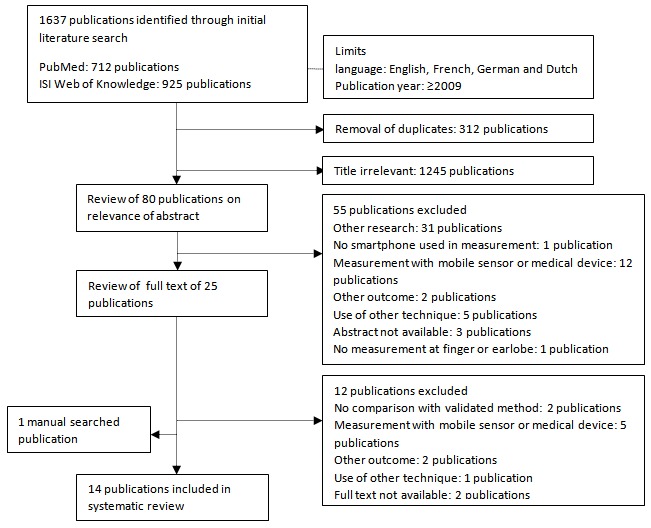
PubMed and ISI Web of Knowledge were searched for relevant studies published between January 1, 2009 and December 7, 2016. The reference lists of included studies were hand-searched to find additional eligible studies. Critical Appraisal Skills Programme (CASP) Diagnostic Test Study checklist and some extra items were used for quality assessment. A fixed effects model of the mean difference and a random effects model of Pearson correlation coefficient were applied to pool the outcomes of the studies.
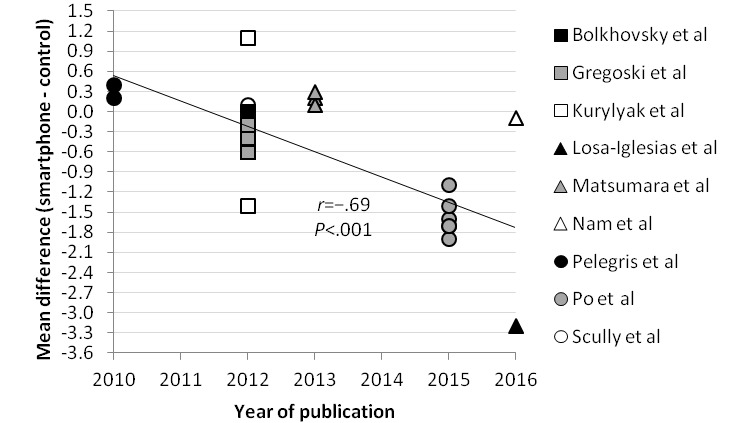
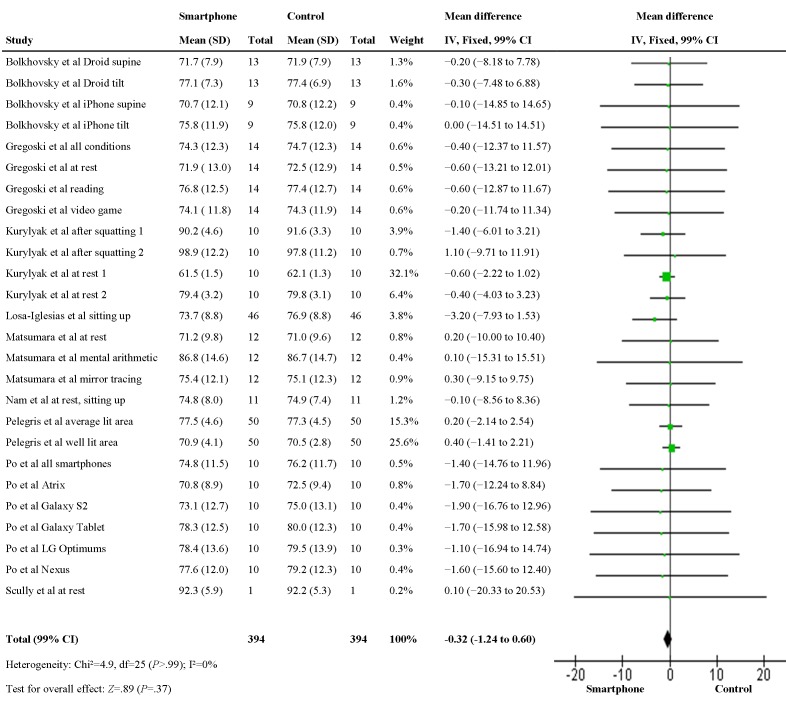
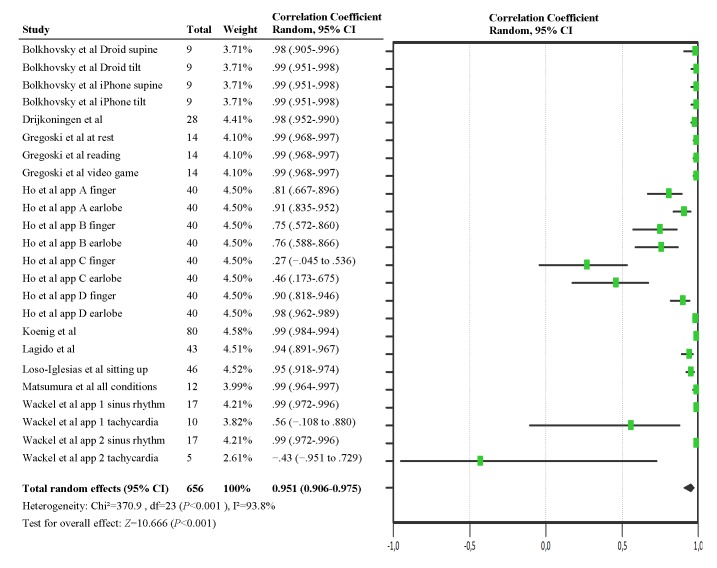
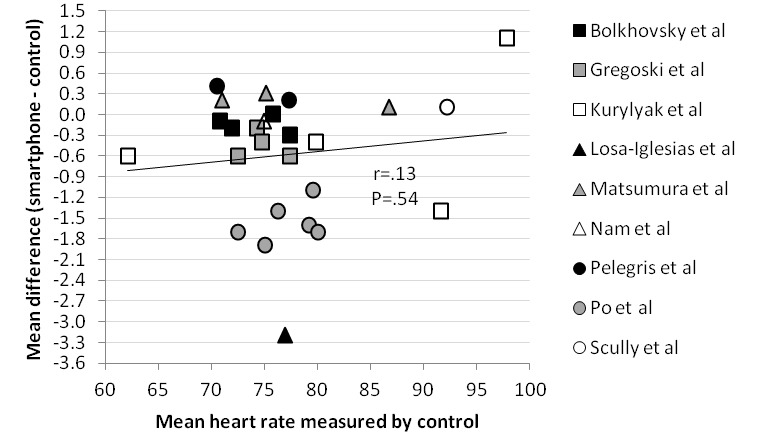
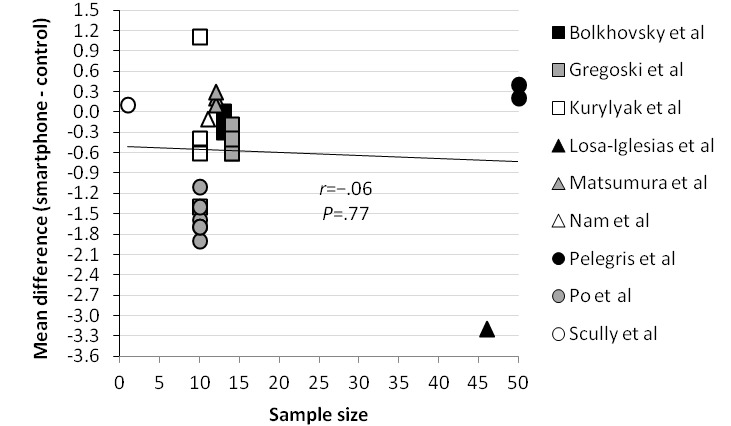
In total, 14 studies were included. The pooled result showed no significant difference between heart rate measurements with a smartphone and a validated method (mean difference -0.32; 99% CI -1.24 to 0.60; P=.37). In adults, the Pearson correlation coefficient of the relation between heart rate measurement with a smartphone and a validated method was always ≥.90. In children, the results varied depending on measuring point and heart rate. The pooled result showed a strong correlation that was significant (correlation coefficient .951; 95% CI 0.906-0.975; P<.001). The reported limits of agreement showed good agreement between a smartphone and a validated method. There was a moderately strong significant negative correlation between the year of publication of the included studies and the mean difference (r=-.69; P<.001).
Smartphone apps measuring heart rate by performing PPG appear to agree with a validated method in an adult population during resting sinus rhythm. In a pediatric population, the use of these apps is currently not validated.
智能手机的拥有率正以惊人的速度增长。此外,由于其可用性、便携性、用户友好性、相对较低的价格、无线连接性、强大的计算能力和大容量存储,智能手机被证明适用于医疗保健领域。为了测量生命体征,智能手机通常与移动传感器或医疗设备相连。然而,通过使用白光发光二极管作为光源,手机摄像头作为光电探测器,智能手机可用于进行光电容积脉搏波描记法(PPG),从而实现生命体征的评估。
本荟萃分析的目的是通过与一种经过验证的方法进行比较,评估使用智能手机应用程序通过PPG测量心率的现有证据。
在PubMed和科学网(ISI Web of Knowledge)中检索2009年1月1日至2016年12月7日期间发表的相关研究。对纳入研究的参考文献列表进行手工检索,以寻找其他符合条件的研究。使用批判性评估技能计划(CASP)诊断测试研究清单和一些额外项目进行质量评估。应用平均差的固定效应模型和Pearson相关系数的随机效应模型汇总研究结果。
共纳入14项研究。汇总结果显示,使用智能手机测量心率与经过验证的方法之间无显著差异(平均差-0.32;99%CI-1.24至0.60;P=0.37)。在成年人中,使用智能手机测量心率与经过验证的方法之间的Pearson相关系数始终≥0.90。在儿童中,结果因测量点和心率而异。汇总结果显示存在显著的强相关性(相关系数0.951;95%CI 0.906-0.975;P<0.001)。报告的一致性界限显示智能手机与经过验证的方法之间具有良好的一致性。纳入研究的发表年份与平均差之间存在中度强显著负相关(r=-0.69;P<0.001)。
在静息窦性心律期间,通过PPG测量心率的智能手机应用程序在成年人群中似乎与经过验证的方法一致。在儿科人群中,目前尚未验证这些应用程序的使用情况。