CORE Group Polio Project, Washington, District of Columbia.
United States Agency for International Development, Washington, District of Columbia.
Am J Trop Med Hyg. 2019 Oct;101(4_Suppl):4-14. doi: 10.4269/ajtmh.18-0916.
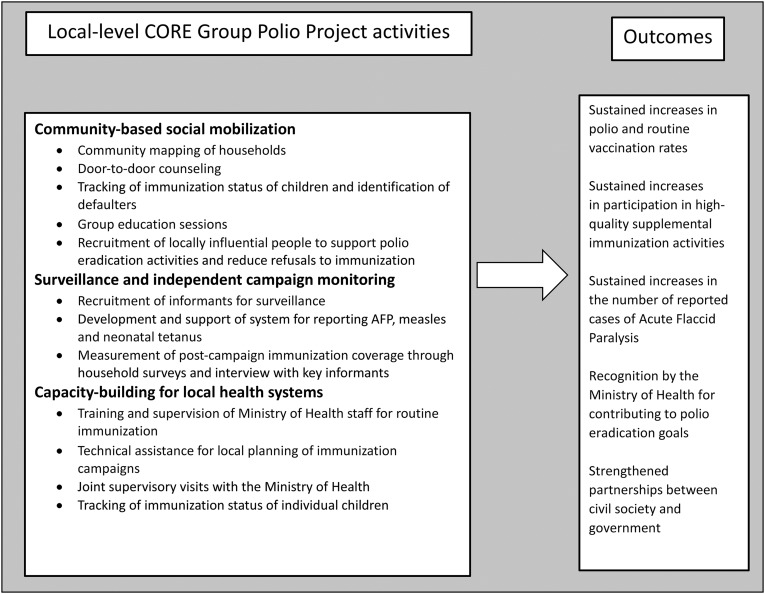
The CORE Group Polio Project (CGPP) has contributed to polio eradication by successfully engaging civil society, particularly the non-governmental organization (NGO) community. This engagement, which began with a grant from the U.S. Agency for International Development in 1999, has contributed to improvements in routine immunization programs, polio campaign quality, and surveillance for acute flaccid paralysis in many challenging geographic areas. The CGPP has worked closely with polio eradication partners in a collaborative and supportive role. The CGPP has focused largely on high-risk areas with marginalized or hard-to-reach populations where health systems and immunization programs have also been weak and where transmission of poliovirus had not been stopped. The CGPP has engaged local civic leaders and communities in ways to complement top-down vertical efforts of ministries of health and other partners in the Global Polio Eradication Initiative. The CGPP has developed innovative strategies to detect cases using community-based surveillance, promoted independent campaign monitoring, established cross-border initiatives, and developed a strong and creative cadre of community mobilizers to track missed children and deliver behavior change education. Many of the innovations and approaches that the CGPP helped to develop are now being replicated by governments and international agencies to tackle other public health priorities in underserved and marginalized communities around the world. This article is the first in a series of articles describing the work of the CGPP. Because the article describes the work of more than 40 NGOs in 11 countries over 20 years, it provides only an overview, leaving many important details and variations of the CGPP's work to be described elsewhere, including in other articles included in this series.
CORE 集团脊灰项目(CGPP)通过成功地让民间社会,特别是非政府组织(NGO)社区参与其中,为脊灰根除工作做出了贡献。这种参与始于 1999 年美国国际开发署的一项赠款,有助于改善常规免疫计划、脊灰运动质量以及在许多具有挑战性的地理区域监测急性弛缓性麻痹。CGPP 与脊灰根除伙伴密切合作,发挥协作和支持作用。CGPP 主要关注高风险地区,这些地区的边缘化或难以到达的人群,那里的卫生系统和免疫规划也很薄弱,脊灰病毒的传播也没有停止。CGPP 通过与地方公民领袖和社区合作,补充了卫生部和全球脊灰根除倡议其他伙伴自上而下的垂直努力。CGPP 制定了创新战略,通过社区为基础的监测来发现病例,促进独立的运动监测,建立跨境倡议,并培养了一支强大而富有创造力的社区动员者队伍,以追踪错过接种的儿童并开展行为改变教育。CGPP 帮助开发的许多创新和方法,现在正被政府和国际机构复制,以解决全球服务不足和边缘化社区的其他公共卫生重点。本文是描述 CGPP 工作的一系列文章中的第一篇。由于本文描述了 11 个国家的 40 多个非政府组织在 20 年中的工作,因此仅提供了一个概述,许多 CGPP 工作的重要细节和变化将在其他地方描述,包括本系列中的其他文章。