Rassati Davide, Marini Lorenzo, Malacrinò Antonino
Department of Agronomy, Food, Natural Resources, Animals and Environment (DAFNAE), University of Padova, Padova, Italy.
Department of Evolution, Ecology and Organismal Biology, Ohio State University, Columbus, OH, United States of America.
PeerJ. 2019 Nov 18;7:e8103. doi: 10.7717/peerj.8103. eCollection 2019.
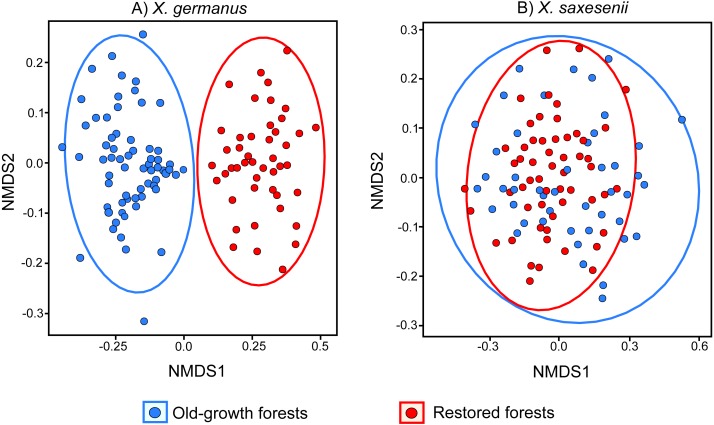
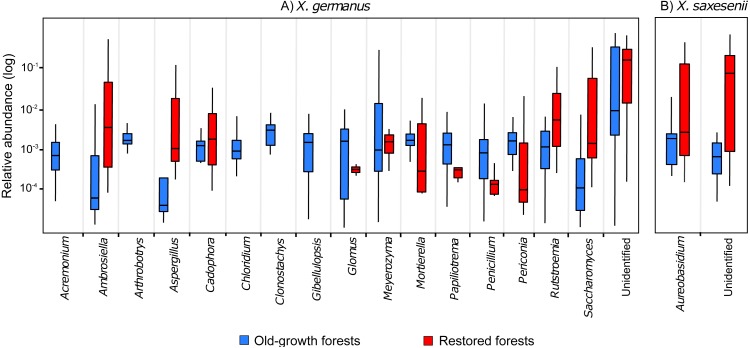
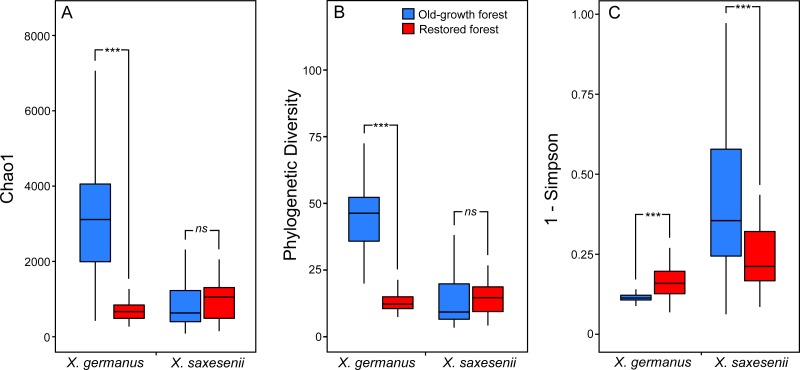
Microbial symbionts can play critical roles when their host attempts to colonize a new habitat. The lack of symbiont adaptation can in fact hinder the invasion process of their host. This scenario could change if the exotic species are able to acquire microorganisms from the invaded environment. Understanding the ecological factors that influence the take-up of new microorganisms is thus essential to clarify the mechanisms behind biological invasions. In this study, we tested whether different forest habitats influence the structure of the fungal communities associated with ambrosia beetles. We collected individuals of the most widespread exotic () and native () ambrosia beetle species in Europe in several old-growth and restored forests. We characterized the fungal communities associated with both species via metabarcoding. We showed that forest habitat shaped the community of fungi associated with both species, but the effect was stronger for the exotic . Our results support the hypothesis that the direct contact with the mycobiome of the invaded environment might lead an exotic species to acquire native fungi. This process is likely favored by the occurrence of a bottleneck effect at the mycobiome level and/or the disruption of the mechanisms sustaining co-evolved insect-fungi symbiosis. Our study contributes to the understanding of the factors affecting insect-microbes interactions, helping to clarify the mechanisms behind biological invasions.
当宿主试图在新栖息地定殖时,微生物共生体可发挥关键作用。事实上,共生体缺乏适应性会阻碍其宿主的入侵进程。如果外来物种能够从被入侵环境中获取微生物,这种情况可能会改变。因此,了解影响新微生物摄取的生态因素对于阐明生物入侵背后的机制至关重要。在本研究中,我们测试了不同的森林栖息地是否会影响与食菌小蠹相关的真菌群落结构。我们在几片原始森林和恢复森林中收集了欧洲分布最广的外来()和本地()食菌小蠹物种的个体。我们通过元条形码技术对与这两个物种相关的真菌群落进行了表征。我们发现森林栖息地塑造了与这两个物种相关的真菌群落,但对外来物种的影响更强。我们的结果支持这样的假设,即与被入侵环境的真菌群落直接接触可能会导致外来物种获得本地真菌。这个过程可能受到真菌群落水平上瓶颈效应的出现和/或维持共同进化的昆虫 - 真菌共生机制的破坏的青睐。我们的研究有助于理解影响昆虫 - 微生物相互作用的因素,有助于阐明生物入侵背后的机制。