Ludwig Nils, Hong Chang-Sook, Ludwig Sonja, Azambuja Juliana H, Sharma Priyanka, Theodoraki Marie-Nicole, Whiteside Theresa L
Department of Pathology, University of Pittsburgh School of Medicine, Pittsburgh, Pennsylvania.
UPMC Hillman Cancer Center, Pittsburgh, Pennsylvania.
Curr Protoc Immunol. 2019 Dec;127(1):e91. doi: 10.1002/cpim.91.
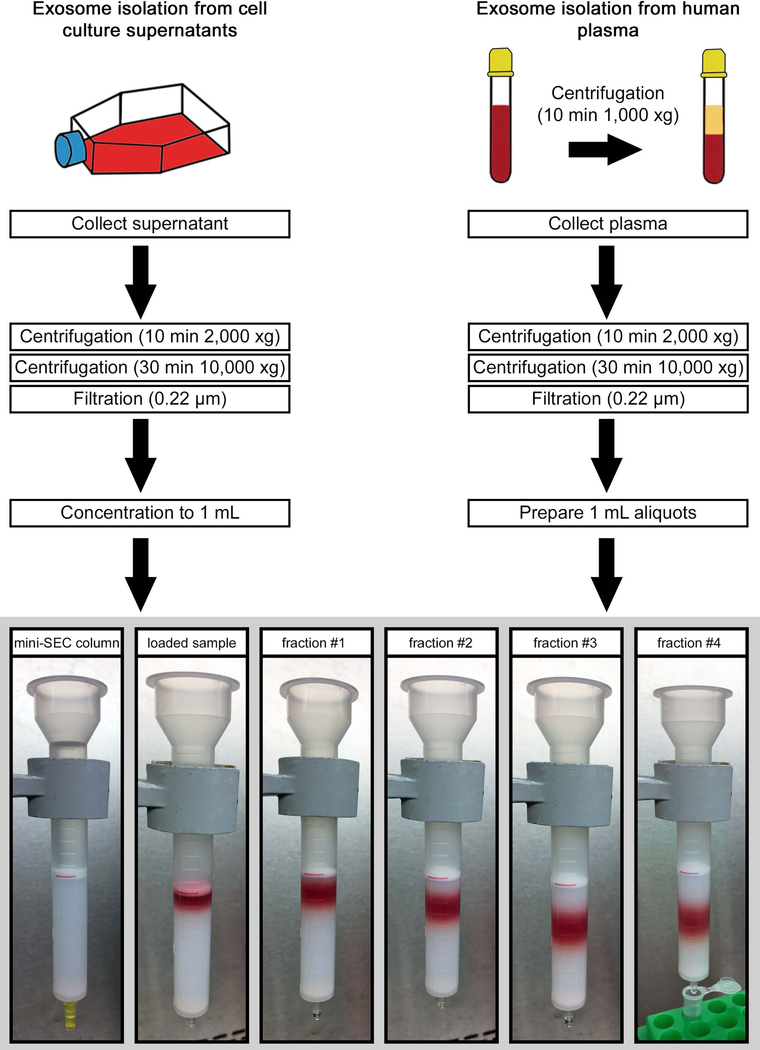
A method for isolation of exosomes from tumor cell supernatants or cancer patients' plasma is presented. Tumor-derived exosomes (TEX) are defined as a subset of extracellular vesicles (EVs) sized at 30 to 150 nm and originating from multivesicular bodies (MVBs). The method utilizes size exclusion chromatography (SEC) for recovery of exosomes from cell-line supernatants or cancer patients' plasma. The recovered exosomes are morphologically intact, aggregate-free, and functionally competent. Their molecular content parallels that of the parent tumor cells and they carry various immunoregulatory ligands known to modulate functions of immune cells. All exosomes isolated from tumor cell lines are TEX, while those isolated from plasma of cancer patients have to be fractionated into TEX and non-TEX. Mini-SEC allows for exosome isolation and recovery in quantities sufficient for molecular profiling, functional studies, and, in the case of plasma, further fractionation into TEX and non-TEX. The mini-SEC method can also be used for comparative studies of the exosome content in serial specimens of cancer patients' body fluids. © 2019 by John Wiley & Sons, Inc.
本文介绍了一种从肿瘤细胞上清液或癌症患者血浆中分离外泌体的方法。肿瘤来源的外泌体(TEX)被定义为细胞外囊泡(EVs)的一个子集,其大小为30至150纳米,起源于多泡体(MVBs)。该方法利用尺寸排阻色谱法(SEC)从细胞系上清液或癌症患者血浆中回收外泌体。回收的外泌体形态完整、无聚集且功能正常。它们的分子含量与亲代肿瘤细胞相似,并且携带各种已知可调节免疫细胞功能的免疫调节配体。从肿瘤细胞系中分离出的所有外泌体都是TEX,而从癌症患者血浆中分离出的外泌体则必须分为TEX和非TEX。微型SEC能够以足够的量分离和回收外泌体,用于分子谱分析、功能研究,并且在血浆的情况下,还能进一步分为TEX和非TEX。微型SEC方法还可用于癌症患者体液系列标本中外泌体含量的比较研究。© 2019约翰威立父子公司。