Department of Oncology, Shaoxing People's Hospital (Shaoxing Hospital, Zhejiang University School of Medicine), Shaoxing, Zhejiang, China.
Department of Radiotherapy, Shaoxing People's Hospital (Shaoxing Hospital, Zhejiang University School of Medicine), Shaoxing, Zhejiang, China.
PLoS One. 2019 Nov 25;14(11):e0225755. doi: 10.1371/journal.pone.0225755. eCollection 2019.
The primary purpose of this study is to investigate the effect of hedgehog-interacting protein (HHIP) overexpression on the proliferation, migration and invasion of non-small cell lung cancer (NSCLC).
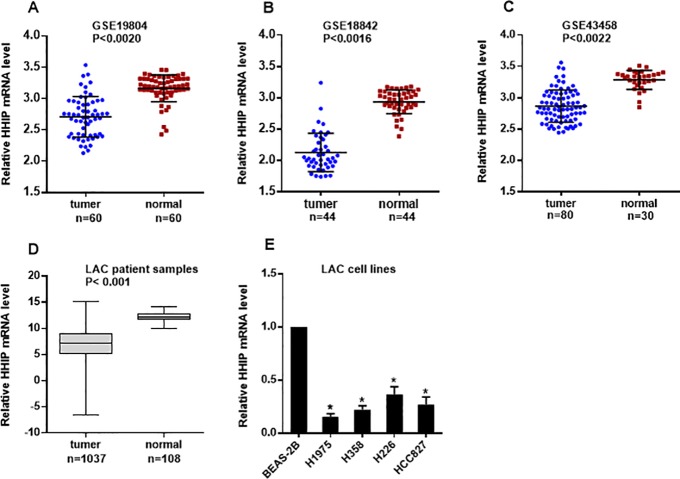
Firstly, HHIP gene expression data of NSCLC tissues and normal tissues were obtained from GSE18842/GSE19804/GSE43458 databases of the Gene Expression Omnibus (GEO) database and then validated by TCGA NSCLC database in a cohort of 1027 cases of NSCLC patients and 108 cases of normal people. A chi-square test was used to analyze the relationship between HHIP expression and clinicopathological characteristics of NSCLC. The expression levels of HHIP in NSCLC cells were detected by quantitative-real time PCR. The function of HHIP was investigated by a series of in vitro assays. CCK-8, wounding healing, Transwell invasion assay were utilized to explore the mechanisms of HHIP.
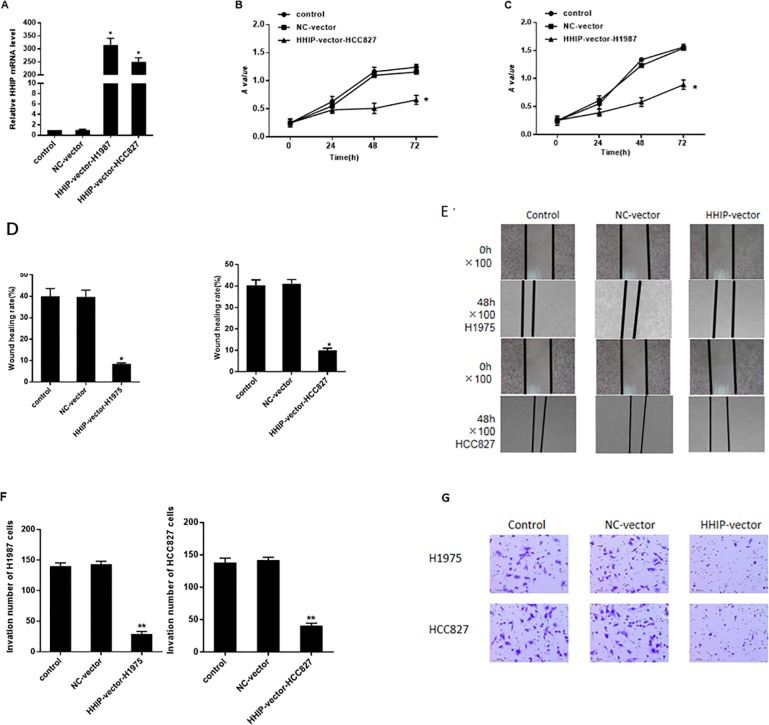
HHIP mRNA were significantly down-regulated in NSCLC in three GEO databases and TCGA database (P<0.05). This result was confirmed in NSCLC cell lines by qRT-PCR analysis, its expression in normal NSCLC cell line BEAS-2B was significantly higher than that in NSCLC cells. Chi-square test results showed that the low expression of HHIP was correlated with gender, cancer type, TNM stage and tumor size. Functional experimental results showed that over-expressing HHIP significantly decreased the ability of cell proliferation, migration and invasion in NSCLC cells (P<0.05).
Overall, the above results indicated that HHIP could regulate proliferation, migration and invasion, and could be used as a judging criterion for identifying NSCLC classification and stage.
本研究的主要目的是探讨刺猬蛋白相互作用蛋白(HHIP)过表达对非小细胞肺癌(NSCLC)增殖、迁移和侵袭的影响。
首先,从基因表达综合数据库(GEO)的 GSE18842/GSE19804/GSE43458 数据库中获得 NSCLC 组织和正常组织的 HHIP 基因表达数据,然后在 1027 例 NSCLC 患者和 108 例正常人的 TCGA NSCLC 数据库中进行验证。卡方检验用于分析 HHIP 表达与 NSCLC 临床病理特征的关系。通过定量实时 PCR 检测 NSCLC 细胞中 HHIP 的表达水平。通过一系列体外实验研究 HHIP 的功能。CCK-8、划痕愈合、Transwell 侵袭实验用于探讨 HHIP 的作用机制。
在三个 GEO 数据库和 TCGA 数据库中,HHIP mRNA 在 NSCLC 中均显著下调(P<0.05)。qRT-PCR 分析证实了这一结果,正常 NSCLC 细胞系 BEAS-2B 中的表达明显高于 NSCLC 细胞。卡方检验结果表明,HHIP 的低表达与性别、癌症类型、TNM 分期和肿瘤大小有关。功能实验结果表明,过表达 HHIP 可显著降低 NSCLC 细胞的增殖、迁移和侵袭能力(P<0.05)。
综上所述,上述结果表明 HHIP 可调节 NSCLC 的增殖、迁移和侵袭,可作为鉴定 NSCLC 分类和分期的判断标准。