Puła Bartosz, Gołos Aleksandra, Górniak Patryk, Jamroziak Krzysztof
Department of Hematology, Institute of Hematology and Transfusion Medicine, 02-776 Warsaw, Poland.
Institute of Hematology and Transfusion Medicine, Warsaw 02-776, Poland.
Cancers (Basel). 2019 Nov 21;11(12):1834. doi: 10.3390/cancers11121834.
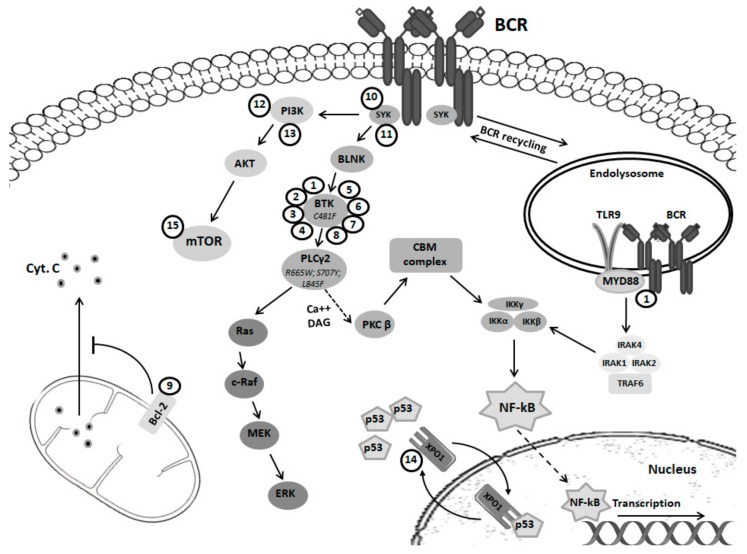
Ibrutinib is the first Bruton's tyrosine kinase (BTK) inhibitor, which showed significant clinical activity in chronic lymphocytic leukemia (CLL) and small lymphocytic lymphoma (SLL) patients regardless of cytogenetic risk factors. Recent results of phase III clinical trials in treatment-naïve CLL patients shift the importance of the agent to frontline therapy. Nevertheless, beside its clinical efficacy, ibrutinib possesses some off-target activity resulting in ibrutinib-characteristic adverse events including bleeding diathesis and arrhythmias. Furthermore, acquired and primary resistance to the drug have been described. As the use of ibrutinib in clinical practice increases, the problem of resistance is becoming apparent, and new methods of overcoming this clinical problem arise. In this review, we summarize the mechanisms of BTK inhibitors' resistance and discuss the post-ibrutinib treatment options.
依鲁替尼是首个布鲁顿酪氨酸激酶(BTK)抑制剂,在慢性淋巴细胞白血病(CLL)和小淋巴细胞淋巴瘤(SLL)患者中显示出显著的临床活性,而不受细胞遗传学危险因素的影响。在未经治疗的CLL患者中进行的III期临床试验的最新结果将该药物的重要性转移至一线治疗。然而,除了其临床疗效外,依鲁替尼还具有一些脱靶活性,导致出现依鲁替尼特有的不良事件,包括出血素质和心律失常。此外,已有关于该药物获得性和原发性耐药的报道。随着依鲁替尼在临床实践中的使用增加,耐药问题日益明显,克服这一临床问题的新方法也随之出现。在本综述中,我们总结了BTK抑制剂耐药的机制,并讨论了依鲁替尼治疗后的选择。